Science & Nature
Rock Star: Meet the Guy Who Excavated O’Hare’s 50-Ton Boulder, and Yes, He Has Thoughts About the Name
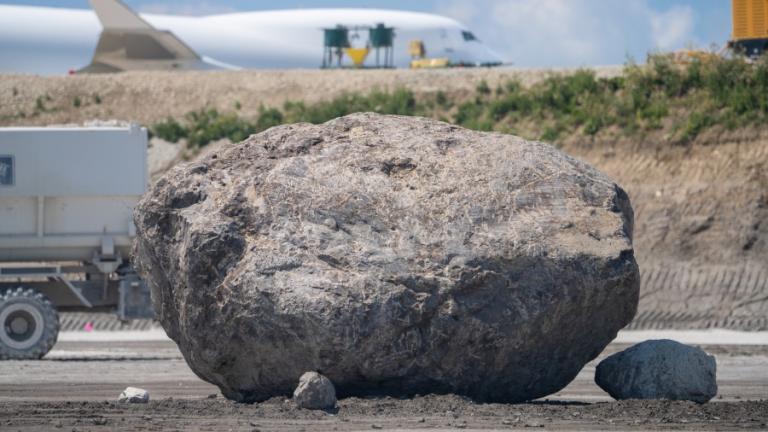
 The O’Hare boulder, during extraction on June 16, 2026. For context, the excavator’s bucket is more than 6 feet wide. (Courtesy of Matt Tracy)
Ron Pitelka has an idea for what to name the 50-ton prehistoric boulder that was unearthed this summer at O’Hare Airport.
“I would probably call it ‘Geo,’” Pitelka said. “It might not be funny, but it’s a little more appropriate.”
Why should his opinion carry any weight?
Because Pitelka’s the guy who found the giant rock back in June, as part of a construction crew working on the airport’s latest expansion project.
In all of the 23 years he’s been operating excavators — so, half his life — “I’ve never seen a boulder this big come out of the ground. It’s pretty damned rare,” Pitelka, who lives in Homer Glen, told WTTW News. “I was like a kid on Christmas.”
The pictures he’s seen circulating online don’t remotely do the boulder justice, he said.
For perspective, Pitelka explained what it took to move the rock.
On June 16, he was behind the controls of a Caterpillar 352, a beast of a machine that’s about as large as excavators come outside of those used for mining. Its bucket is six-and-a-half feet wide — four scoops can overload a semi — and it’s capable of lifting 50,000 pounds.
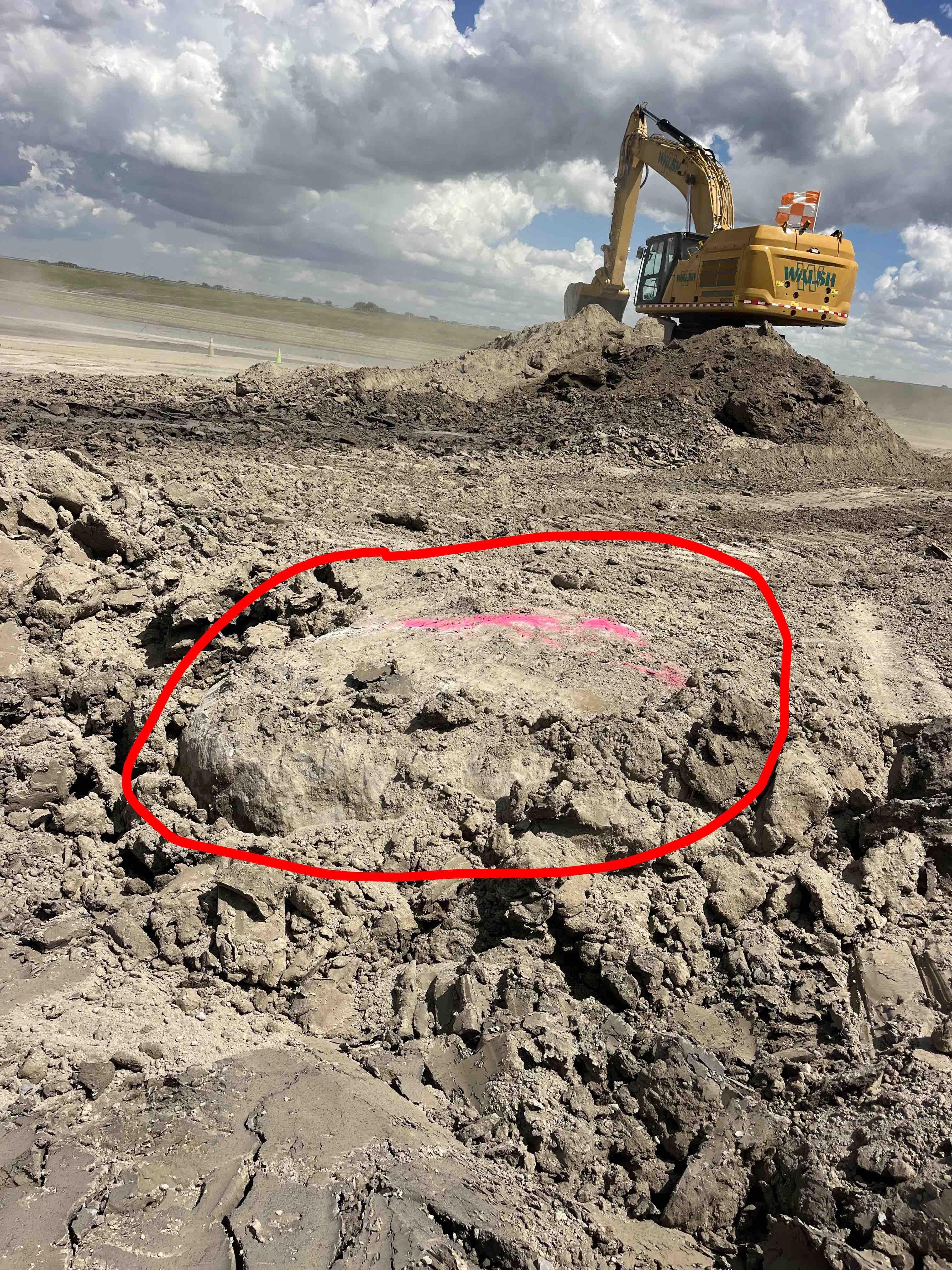 Good eyes! A view of the giant boulder, circled in red, before it was excavated. (Courtesy of Alex Franco)
His team had been digging in O’Hare’s South Basin, a 110-acre stormwater retention pond undergoing expansion, with the dirt then being trucked over to backfill the airport’s Central Basin. Bulldozers were making thin cuts into the soil — previously undisturbed “virgin” blue clay — and then pushing it into piles for operators like Pitelka to transfer into semis.
“At the bottom of one of the dirt piles I hit extremely hard ground,” he said.
Pitelka’s colleague, Matt Tracy, attempted to budge the object with his bulldozer. It didn’t move. Pitelka tried to hook it and the Cat 352 balked. Eventually, with the combined force of the bulldozer pushing and the excavator pulling, they got the boulder out of the ground.
“I dragged it and rolled it to get it out of the way,” Pitelka said, and then he notified the site’s construction superintendent that he’d found something special.
It wasn’t just the size that impressed him. As a lifelong rockhound — don’t get him started on the sandstone at Moab — Pitelka immediately understood he was looking at a huge chunk of ancient Illinois bedrock that had been entombed under glacial deposit.
Now, nine times out of 10, general contractors consider big boulders — granite, limestone, whatever — an inconvenience when they surface during excavation, Pitelka said, largely because it’s costly to move them anywhere else. They’ll either tell crews to pound the boulders into pieces or rebury them.
Over the years, Pitelka has rescued some of these rocks and deposited them at his mom’s five-acre property, including a large hunk of limestone that, when he dumped it out of his truck, split in half to reveal a perfect trilobite fossil, convex on one side and a matching imprint on the other.
“I’m always looking for stuff like that,” he said. “When I go on vacation, I always bring a rock back.”
It’s a love he traces to his childhood home, where a pair of two-and-half-foot boulders were his favorite things to climb.
“That kind of started something,” Pitelka said of his interest in rocks. “I just think they’re fascinating.”
In fact, when he sent a text to friends showing them a picture of “Geo,” they all responded: “When are you bringing it home?”
 Ron Pitelka’s view of the boulder from his cab. The excavator’s 6.5-foot bucket is completely obscured by the size of the rock. (Courtesy of Ron Pitelka)
Knowing that the massive find at O’Hare could easily be 300 to 400 million years old, Pitelka asked the construction superintendent to fight for the behemoth’s preservation. He hoped maybe it could be embedded in the basin’s embankment, where he could view it via Google earth.
It was only this week, when the airport announced the naming contest for the rock, that Pitelka learned the boulder had been saved and was destined for greater things.
“I was so excited to hear that the right people got involved,” he said. “I’m absolutely ecstatic it’s going to be on display. For me, as an (excavator) who loves boulders, it’s the coolest thing that people understand its historical significance and appreciate it.”
What’s been wild to witness, Pitelka said, has been the public’s reaction to the boulder’s discovery.
“The fact it turned into a news story is mind-blowing to me. If it was a dinosaur bone,” he said, trailing off. “I’m so surprised.”
Maybe this will be his claim to fame, Pitelka joked, though he’s holding out for a potentially even greater scoop: a meteorite, which is not outside the realm of possibility.
“Not only am I digging every day,” he said, “but I know what to look for.”
For now, Pitelka is looking forward to visiting whatever exhibit O’Hare has in mind for the soon-to-be-named boulder and showing off the discovery to his wife and kids.
“Long after I’m gone, that boulder is still going to be there,” Pitelka said.
This article originally published on Sept. 11 and has been updated to correct a photo credit.
Contact Patty Wetli: [email protected]