Crime & Law
Border Patrol Chief Greg Bovino, Federal Agents Repeatedly Lied About What They Did During Aggressive Immigration Raids: Judge
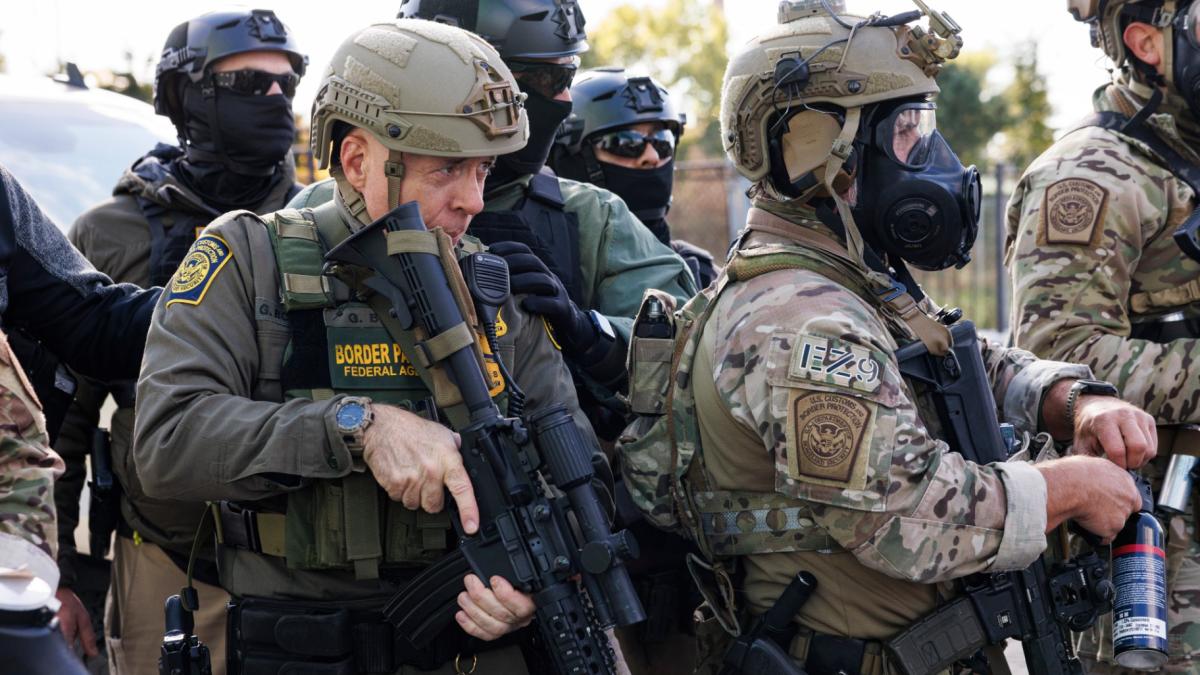 Border Patrol chief Gregory Bovino stands with federal immigration enforcement agents during a skirmish with protesters in Little Village neighborhood, Chicago Thursday, Oct. 23, 2025. (Anthony Vazquez / Chicago Sun-Times via AP)
Border Patrol chief Greg Bovino, and the agents under his command who led a series of increasingly aggressive raids across Chicago and its suburbs for more than two months, falsely depicted ordinary Chicagoans as professional agitators determined to mount a violent resistance, a federal judge determined.
U.S. District Court Judge Sara Ellis used the blistering 233-page ruling that formalized her sweeping order regarding use of force — which has already been put on hold by the 7th Circuit Court of Appeals — to painstakingly detail how agents, over and over again, falsely asserted in court and in official reports that they had been confronted with unrelenting, coordinated and life-threatening violence every time they attempted to carry out President Donald Trump’s mass deportation effort.
Federal officials “cannot simply create their own narrative of what happened, misrepresenting the evidence to justify their actions,” Ellis wrote, again saying the violence used by federal agents “shocks the conscience.”
Department of Homeland Security Assistant Secretary for Public Affairs Tricia McLaughlin responded to a request for comment from WTTW News about Ellis’ order by asserting that the conduct Ellis specifically found agents lied about had, in fact, occurred.
McLaughlin praised federal agents for exercising “restraint and prudence” while in Chicago and celebrated the appellate court block on Ellis’ order.
However, the three-judge appellate panel noted that it had “not overread” Ellis’ order and said her findings “may support entry of a more tailored and appropriate preliminary injunction.” Arguments are set for Dec. 17.
Ellis is the second federal judge in the Northern District of Illinois to find that federal agents have presented unreliable testimony about their actions and the actions of Chicagoans during what the Trump administration called “Operation Midway Blitz.”
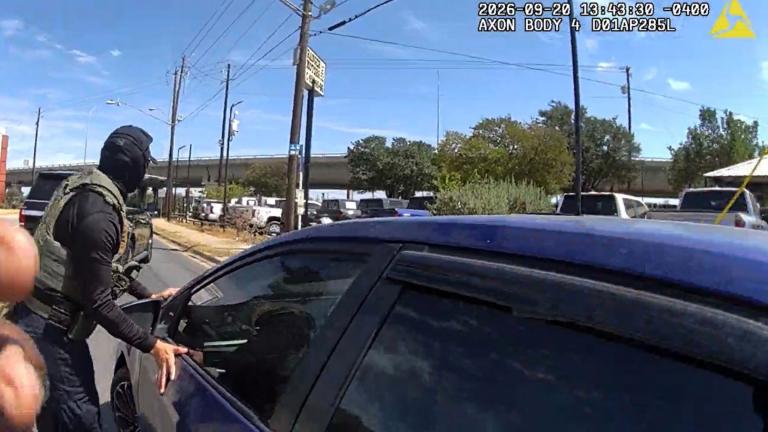
Ellis’ order, which examined 47 videos captured by the body-worn cameras she ordered agents to wear and activate, said that footage contradicts what agents wrote in official use-of-force reports, rendering those statements “simply not credible.” The testimony provided by federal agents in her courtroom “strains credulity.”
At “some point, it becomes difficult, if not impossible, to believe almost anything that” federal officials told her, Ellis wrote, giving federal officials until Wednesday to make those videos public.
Prosecutors have dropped a number of high-profile criminal cases against Chicagoans accused of attacking and impeding federal agents — an indication that claims by the Trump administration have failed to hold up under judicial scrutiny.
Even when the “peaceful nature of the crowds” should have been clear to agents, as when a crowd of protesters objected to agents’ presence in the East Side neighborhood, many agents braced for imminent violence that never came, Ellis wrote. That did not stop them from deploying tear gas, pepper balls and other crowd control measures.
“I can tell you right now how it’s going to go,” an agent said in one video. “We’re going to try to get out, they’re going to block our vehicles, we’re going to tell them to move, they don’t, we gas ’em.”
The agent he was speaking to quickly agreed with his assessment.
“We’re definitely gassing them when we leave. Just start throwing s---,” he said.
Thirteen Chicago police officers were also exposed to the chemical agent during that incident, records show.
One body-worn camera video captured an immigration agent use an AI tool to “compile a narrative for a report based off of a brief sentence about an encounter and several images,” according to Ellis’ ruling.
“To the extent that agents use ChatGPT to create their use of force reports, this further undermines their credibility and may explain the inaccuracy of these reports when viewed in light of the BWC footage,” Ellis wrote, using an acronym for a body-worn camera.
In other confrontations, agents were captured “actively attempting to rile up the protesters,” Ellis wrote.
“I like to poke the bear a little bit,” one agent said to another during an confrontation in Albany Park on Oct. 12. “But it is crazy ’cause like, nothing they’re saying is like, the slightest bit of reality whatsoever.”
Body-worn camera footage shows agents deployed tear gas without ordering the crowd to disperse or without warning that chemical agents could be used if that order was not followed, even though agents wrote in their official reports that they had issued those orders, Ellis said.
“Without giving the protesters an opportunity to comply, contrary to his claim in the use of force report that he waited ‘a considerable amount of time,’ (the agent) rolled a tear gas canister toward the protesters,” Ellis wrote.
Agents also repeatedly claimed that Chicagoans used their cars as weapons and that agents faced a near constant threat of being rammed, Ellis wrote.
But body-worn cameras suggest agents “drove erratically and brake-checked other motorists in an attempt to force accidents that agents could then use as justifications for deploying force,” Ellis wrote.
Ellis singled out the conduct of Bovino, whose brash social-media presence and frequent appearances in the media have come to define the federal government’s aggressive immigration raids.
During his deposition, given under oath, Bovino was “evasive” during his three days of sworn testimony with plaintiffs’ attorneys, “either providing ‘cute’ responses” or “outright lying,” Ellis wrote.
Bovino fired at least two canisters of tear gas at a crowd in Little Village on Oct. 23 during a confrontation sparked by agents’ decision to detain a man at a bus stop near 26th and Whipple streets, prompting a crowd of angry residents to flock to the scene.
Little Village, also called La Villita, is the heart of Chicago’s Mexican American community, and is home to the second largest shopping district in the city, behind North Michigan Avenue.
While Bovino and McLaughlin said federal agents fired tear gas at the crowd because protesters used fireworks in an attempt to injure federal agents, Ellis said the only explosive was actually a flash-bang grenade fired by federal agents.
“Defendant Bovino admitted that he lied about whether a rock hit him before he deployed tear gas in Little Village,” Ellis said from the bench on Nov. 6.
Bovino testified he saw people he believed to be members of the Latin Kings gang unloading weapons from a car in Little Village and others on rooftops and in the crowd.
Bovino said he reached that conclusion because they were wearing maroon hoodies and that “would signify a potential assailant or street gang member that was making their way to the location that I was present,” according to Ellis’ opinion.
However, maroon is not a color used to signal membership in the Latin Kings, Ellis wrote.
Footage captured by agents’ body-worn cameras showed just a few people wearing maroon clothing, including Ald. Byron Sigcho-Lopez (25th Ward).
The testimony about “individuals in maroon hoodies being associated with the Latin Kings and threats strains credulity,” the judge said.
In fact, Bovino was not hit by a rock before lobbing a tear gas canister, without warning, at the crowd, Ellis said. In addition, Bovino fired a second canister at the crowd as people fled the area and posed no threat to anyone, Ellis said.
Ellis pointedly noted that that several incidents occurred after she ordered agents to issue two warnings before deploying tear gas or other “less lethal” crowd control measures and only when there was a clear threat posed by protesters.
Contact Heather Cherone: @HeatherCherone | (773) 569-1863 | [email protected]