Politics
Months After Johnson Said It Wasn’t Necessary, CPD Updates Policy to Allow Probes of Federal Agents for Actions During Immigration Raids
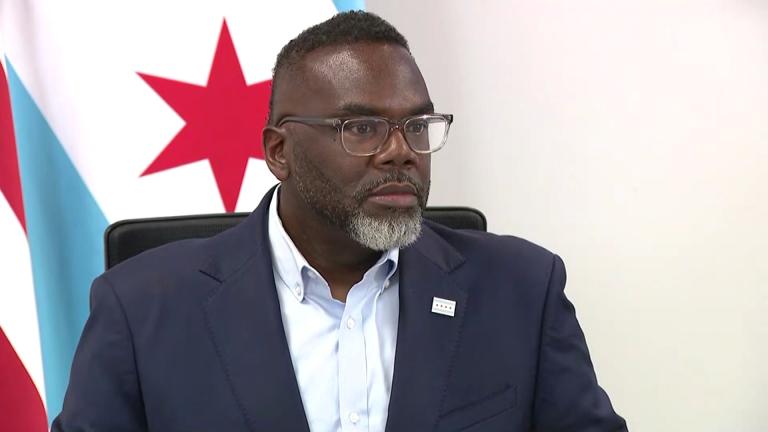
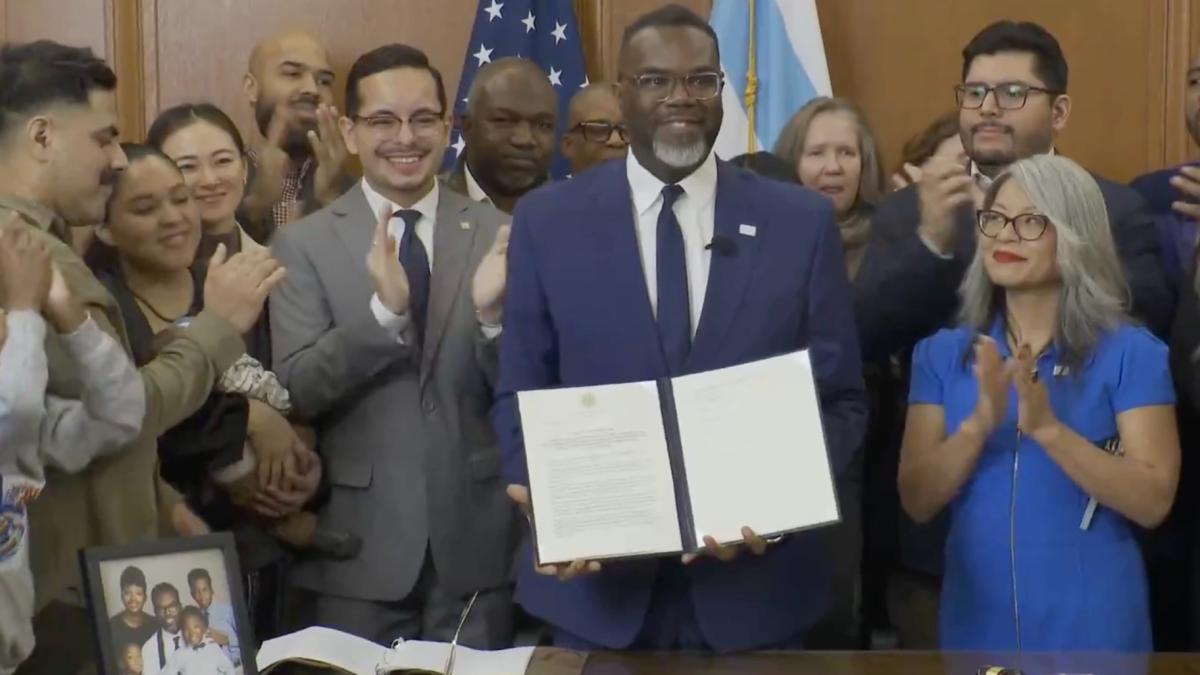 Mayor Brandon Johnson displays the executive order he signed on Saturday, Jan. 31. (Provided)
Chicago Police Department brass updated a policy that would allow officers to investigate federal agents for their actions during immigration enforcement raids, according to records obtained by WTTW News.
The policy was updated nearly four months after Mayor Brandon Johnson told reporters the existing policy complied with an executive order he promised Chicagoans would lay “the groundwork to prosecute Immigration and Customs Enforcement and Border Patrol agents for criminal misconduct.”
Nearly six months after Johnson seized the national spotlight by signing what he called the “Ice on Notice” executive order, there is no public evidence that CPD has launched an investigation of any action by a federal immigration agent, even as raids ramped up earlier this month.
That executive order, signed Jan. 31, gave CPD leaders 30 days to develop a policy directing officers to document suspected misconduct or criminal violations by ICE and Border Patrol agents and identify those responsible.
The new policy that governs how CPD officers “respond to incidents involving citizenship status” was finalized Friday, the same day the Chicago City Council Committee on Immigrant and Refugee Rights Committee held a hearing into why the executive order had not translated into action.
Ald. Andre Vasquez (40th Ward), the committee’s chair, said he did not believe that was a coincidence.
“I’m sure it helped,” Vasquez said, his voice dripping with sarcasm. “It shouldn’t have taken five months.”
The specifics of CPD’s policy are particularly important because, in most cases, state and local law enforcement officials are prohibited from charging federal officials for reasonable conduct that occurred during the course of their official duties.
The updated policy requires officers to record incidents involving suspected or reported misconduct by federal agents using their body-worn cameras, to help those who are injured and “document apparent violations of law by members of a federal immigration or other federal law-enforcement agency.”
Officers must also detail the actions of federal immigration agents to the highest-ranking supervisor on duty, usually the street deputy or the watch operations lieutenant, who must report to the scene and document the officers’ report, according to the policy.
That supervisor is required to identify the highest-ranking federal agent on scene and “activate their body-worn camera to record the identification of the federal supervisory officer on the scene, including any refusals or requests for supervisory verification.”
During the aggressive immigration enforcement efforts ordered by the Trump administration as part of the largest mass deportation effort in U.S. history that swept Chicago this fall, federal agents routinely wore masks, did not wear badges or cameras and refused to identify themselves to members of the public.
In addition, the updated policy requires officers to take reports from members of the public about misconduct by federal agents during an immigration enforcement action and notify their supervisor.
Those reports must be tracked and CPD is required to “publicly report” the number of incidents and the details of alleged misconduct, according to the policy.
Shortly before the marathon committee hearing began, Johnson urged anyone who may have been victimized by federal immigration agents to come forward and detail their experiences in a police report.
Sheila Bedi, the mayor’s chief strategy officer, told the committee that the revised policy affirmed that CPD always had the power to investigate federal agents accused of committing misconduct or abuse while on duty.
In addition, the revised policy explicitly requires CPD officials to take complaints involving federal agents and ensures that Chicagoans have a way to documents how officers handle those reports, Bedi told the committee.
Leo Feler, a Lakeview homeowner, told the news media on Oct. 31, 2025, that police officers refused to investigate the federal immigration agents who entered his home while trying to detain construction workers who were installing windows on his building, touching off a bloody melee.
Feler said the agents violated his Constitutional rights by entering his home without permission and conducting an illegal search in an effort to detain the men working on his home, at least one of whom was injured while trying to flee.
As Feler’s neighbors protested the agents’ actions by yelling and blowing whistles, agents driving a large, unmarked SUV rolled backward down the tree-lined street before deploying several canisters of tear gas, enveloping the neighborhood in the noxious fumes without warning.
None of the federal agents involved in that incident, one of the most high-profile confrontations between Chicagoans and those carrying out what the Trump administration called “Operation Midway Blitz,” have faced formal, public charges of misconduct.
Controversy Swirls Around Executive Order
Johnson’s January executive order triggered a firestorm of controversy as soon as he signed it, just days after federal agents shot and killed Renee Nicole Good and Alex Pretti in Minneapolis.
Those killings ramped up the pressure on Johnson and other Democratic elected officials who have been under intense pressure to step up efforts to rein in the aggressive immigration raids launched by President Donald Trump.
Johnson’s executive order brought a rebuke from Cook County State’s Attorney Eileen O’Neill Burke, who called it “wholly inappropriate.”
O’Neill Burke, who frequently criticizes Johnson’s approach to public safety issues, blasted the section of the executive order that requires CPD supervisors to preserve evidence of suspected wrongdoing by federal immigration agents and “at the direction of the mayor’s office, make a referral of felony matters to the Cook County State’s Attorney.”
That language does not appear in the updated policy.
O’Neill Burke’s office took no action after federal agents shot and killed Silverio Villegas-Gonzalez on Sept. 12 and after federal agents shot Marimar Martinez five times on Oct. 4.
Villegas-Gonzalez was shot and killed during a traffic stop in suburban Franklin Park after dropping his children at daycare.
Federal agents alleged Villegas-González dragged an officer with his vehicle while attempting to flee, seriously injuring an officer.
However, local police body camera videos showed the agent who shot Villegas-González walking around afterward and dismissing his own injuries as “nothing major.”
Martinez was charged with a felony after federal officials accused her of trying to ram agents with her vehicle in Brighton Park. The case was dismissed after videos emerged that Martinez’s attorneys said showed an agent steering his vehicle into Martinez’s truck.
There is no evidence that either CPD or Franklin Park police investigated either shooting.
After Martinez was shot, Chicago Police Supt. Larry Snelling said his officers “cannot and will not” arrest federal agents conducting immigration enforcement operations in Chicago and implored residents not to interfere with those efforts.
Snelling retired July 15. Interim Supt. Fred Waller has signed the revised policy.
Ten days after her office slammed Johnson’s executive order, O’Neill Burke unveiled a new protocol that she said would allow the use of force by federal immigration officers to be scrutinized.
A spokesperson for the state’s attorney’s office said Tuesday evening they are supporting the Illinois State Police’s investigation of Villegas-Gonzalez' shooting, as the new policy requires.
More than 400 attorneys, clergy members, elected officials and community organizers accused O’Neill Burke of abandoning her official duties in refusing to investigate widespread allegations of crimes committed by federal agents in Cook County.
A Cook County judge refused their request to appoint a special prosecutor to probe those allegations of misconduct, ruling that it is the responsibility of law enforcement agencies to investigate alleged misconduct — regardless of whether those claims accuse federal agents of wrongdoing.
WTTW News’ Matt Masterson contributed to this report.
This story was updated July 22 to add a statement from the Cook County State’s Attorney’s Office."
WTTW News coverage of policing and police reform is supported by The Joyce Foundation.
Contact Heather Cherone: @HeatherCherone | (773) 569-1863 | [email protected]