Education
CPS Board Members Pass Last-Minute Amended Budget Assuming $150M More in State Revenue Despite Sharp Criticism Cash May Not Materialize
 CPS headquarters are pictured in a file photo. (WTTW News)
The Chicago Board of Education on Thursday passed an approximately $10 billion budget after hours of contentious debate, a lengthy recess, sharp questions over revenue assumptions and a last-minute amendment aimed at holding state lawmakers’ feet to the fire to come through with $150 million more revenue for the cash-strapped district.
The move to assume additional revenue via an 11th-hour addendum unvetted by district officials marks an unprecedented approach to CPS budgeting that district officials say could lead to unknown ramifications down the line.
The vote came after nearly three hours of heated argument – and nearly eight and a half hours after the meeting first convened. It saw opponents of the budget as proposed by Superintendent Macquline King arguing that assuming Chicago Public Schools will receive $285 million in surplus TIF funding is no more guaranteed than additional revenue from Springfield, citing recent supportive comments from Illinois House Speaker Emanuel “Chris” Welch about leading the charge on the district’s behalf in the fall veto session.
The added amendment assumes the state will come through with $150 million in additional funding, which would allow the district to stave off the layoffs in the proposed budget King and district officials pushed for.
Board member Michilla Blaise, who introduced the late amendment, said “we are giving a pass to the state” and “robbing our kids of opportunities.” The amendment passed by an 11-7 vote.
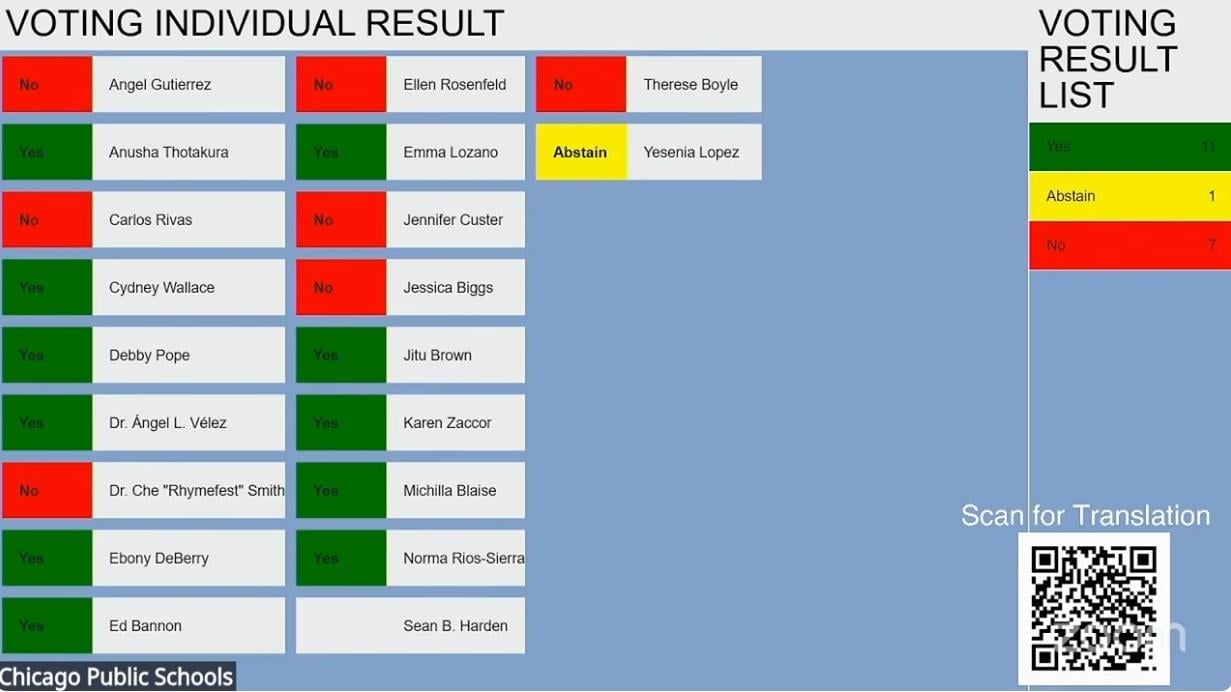
Blaise said additional state money is the only way to fix the district’s structural deficit, not surplus TIF money from the city with an amount that fluctuates yearly.
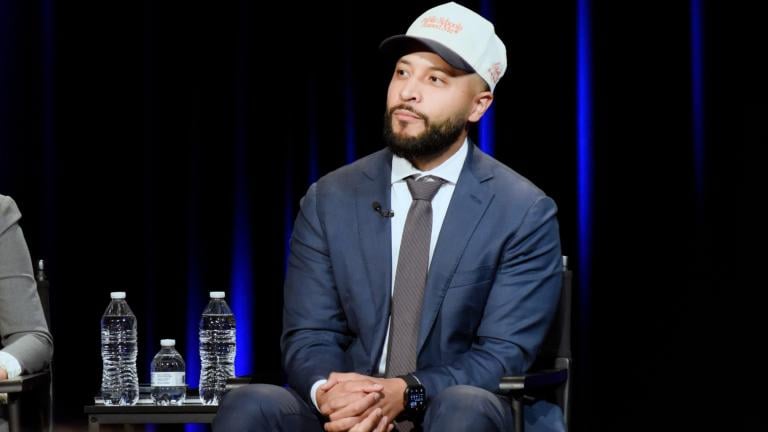
Board member Che “Rhymefest” Smith said while he shares his colleagues’ enthusiasm to demand money owed to CPS from the state and Cook County, he warned “Let’s not cut our nose to spite our face.”
Budget officials, some board members, and the district’s top attorney also underscored the legal obligation under the school code and state law to pass a budget that makes reasonable assumptions about revenue, with board member Ellen Rosenfeld questioning whether the board could be in violation of its fiduciary duty by making an assumption about an additional $150 million in revenue from the state.
After the vote, a CPS spokesperson released a statement warning again that the amended budget threatens the ability of the district to secure short-term financing to cover payroll in early September.
“Simply put: we cannot guarantee that CPS will receive financing in time for the September 4 payroll,” the statement reads. “Failing to meet payroll is unacceptable. This places the District at significant risk of being in violation of the law and collective bargaining agreements. It may also damage our credit rating and severely restrict our future borrowing capacity for capital projects and operational needs.”
Chicago Civic Federation President Joe Ferguson said the move is not based on “fact-based revenue projections.”
"By adopting a budget that relies on uncertain state revenue, the board has increased the District’s financial risk,” Ferguson said in a statement. “If these funds do not materialize, CPS will likely need to enact mid-year cuts and layoffs and further delay the long-term reforms needed to restore the District’s financial stability.”
The Chicago Teachers Union praised the budget amendment and said those members who voted in favor “overcome intimidation and threats from CPS lawyers.”
“They led a budget amendment to hold the Governor to account for what he owes,” the CTU statement reads. “For the first time, they balanced the budget on the payments the Governor and General Assembly have skipped instead of on the backs of children and educators.”
A Time Crunch
King and top budget officials told the board Thursday that delayed property tax returns have “severely disrupted our cashflow,” meaning the district needs a budget approved to take out short-term loans to cover checks due on Sept. 4 – with the funds estimated to arrive just in the nick of time on Sept. 2.
“Delaying the budget would be catastrophic for our district,” King said. “It would be a de facto shutdown right when students are returning to school.”
Smith said he takes those warnings seriously. “This is not the time to be playing chicken with people’s paychecks,” he said at the meeting.
The lengthy meeting began around 10:30 a.m. Thursday morning with King making an impassioned plea to the board to pass the budget as presented, arguing that it would ensure staff paychecks and keep cuts away from classrooms as best as possible.
“We are maintaining the core investments that have the most direct impact on our overarching goal, which is to provide every child from every community a rigorous, joyful, and equitable learning experience,” said Superintendent Macquline King at Thursday’s meeting.
If state lawmakers do not approve the now assumed additional CPS funding, budget cuts will directly impact schools, amendment opponents warned. They also warned of hits to the district’s credit rating and increased borrowing costs.
After nearly 30 public commenters and remarks from several elected officials, the board voted to recess for two hours. Upon returning from the lengthy break, the district’s acting chief budget officer and chief financial officer walked the board through King’s proposed budget, with lengthy debate about state vs. city funding the legal responsibilities members face to pass a balanced spending plan.
Later, once the board moved to consider the resolution approving the proposed budget, Blaise’s amendment sparked another long back-and-forth among members, without sometimes vocal reactions from observers.
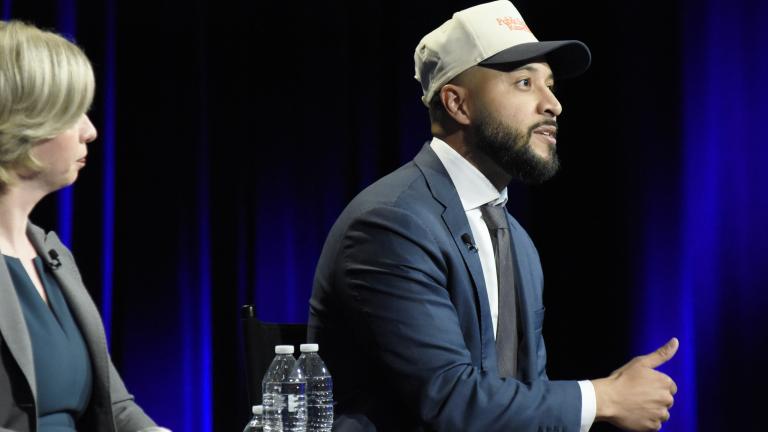
Board member Jennifer Custer, who’s also running for board president in November, said assuming further state revenue is a “hallucination,” arguing that the amendment “completely fabricates revenue” and risks violating law. But fellow member Debby Pope, a former longtime teacher, said it’s time for Gov. JB Pritzker to be a “beacon” for more funding.
Custer also asked if the amendment could upend the capital budget, with the district’s COO telling her CPS is in uncharted waters.
A Tense Process
This year’s budget cycle has been a contentious one, with the Chicago Teachers Union pushing back against staff layoffs, and CPS officials warning that if the board doesn’t approve the spending plan this month, the cash-strapped district will have trouble covering its payroll costs in the coming weeks.
In order to plug its $732 million budget gap, CPS expected some 759 teachers, 801 support personnel, and 41 assistant principals to be laid off, though they say the district has typically rehired around 75% of impacted employees in past years.
Already, the district has laid off 162 central office and citywide staff.
“These aren’t just reductions on paper. They impact people, their lives, their well-being, and the students that they serve,” King said, acknowledging the budget involves “slightly adjusting” student-teacher ratios but won’t increase class size limits.
That drew pushback from Chicago Teachers Union President Stacy Davis Gates, who told King and the board “that math doesn’t math.”
CPS is also counting on $285 million in Tax Increment Financing (TIF) funding from the city. While the exact number will not be clear until the Chicago City Council approves next year’s budget – with budget hearings getting underway in the fall ahead of a Dec. 31 deadline – King said it’s a reasonable expectation based on the amount of TIF surplus the district has received in recent years. But skeptical board members seeking to pressure state lawmakers questioned whether district budget officials had gotten guarantees from the city that money would come through.
King agreed that the district is underfunded according to the state’s own evidence-based funding formula, but said the district has seen that to create lasting change, “a long-term sustained statewide effort with a clear vision and a clear strategy.” And she warned of the layoffs, furloughs, and costly borrowing that hit in 2017 after CPS included the assumption of state funding that never materialized, calling the current situation “eerily similar.”
But board member Jitu Brown pushed back on that comparison. “The political will was not there in 2017,” Brown said as he spoke in support of the amendment.
The original budget proposed by King earlier in July drew the ire of CTU officials and some board members, who objected to shifting five professional development days into unpaid furlough days and relying on a mid-year, districtwide spending freeze. That prompted King and CPS budgeteers to increase the TIF surplus assumption from $200 million to stave off furloughs.
Despite the changes to the budget, CTU still objected to the revised spending plan, with Davis Gates calling it a “first draft” and urging officials to take the time to propose further revisions.
“We’ve become far too comfortable asking educators to absorb the consequences of political failure,” said Cook County Commissioner Tara Stamps, who is also a 25-year public school teacher. “We’ve become far too comfortable with asking children to wait while adults debate whether they deserve the fully funded schools that they were promised.”
Pressuring State Leaders
The union and several board members have long pushed state and county leaders to come through with the necessary funding CPS is owed. Educators and school staff have called on Gov. JB Pritzker and state legislators to convene a special session to fully fund CPS, which is owed nearly $2 billion more than what it has received from the state under its evidence-based funding formula.
“Solve this problem, Governor Pritzker. We know you can,” Davis Gates said at a rally before the board meeting. “You’re a billionaire, and you know other billionaires. And if anyone can organize billionaires on behalf of the people of Illinois, it is our billionaire governor.”
On Thursday, Illinois House Speaker Emanuel “Chris” Welch told the Illinois Federation of Teachers he was “strongly committed” and would “lead that effort” to secure additional CPS funding in the fall veto session scheduled to begin Nov. 17. Welch, who’s currently embroiled in a controversy over sexual harassment allegations against former state Rep. Harry Benton and sharp questions about Welch’s own past actions toward women – stopped short of calling for a special session, expressing doubt there was enough support among lawmakers.
“It’s also important to remember that for decades, Illinois, despite having an international city in its midst, was 49th in education funding,” Jitu Brown, a board member representing District 5A, said last week on “Chicago Tonight.” “It is time for the state to do some get-right by its children.”
Brown last week also urged district leaders to look into alternatives to avoid those cuts “so that this board is not backed into a corner” ahead of its vote Thursday.
Other board members have countered that even if a special session were approved and the state did send more money, it’s unlikely those funds would arrive quickly enough to help CPS in the short term.
District officials echoed that belief at Thursday’s board meeting, saying a budget passed assuming more state funding in the fall would not be balanced, leading to credit downgrades, more costly debt and missed payroll. Even if that money did come through, it would not reach district coffers until 2028, officials said.
State Sen. Rob Martwick told the board that “until we reach adequacy at a minimum we are failing.” While he didn’t specifically call for a special session, Martwick said action was needed “sooner than later, the pace that it’s being done at is not acceptable.”
The union also claimed CPS has incurred more than $40 million in interest costs from short-term borrowing undertaken due to the disbursement of Cook County property tax revenue it is owed. This week, IFT sued Cook County Treasurer Maria Pappas, accusing her of failing to properly disburse some $400 million to public school districts around the county.
But at Thursday’s board meeting, King said the missing tax revenue will only “backfill” last year’s budget and wouldn’t ease this year’s budget crunch.
Amid the heated debate, board member Rosenfeld lamented that even though the board voted nearly unanimously for King’s appointment, some of her colleagues weren’t trusting King and her staff.
“She presents us with a budget,” Rosenfeld said. “And we come right at it.”
Matt Masterson contributed to this report.
WTTW News education reporting is supported, in part, by Press Forward Chicago.