Crime & Law
Cook County Judges Often Detain Pretrial Defendants Deemed a Low Risk of Reoffending or Missing Court, Report Says
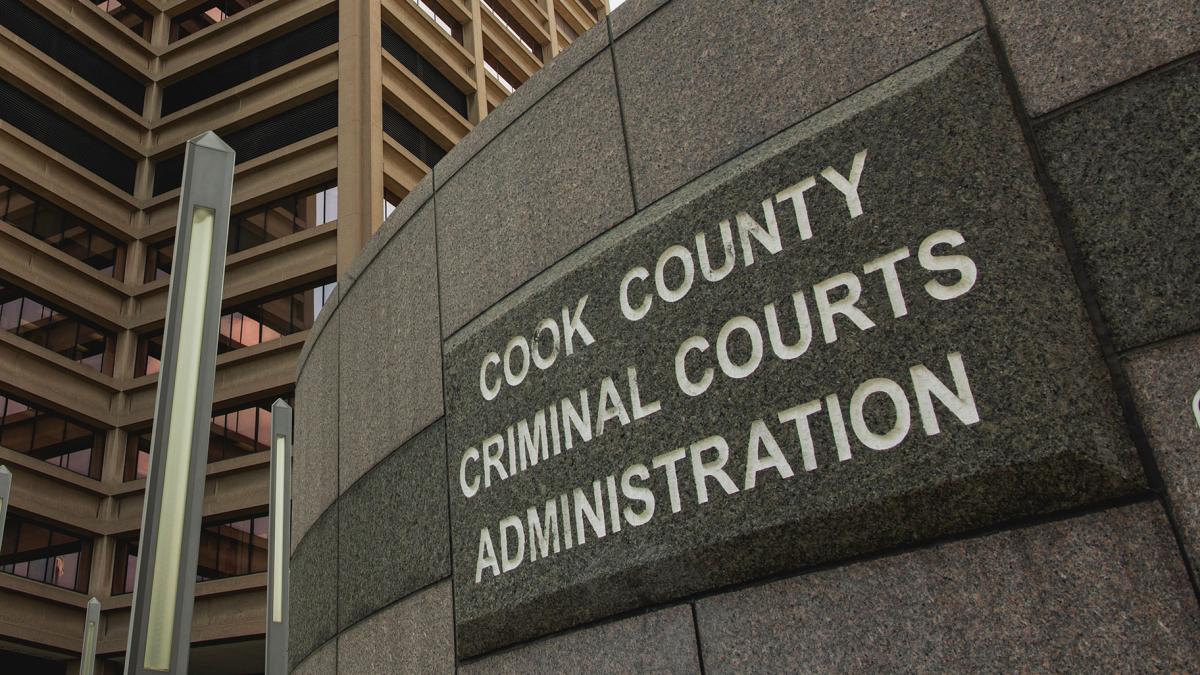 (Michael Izquierdo / WTTW News)
Cook County judges often ordered accused people to be detained while awaiting trial despite, by the court’s own assessments, being at low risk of rearrest or missing court.
That’s the assertion made in a recent report from the Illinois Network for Pretrial Justice. The group sent more than 50 volunteers to the Leighton Criminal Courthouse to observe 167 detention hearings last spring.
Their goal was to evaluate the court’s landscape two years after the Pretrial Fairness Act went into effect. The act made Illinois the first state to abolish cash bail. Previously, whether or not an accused person was detained pretrial was determined by their ability to pay the set bail amount.
Now, a prosecutor will file a petition to the judge asking for a defendant to be detained. Judges will generally detain someone if they’re determined to be a flight risk or pose danger to the community. Judges also take into account the accused’s Public Safety Assessment score, which is used to calculate someone’s likelihood of not appearing in court or being rearrested or charged with a new violent offense pretrial.
Court-watchers observed that of the 30.5% of people with low scores on that assessment, 80.4% of them were either jailed or placed on electronic monitoring.
“The purpose of the act was to get away from those very general practices and really add some depth to the decision making, and that hasn’t happened,” Cook County Public Defender Sharone Mitchell Jr. said during a discussion about the report on Thursday.
In 73.8% of the cases observed by court-watchers, judges ordered the accused person to be detained pretrial.
A spokesperson for Cook County Chief Judge Charles Beach’s office said it was “misleading” to focus on that percentage as evidence of whether or not the law is being applied consistently because “there is no mandated number or quota for detentions or release.”
“Rather than showing a failure of the law, the current trends reflect a system where judges and prosecutors are actively exercising the discretion granted to them to address specific public safety risks,” continued the statement.
These observations help provide context as to why, after an initial decrease following the implementation of the Pretrial Fairness Act, the Cook County jail population increased 26% between January 2024 and June 2025, according to a study from the Loyola Chicago Center for Criminal Justice.
Gun possession cases were the most prominent charge that court-watchers documented, making up 67.1% of the cases. The second most common charge observed was robbery.
Of those gun possession cases, judges granted a prosecutor’s detention position 70.3% of the time.
However, nearly one-third of gun possession cases are dismissed or result in a not guilty verdict, the report found.
This tendency to detain as default suggests that prosecutors and judges are ignoring evidence that releasing people pretrial does not compromise public safety, the report states. The report cites a Prison Policy Initiative study of jurisdictions that ended or limited their use of money bond which found that crime or re-arrests rates did not substantially change.
Judges, observers documented, uncritically accepted the validity of police reports as presented by prosecutors. Defense attorneys, on the other hand, seem to have minimal influence over the judge’s decision-making in these hearings, the report states.
The accused were disproportionately Black, observers found: approximately 75% of accused people in detention hearings were identified as Black, as compared to less than 31% of Cook County’s population being Black.
The report made recommendations to Cook County State’s Attorney Eileen O’Neill Burke and the chief judge.
The group recommended that the State’s Attorney’s office grant more discretion to prosecutors to decide whether to file felony charges and whether to seek detention and release more data on pretrial detention petitions and outcomes.
The report cited policies from the office that “undermine the discretion of prosecutors” and “guarantee that a greater number of people will face felony charges and pretrial detention,” such as the Felony Review Bypass Program. That program allows police officers to directly file felony gun charges without first getting approval from a prosecutor. In addition, she has required prosecutors to seek pretrial detention with charges like unlawful possession of firearms equipped with extendable magazines, one that is defaced, or a ghost gun.
“What we need are state’s attorneys to realize that you can’t just call everybody and everything you see the worst thing in the world and seek detention for everybody,” state Sen. Robert Peters (D-Chicago) said on Thursday.
In a statement, a spokesperson for the Cook County State’s Attorney’s office defended the “stricter pretrial detention policy” and that prosecutors ask for pretrial detention “whenever a dangerous offender poses a risk to public safety.”
“Prosecutors continue to carefully evaluate the facts and evidence in every case and seek detention for dangerous individuals who pose a threat to our communities,” continued the statement.
As for the Chief Judge’s office, the group recommended that it call on judges to engage in “more holistic decision making,” collect data on judicial decision-making and regularly assess judicial performance.
Contact Blair Paddock: @blairpaddock.bsky.social | [email protected]