Politics
80% of Chicago Voters Say State Lawmakers Should Tax Millionaires
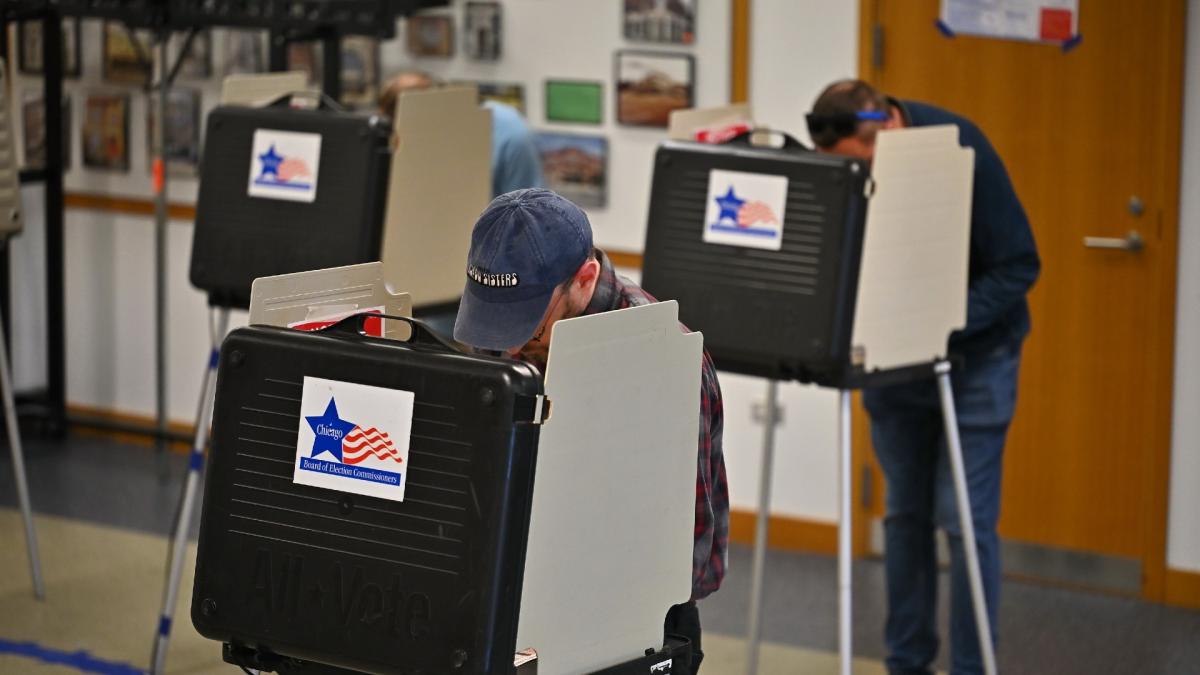 Voters cast their ballots in Chicago's Edgewater neighborhood on Nov. 3, 2026. (Victor Hilitski / WTTW News)
Nearly 80% of Chicago voters urged the Illinois General Assembly to impose a 3% surtax on those earning $1 million or more annually, an overwhelming result that will fuel efforts to overhaul Illinois’ tax system, according to unofficial results from the Chicago Board of Election Commissioners.
In addition, more than 71% voters in suburban Cook County also voted in favor of the nonbinding ballot question, according to unofficial results from the Cook County Clerk’s office.
The Chicago City Council blocked Mayor Brandon Johnson’s push to ask Chicago voters a similar question, prompting the Cook County Board of Commissioners to add the question to all ballots countywide.
State lawmakers declined in June to give voters a chance during Tuesday’s election to impose a 3% surtax on Illinois residents earning $1 million or more per year, much to Johnson’s frustration.
Johnson has touted the so-called millionaires’ tax as a necessary change to ensure that Chicago’s wealthiest citizens pay what he repeatedly contends is their “fair share,” while opponents warn it will hurt small businesses and the state’s economy.
When lawmakers return to Springfield in January at the start of Gov. JB Pritzker’s third term, Democrats will have expanded their supermajorities in both the Illinois House and Senate, according to unofficial results.
When moderate and conservative members of the City Council blocked the advisory referendum on the millionaires’ tax, they approved a measure designed to give voters a chance to tell Johnson to replace the city’s controversial gunshot detection system.
More than 72% of voters urged Johnson to do just that, according to unofficial results.
Johnson, who is running for reelection, announced two weeks ago that officials would begin testing a new gunshot detection system in six South and West side police districts.
Johnson’s proposed spending plan earmarks $2.24 billion for CPD, including $5 million for “software maintenance and licensing” that could be used to pay for a gunshot detection system.
Representatives of Johnson did not immediately respond to questions from WTTW News about whether that pilot program had begun as scheduled.
Interim Chicago Police Supt. Fred Waller told the City Council during the department’s budget hearing on Oct. 28 that he had little information about the specifics of that pilot program. Waller told alderpeople that he did not know which company’s technology will be tested, how it will operate or how its effectiveness would be assessed.
Waller told alderpeople that a gunshot detection system would be “a valuable tool.”
During 2025, the first full year without a gunshot detection system, the number of Chicago homicides hit a 60-year low.
Chicago’s homicide rate dropped by approximately 29% in 2025, as compared with 2024, according to Chicago Police Department data. The city’s overall violent crime rate decreased by nearly 23%, according to CPD data.
In addition, the 12 South and West side neighborhoods that had ShotSpotter sensors recorded an approximately 32% decrease in homicides in 2025 as compared with 2024, according to an analysis of Chicago crime data by Rob Vargas, a sociology professor at the University of Chicago who leads the UChicago Justice Project.
Since the beginning of the year, homicides are down 3.6%, and the overall violent crime rate has dropped more than 7.3%, according to CPD data.
The City Council twice rebuked Johnson over ShotSpotter and demanded that he reverse his decision to scrap the system, which he has said leads to the overpolicing of neighborhoods home to a majority of Black and Latino Chicagoans and derided as nothing more than a “walkie talkie on a stick.”
The City Council attempted to give former Chicago Police Supt. Larry Snelling the power to bypass the mayor’s office and directly ink a contract with SoundThinking, the firm that operates ShotSpotter. Snelling supported the use of the system, but did not openly defy the mayor, who appointed him and has the power to fire him.
Snelling and other supporters of the gunshot detection system said it helped officers save lives when shootings were not reported to emergency services.
ShotSpotter was never used to directly dispatch paramedics.
In addition, nearly 85% of voters urged the city to “pursue all lawful means” to make the Trump administration pay for the cost of the federal immigration raids known as “Operation Midway Blitz,” according to early results.
Nearly 68% of voters also urged city officials to create a permanent home for festivals and other large events, according to early results.
Contact Heather Cherone: @HeatherCherone | (773) 569-1863 | [email protected]
Related Stories