Arts & Entertainment
It’s Time to Set Clocks Back This Weekend. Let’s Look at Some of Chicago’s Iconic Timepieces
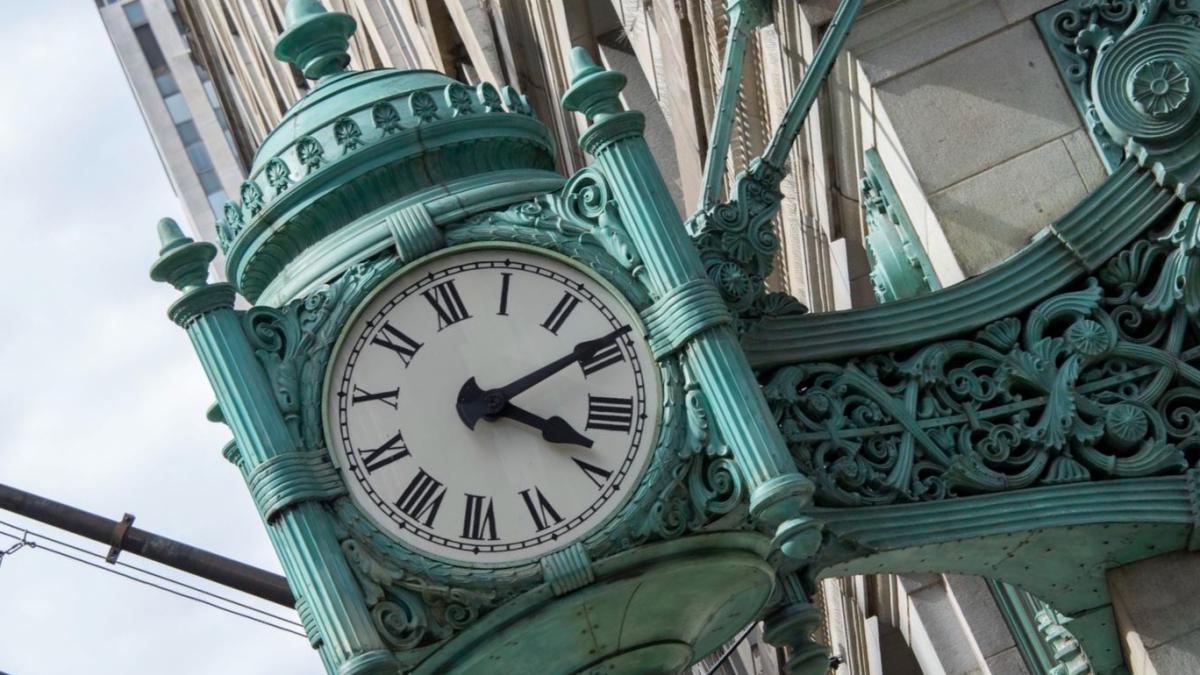 Call it Macy’s, call it Marshall Field’s, but the clocks are timeless. (Juli Scalzi / iStock)
Daylight Saving Time ends this weekend, meaning we “fall back” an hour.
While the extra hour of sleep might feel refreshing at first, the loss of daylight will hit hard when the sun sets at 4:43 p.m. Sunday.
Technically, the return to Standard Time happens at 2 a.m. Sunday. Today, smart devices make the adjustment themselves. Apart from stoves and microwaves — and kudos to anyone who manages to synchronize those two — there aren’t nearly as many timepieces to recalibrate as there used to be even 20 years ago.
That got us thinking about what a big deal clocks once were — and we mean big in every sense of the word.
Chicago has a number of towering timekeepers, some of them works of art, some of them landmarks, and all of them a reminder that time never stands still.
Marshall Field’s
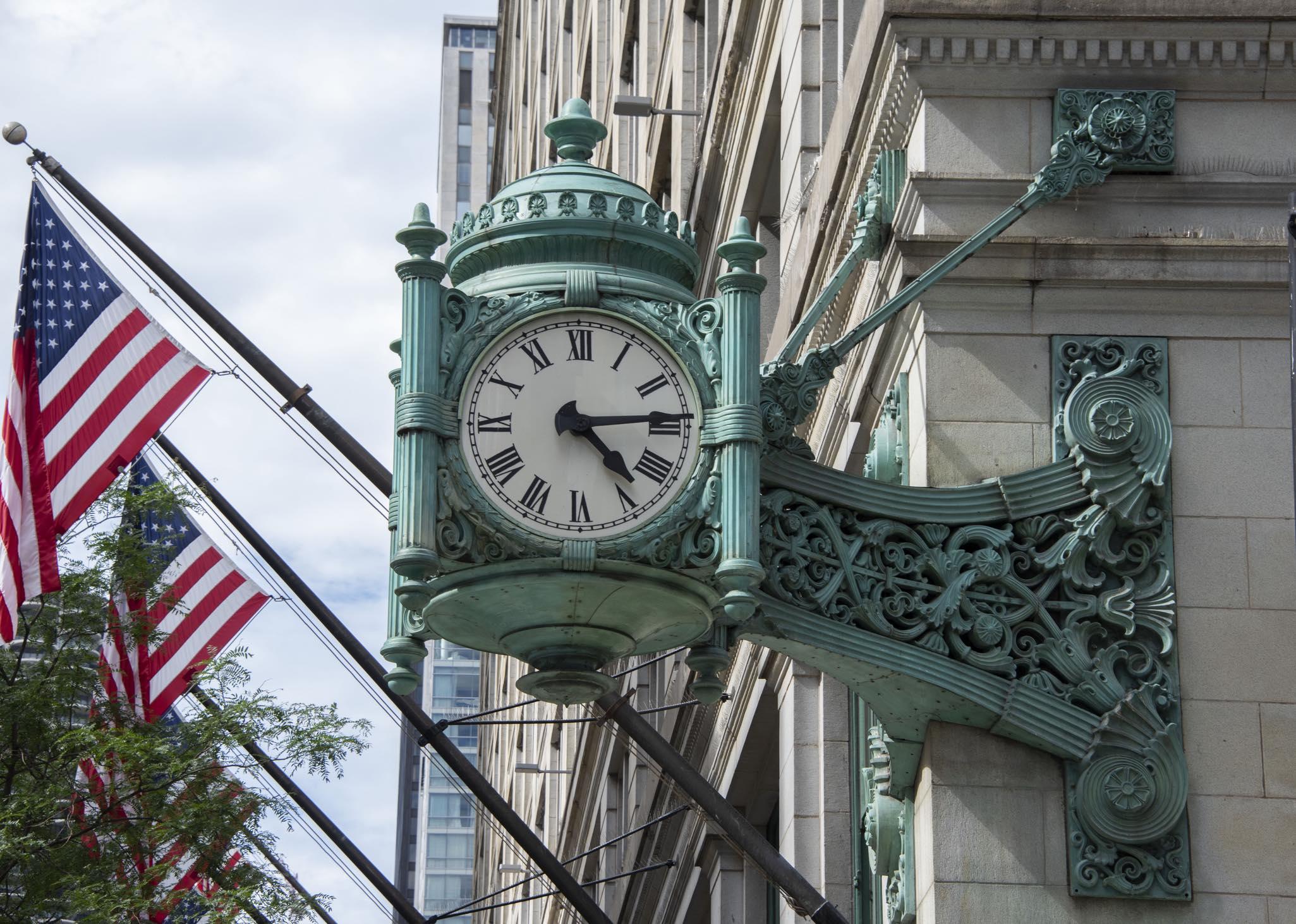 Clocks at Marshal Field’s/Macy’s have provided Chicagoans and tourists with a meet-up point for more than a century. (Juli Scalzi / iStock)
Location: Corners of State/Washington and State/Randolph
We know the retailer Macy’s now occupies this building but “Meet me under the clock” became a catchphrase on Marshall Field’s watch, so we’re going to split hairs.
The original clock was a 500-pound work of iron at State and Washington.
A second 7-ton bronze clock was added at State and Randolph in 1904. Its twin went up at State and Washington in 1907, replacing the original.
A GPS system was installed in 2009 to synchronize the pair four times per day.
Wrigley Building
 A close-up image reveals the Wrigley Building’s intricate level of detail in all aspects of construction, including the clock. (Emilie1980 / iStock)
Location: 400 N. Michigan Ave.
The Wrigley Building was once the tallest in Chicago and so was its clock back in 1921. Its faces, all four of them, have a diameter of 19 feet and 7 inches.
The clock tower is constructed of the same brilliant white terra cotta as the rest of the building. Its design was inspired by the bell tower of the Seville Cathedral in Spain (click here to view the resemblance).
Reportedly, the clock was not initially particularly good at its job but has since gotten better at keeping the correct time.
Jeweler’s Building
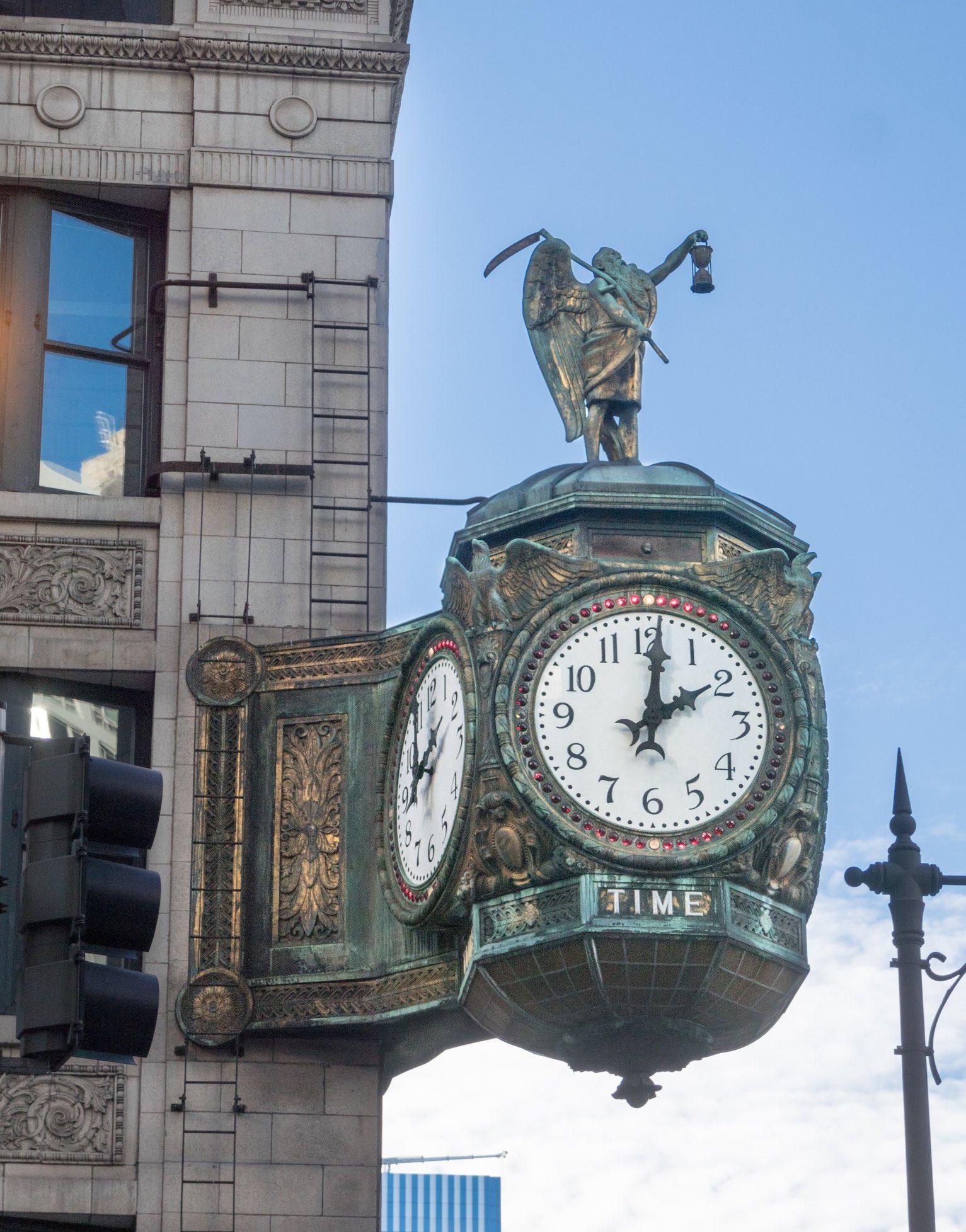 The Jeweler’s Building clock is nicknamed Father Time. (Gerald Zaffuts / iStock)
Location: 35 E. Wacker Drive
Mounted on the third floor at the corner of Wabash and Wacker, this clock is a real gem.
Dating back to 1926-27, the clock was donated by the Elgin National Watch Company, which was one of the Jeweler’s Building’s first tenants. The sculpture of Father Time that tops the clock — and gives the timepiece its nickname — is taken from the watch company’s logo.
Additional artistic flourishes include bald eagle adornments, bezel-set lights encircling each clock face and the word “Time” at base of the clock just in case that wasn’t obvious.
Reid Murdoch Building
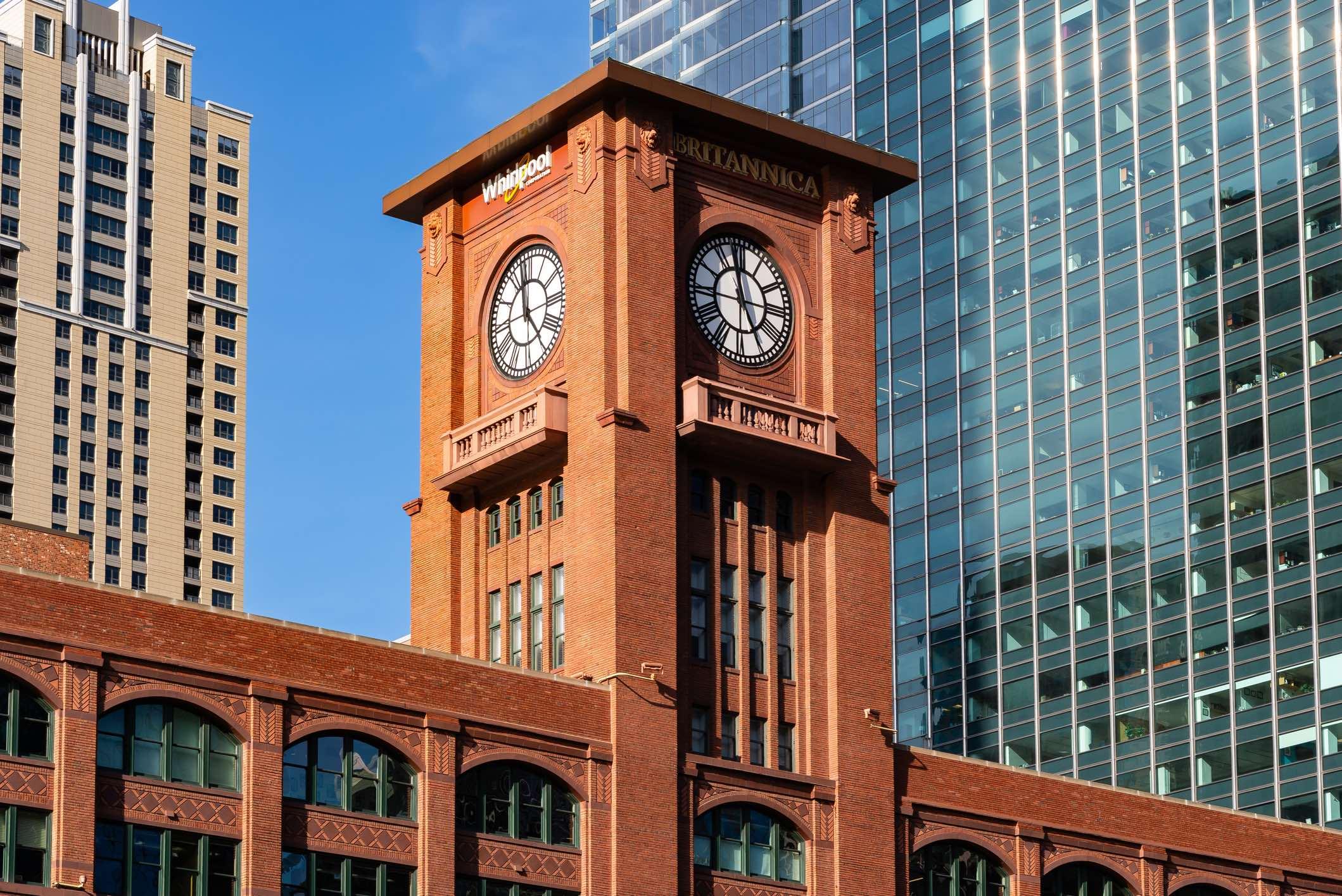 Newer tenants of the Reid Murdoch Building have put their stamp on the clock tower. (EJ Rodriguez / iStock)
Location: 325 N. La Salle St., overlooking the Chicago River
The name of this building might not ring a bell, but it’s instantly recognizable to anyone who has looked out the window of a Brown Line train as it crosses the Chicago River or who has strolled the Riverwalk.
Constructed in 1914 for a major importer of canned food products, this building was unique for its time in that it faced the river.
Unlike the Wrigley clock tower, which mirrored classical architecture, the Reid Murdoch timepiece incorporates elements of homegrown prairie design.
Pullman Administration Clock Tower Building
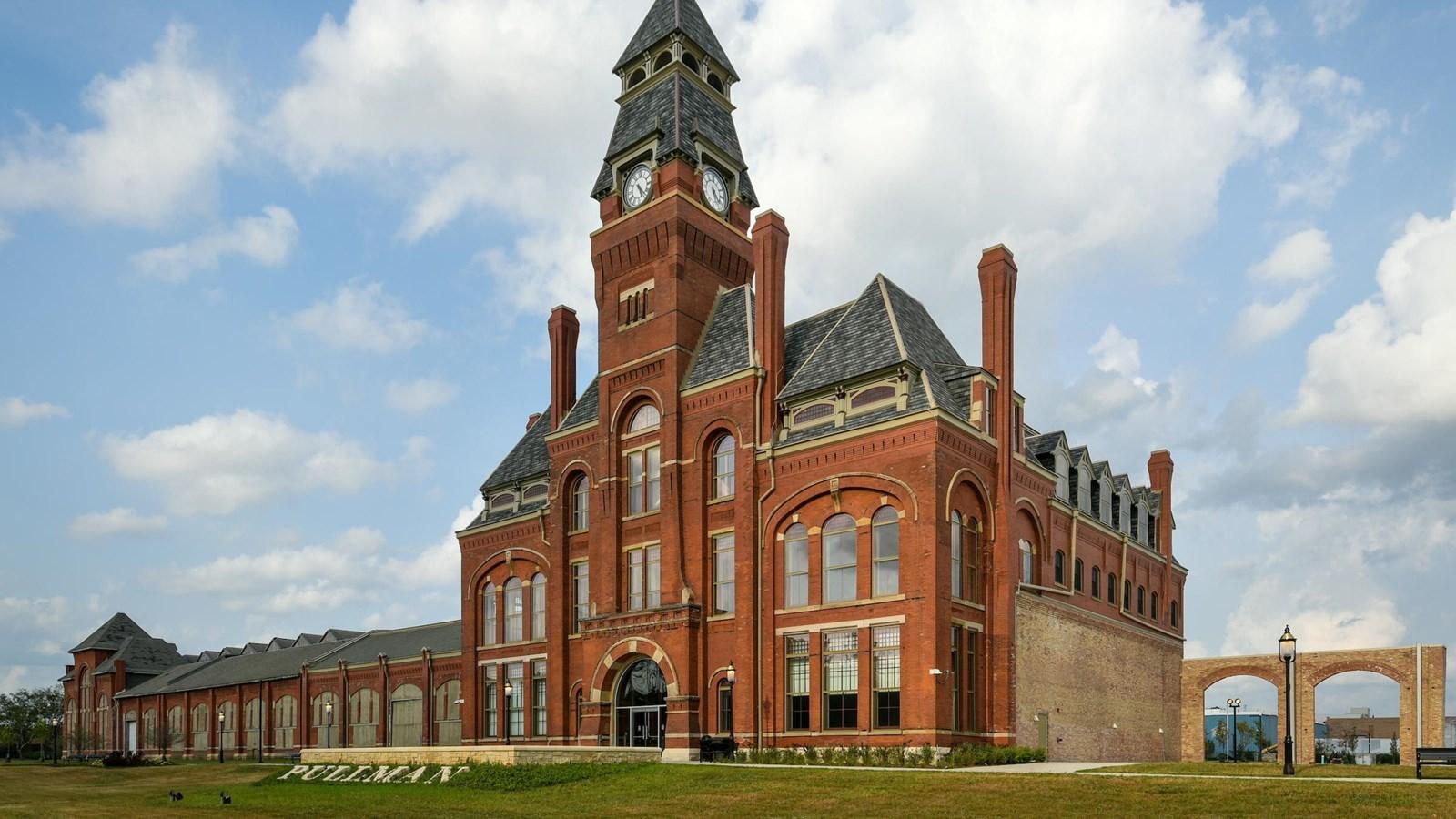 The Pullman clock was restored after a 1998 fire. (Courtesy of the National Park Service / Daniel Ples)
Location: 610 E. 111th St.
Time is money and money is time. No one knew that better than George Pullman, the industrialist who built a company town around his rail car factory — the whole of which is now Pullman National Historical Park.
The Administration Building and its imposing clock tower formed the centerpiece of this manufacturing hub, which ran like, well, clockwork.
On Dec. 1, 1998, an arsonist set fire to the 117-year-old building causing major damage. The tower and clock were rebuilt and installed in late 2005.
Central Manufacturing District
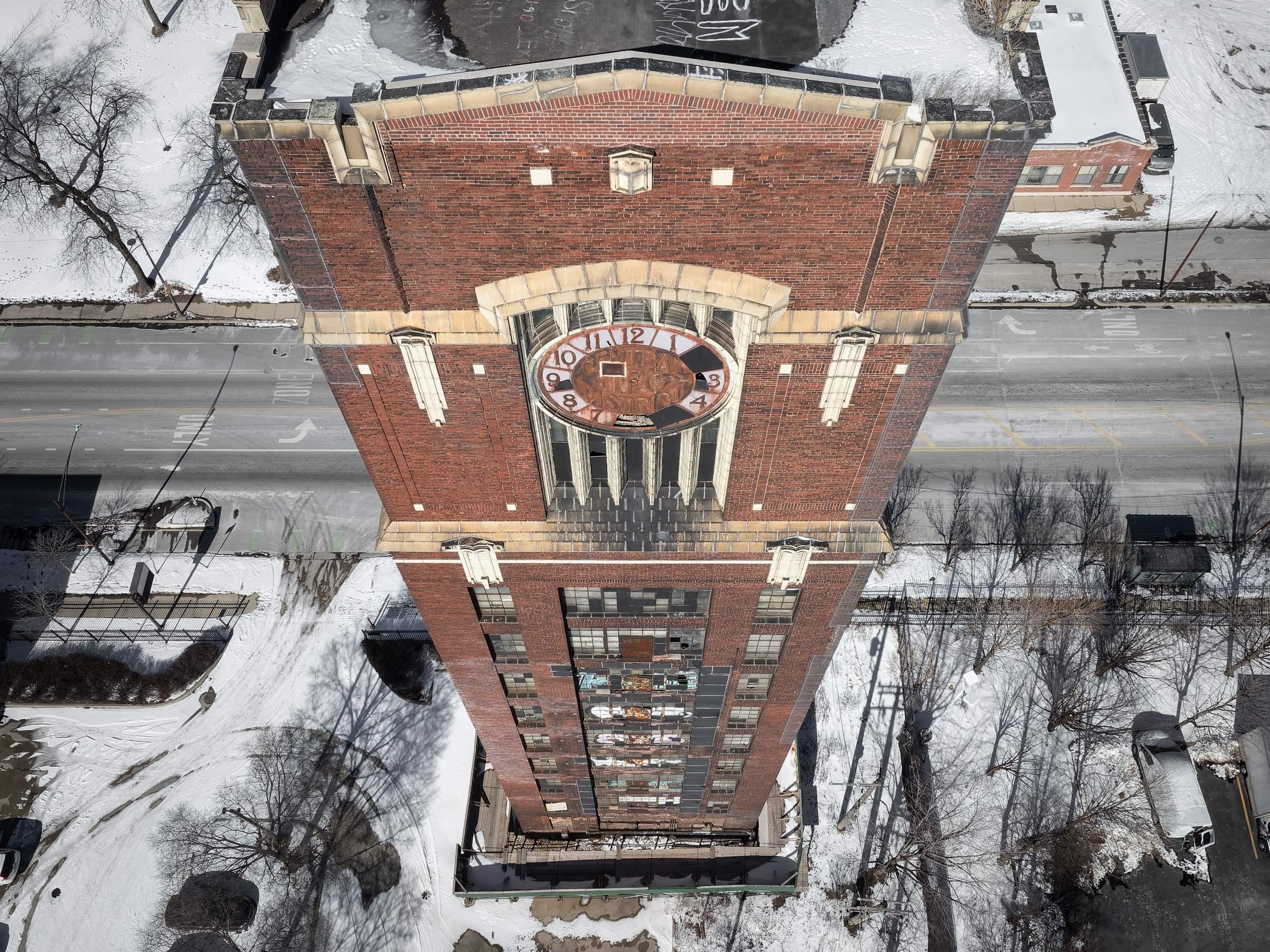 Central Manufacturing District Clock Tower, a Chicago 7 Most Endangered in 2025. (Serhii Chrucky / Esto)
Location: 2000 W. Pershing Road
The Central Manufacturing District in McKinley Park is often credited as the nation’s first planned industrial park. The roll call of companies that operated out of the district at one time or another include Sears, Wrigley, Walgreen, Glidden, Jewel, Proctor & Gamble and Westinghouse Electric.
The 12-story clock tower — the tallest point in the entire development — isn’t just a visual focal point, it contained a large water tank that provided the district’s fire suppression system.
In terms of historic preservation, the Central Manufacturing District hasn’t fared as well as some of the other properties on this list. The clock tower was named to Preservation Chicago’s 7 Most Endangered sites in 2025.
Deagan Building
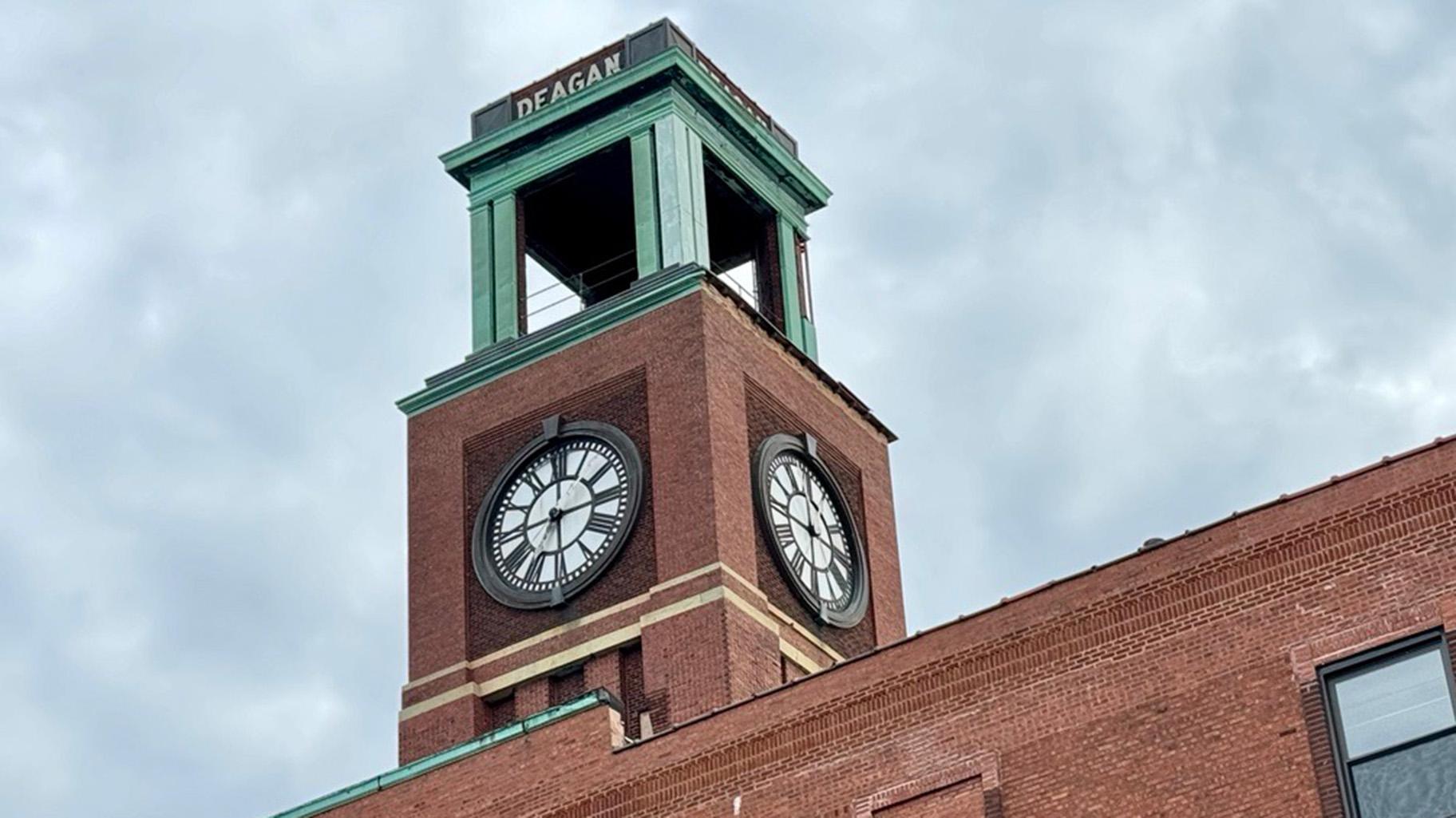 The Deagan Building is a well-known landmark in Ravenswood. (Patty Wetli / WTTW News)
Location: 1770 W. Berteau Ave.
The Deagan Building clock is another landmark visible from the Brown Line as it clatters through Ravenswood.
The building dates to 1916 and once rang out with the sound of the xylophones, marimbas and other percussive instruments manufactured on site. The JC Deagan Company also produced chimes for carillons and broadcast its expertise by piping recordings from speakers in the tower.
What was music to some neighbors’ ears was a racket to others, and the chimes were eventually silenced.
Instruments are no longer made in the building, but it does still house a repair shop, Century Mallet Instrument Service, which counts the Chicago Symphony Orchestra among its clients. Members of the public can usually get a glimpse of the operation during the annual Ravenswood ArtWalk.
Waveland Clock Tower
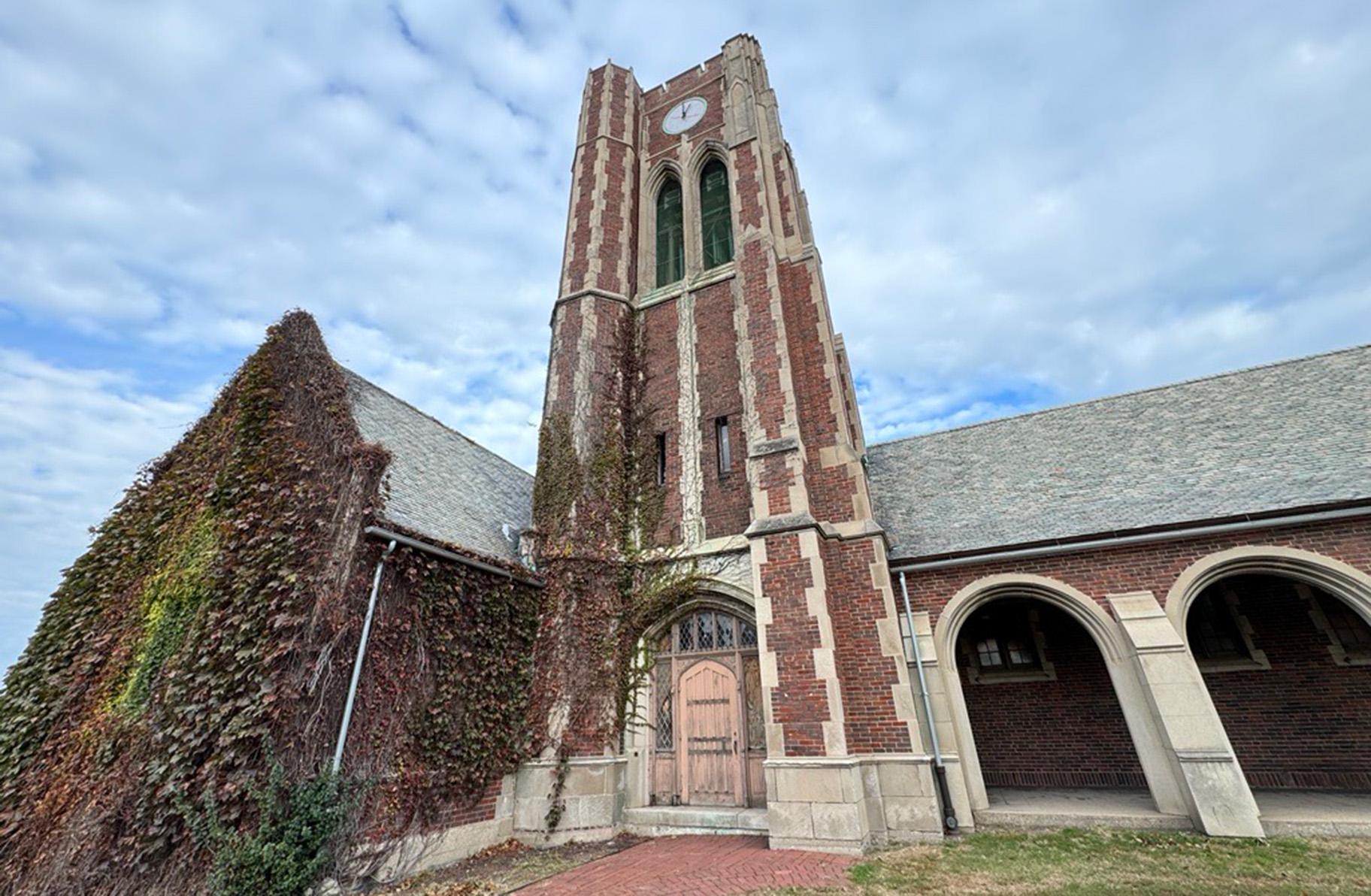 The Waveland clock tower stands out along Chicago’s north lakefront. (Patty Wetli / WTTW News)
Location: 3600 N. Recreation Drive
This seven-story gothic structure along Lake Michigan dates back to 1931, part of a new field house and other amenities that sprung up as this stretch of lakefront was developed (i.e., created from landfill). Tennis courts and a nine-hole golf course are nearby.
Speaking of Deagan, the clock tower originally included a carillon built by the company. The chimes were played daily at regular intervals, and you can guess where this story’s headed. No more chimes.
Volunteers kept the clock ticking in recent decades but it’s currently not in working order: Of the four clock faces, only one has numbers and another is missing everything including the hands. So maybe time actually does stand still.
Contact Patty Wetli: [email protected]