Science & Nature
When Their 98-Year-Old Parkway Tree Bit the Dust, These Chicagoans Decided to Make Its Life Count
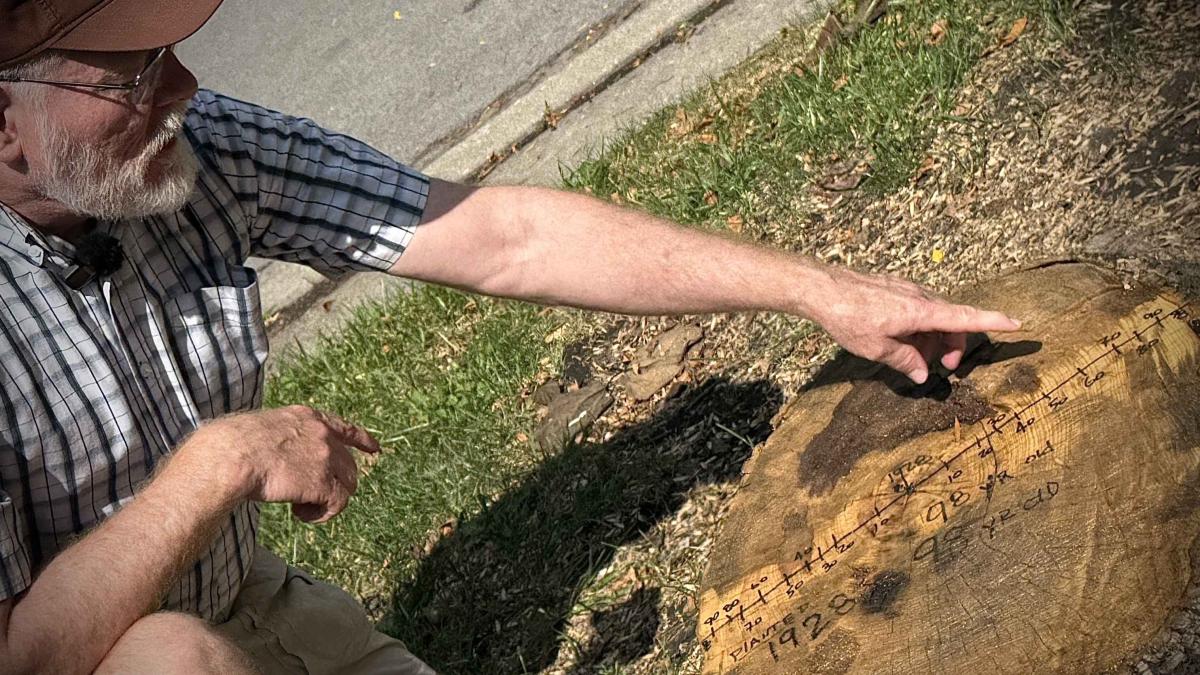 Bruce Wexelberg explains how he counted rings to estimate the age of a parkway tree cut down after this summer’s storms. (Patty Wetli / WTTW News)
Matt McDermott and Bruce Wexelberg are still getting used to how bright it is inside their house, ever since they lost one of the parkway ash trees that used to shade the front corner of their Lincoln Square bungalow.
“Our new view out our front door is just open land now, instead of seeing the ash tree right there,” McDermott said.
The ash was a casualty, in a roundabout way, of this past summer’s storms, like so many thousands of trees across Chicago. But it’s hardly been forgotten. In fact, the remaining stump has become something of a neighborhood conversation piece.
“Yeah, we see people stopping. Now it’s an attraction,” McDermott said. “People stop and look at the stump.”
What’s so eye-catching about dead wood?
Well, Wexelberg, who’s a certified TreeKeeper and a bit of a history buff, turned the tree’s base into a quasi memorial.
“I got a grinder with a sanding disc and I sanded down a strip across so that it was smooth,” he said. “And then I drew a line straight across with a straight edge (ruler) and a pencil, and I counted all of the rings.”
Every 10 rings, he made a hash mark — 10 years, then 20, then 30 — first in pencil and later in Sharpie.
Given the tree’s size, McDermott, who’s lived in the house since 1987, thought maybe the ash had been planted in the ‘60s or ‘70s.
“It was actually a smaller ash tree,” he said. “It was a very thin and just upright kind of ash tree.”
But Wexelberg’s tally blew past McDermott’s educated guess.
The total was 98 rings, dating the ash back to 1928, just three years younger than the house itself.
“Most people walk by trees and they don’t really notice or think that tree might have been here 100 years,” Wexelberg said. “It’s also a way to honor the tree, like, ‘I’ve been here for 98 years.’ A lot longer than any of us, you know, so I think it’s a tribute to the tree. We’ve had a lot of people stop and say that was really cool to put the markings down.”
Video: Alternating bands of light and dark count as a single year. (Patty Wetli / WTTW News)
McDermott could be forgiven for shaving decades off the tree’s age.
It’s a common mistake for people to either assume a relatively small tree must be a young tree or that an uncommonly large tree must be ancient, said Christy Rollinson, senior scientist at Morton Arboretum.
Take the case of Great Basin bristlecone pines, she said. They grow at high elevation in California, Nevada and Utah, and are the oldest single organisms on the earth. Some have lived longer than 5,000 years — “They’re older than the pyramids,” Rollinson said — but it may take 40 years for them to top six inches.
“Slow and steady often wins the race,” Rollinson said.
Growth rate is influenced by many factors, she noted, and the longer a tree lives, the more those differences can compound and throw off a visual estimate.
“Some of the oldest trees that I have ever done research on or found are not what you’d expect them to be,” Rollinson said. “Size is not age.”
To date a tree, professionals use a hollow hand drill called an increment borer to remove a pencil-width piece of wood from living trees in order to obtain an approximate age.
“That requires a lot of upper arm strength and time and skill to do right,” Rollinson said.
But old-fashioned ring counting remains a tried and true method, and for an amateur, Wexelberg’s technique was spot on.
Rollinson gave him high marks for sanding the stump, which erases the chainsaw slashes that can obscure tree rings.
Wexelberg also counted the rings correctly. Each year is actually represented by a twinned set of rings: a light one indicating a tree’s spring growth spurt and a dark one added during late summer and fall. Some people wind up essentially doubling a tree’s age by erroneously adding up these alternating light and dark bands individually.
The 98 years Wexelberg arrived at is certainly within the range of what’s possible for an ash tree, Rollinson said, but for a street tree to have reached that age is remarkable.
“Sadly, the average life expectancy of an urban tree is nine to 17 years,” she said.
“That’s not because the tree biologically can’t live longer,” Rollinson noted. “The vast majority of that is because we plant trees, or some people plant trees, without thinking far ahead or they’re not planted well and don’t survive the first couple of years. Life is hard for urban trees. It shouldn’t be nine to 17 years.”
Even in the wild, a tree’s lifespan is a roll of the dice, with much of its success left to chance.
“Very few trees die of ‘old age,’” Rollinson said. “You just end up playing the odds of getting hit by disease or getting hit by a storm.”
The McDermott-Wexelberg ash tree darned near survived both of those hazards, until it didn’t.
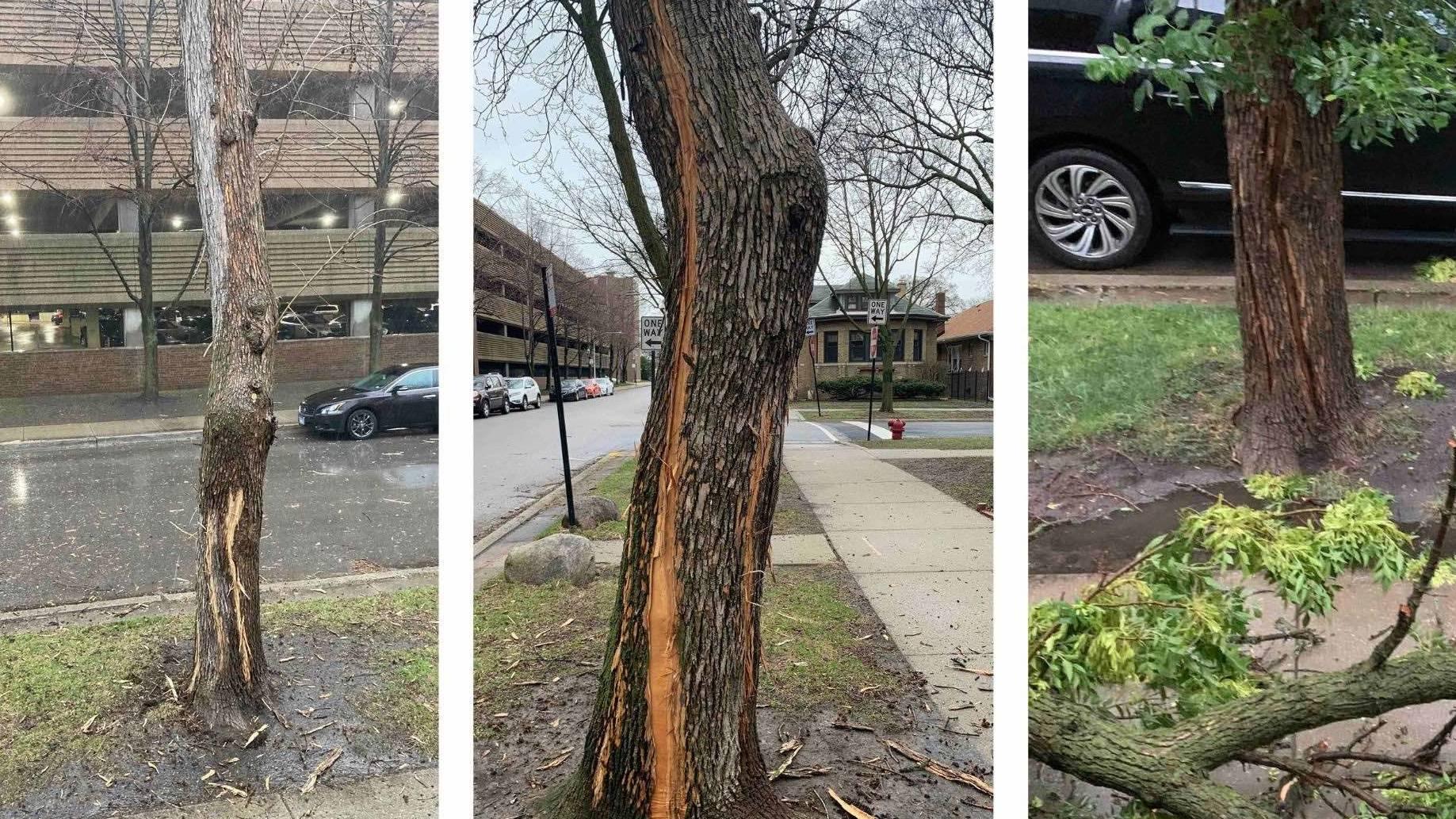 A lightning strike split the ash tree’s bark open in 2025. The tree’s relatively slim profile turned out to be misleading in terms of its age. (Courtesy of Matt McDermott and Bruce Wexelberg)
“So, April of last year, 2025, I was sitting in the den and I hear this big thunderclap and the lights blinked,” McDermott said. “I observed sort of a smell in the house and I noticed that the ADT (security) system wasn’t working — a red light was blinking.”
That thunderclap was a direct lightning hit.
The bolt had struck the ash, scattering a few branches but more notably popping the bark loose from the trunk. There were also three vertical splits running down the length of the bark, McDermott said.
Lightning packs an incredible punch in terms of energy, Rollinson said, and that energy causes the water inside a tree to boil. “It’ll blow apart,” she said.
Such damage to a tree isn’t always fatal, but this particular ash had already been weakened by the emerald ash borer beetle.
McDermott opened a 311 ticket to have the tree removed. Because the situation wasn’t considered an emergency — no branches were blocking a street or sidewalk — the tree was placed in a queue with other removal requests.
Fast forward to July 2026.
While the couple was still waiting on the city to remove the lightning-struck tree, they became increasingly worried about the health of two other parkway ash trees looming over the north side of their corner lot.
Chicago’s Bureau of Forestry had inoculated the ash trees in 2013 against the emerald ash borer but eventually stopped treating parkway trees. A community group raised funds to inject neighborhood ash trees in 2022 and 2023, including theirs, but McDermott and Wexelberg had started to notice considerable die-back in the trees’ crowns.
“The timeline’s run out,” Wexelberg said.
The two were in the process of enlisting their alderperson’s help to have the trees inspected when Mother Nature intervened.
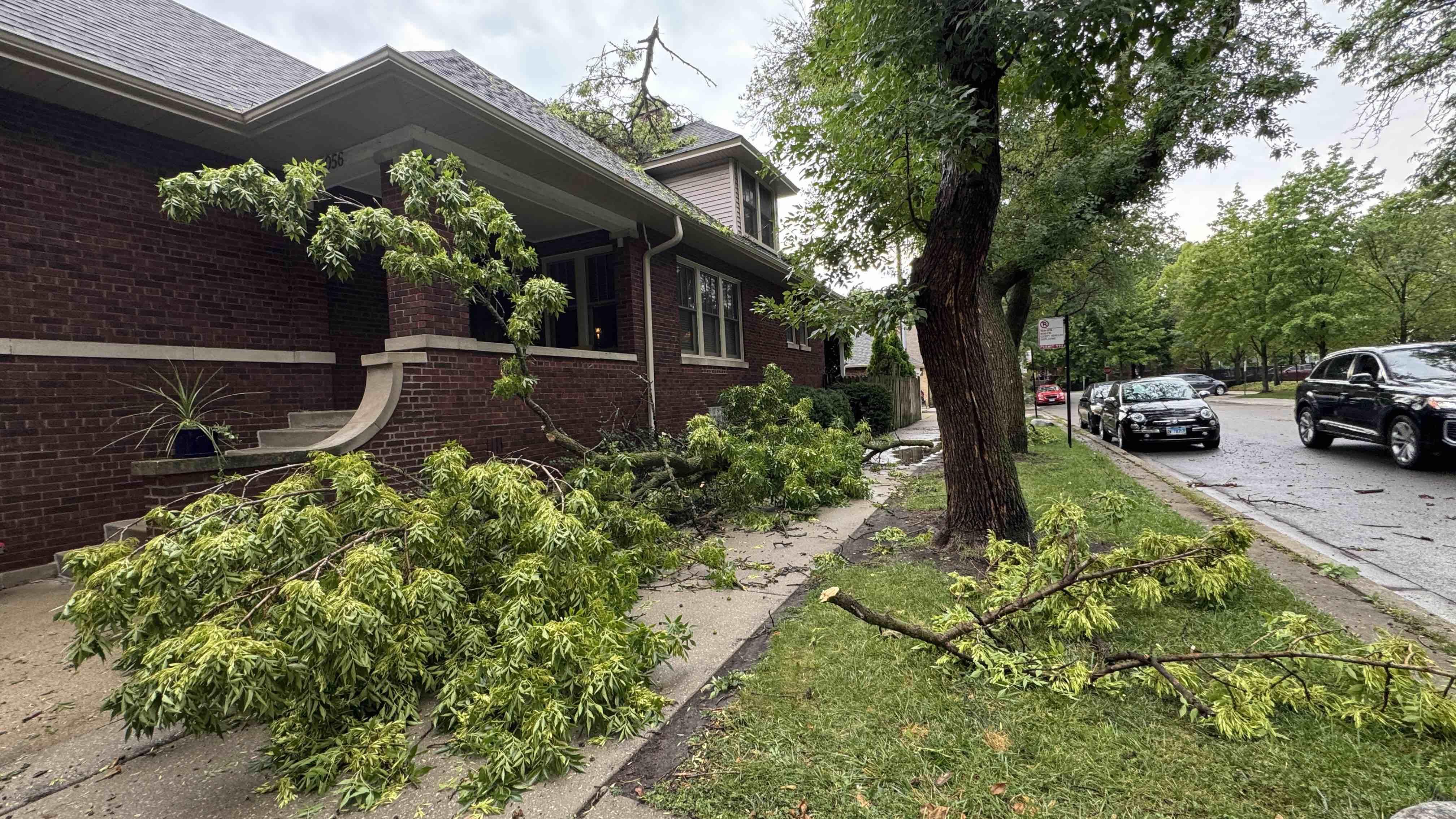 The McDermott-Wexelberg home, after the top of a parkway tree came crashing during storms on July 27, 2026, just a month after the couple had their roof replaced. You can see the lightning-struck ash tree in the foreground, before it was reduced to a stump. (Patty Wetli / WTTW News)
McDermott and Wexelberg were both at home on July 27 as severe storms sped toward Chicago. They had the TV on, listening to forecast updates, when they heard a loud, sustained roll of thunder directly overhead.
“Like, ‘Boom. And then boom, boom, boom,’” Wexelberg recalled.
But it wasn’t thunder. And this time, it wasn’t lightning either.
“It was a rolling tree on top of the house. Bam, it hit the chimney and rolled off the roof,” he said. “We didn’t realize what had happened initially. We realized pretty quickly after that.”
Those ash trees that had been making them nervous? The top of one had come crashing down onto the house.
Huge branches blocked the sidewalk, another had fallen on the south side of the house and a large limb was sticking straight up from the dormer.
“We knew something was bad,” McDermott said.
Leaves and other debris from the tree clogged the gutters — a portion of which was bent by a falling branch — and water started overflowing into the side yard.
“So there’s waterfalls coming down in front of the porch and we’ve got all this greenery and big branches out there,” McDermott said. “It was still raining really hard, so there’s nothing we could do.”
Neighbors called to see if the two were home and aware that a tree was sticking out of their house.
“That the nice thing about this neighborhood — everyone knows each other,” McDermott said. “We just ended up sitting on the porch for a while and people were coming by and we were talking to them. … Sometimes disasters bring out the best in people.”
They happened to have a roofing contractor on speed dial because, you can’t make this stuff up, they had just replaced the bungalow’s shingles in June.
When the contractor came out the next day, “His comment was, ‘The fact that there is a branch still on the roof is not a good sign.’ Something’s holding it up there, which, turns out, it had punctured the roof,” Wexelberg said.
At least they wouldn’t have to argue over depreciation, an insurance adjuster later told the couple.
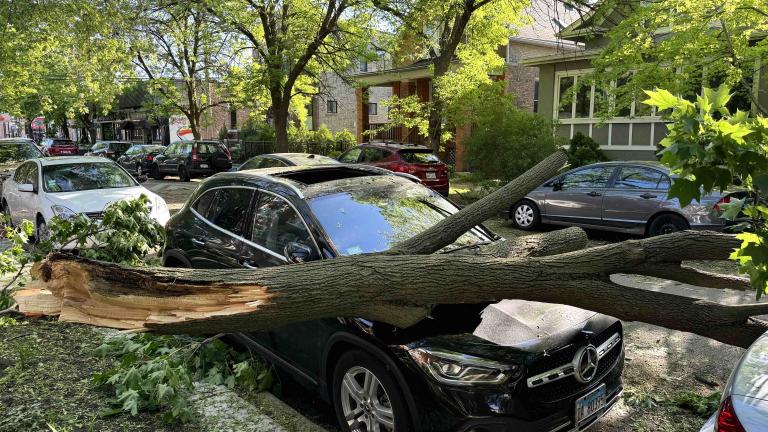
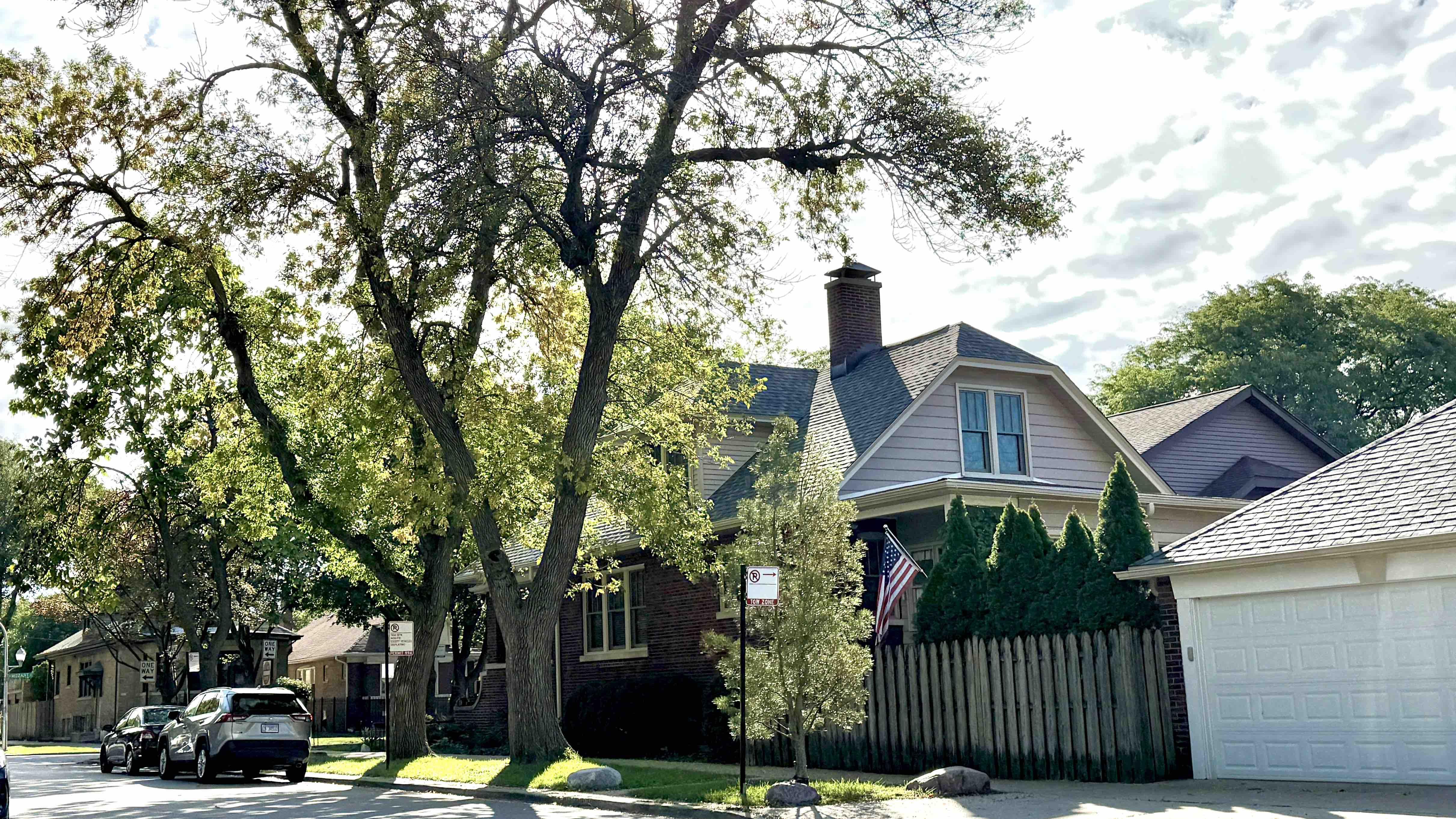 And then there were two. Four ash trees lined the parkway when Matt McDermott moved into his house in the late 1980s. One fell in the 1990s, crushing a car in the street, and one was removed this summer. (Patty Wetli / WTTW News)
In the aftermath of the storm, city crews cleared the fallen branches — their position on the sidewalk qualified as an emergency — and cut down the ash tree hit in the 2025 lightning strike for good measure. They left the other two parkway ash trees in place, including the one that had shed its top.
Now McDermott and Wexelberg are fearful that, if bad things really do come in threes, their house could suffer another blow.
“When you go outside and look at the trees, you’ll see that there’s a couple of very large branches that have no leaves on them,” McDermott said. “There’s one gigantic branch that’s going right over the back of our house. So you wonder, if that falls off, what’s going to happen?”
According to a spokesman with Chicago’s Department of Streets and Sanitation (which oversees forestry), there are approximately 21,000 remaining parkway ash trees, only some of which are currently protected against emerald ash borer.
There is no special forestry policy for ash trees, the spokesman told WTTW News via email. Untreated ash won’t be removed until they decline or become structurally deficient, he said, adding that residents should request a tree inspection via 311 if they have a concern about a dying tree.
McDermott and Wexelberg said they planned to log a request to have the remaining two ash trees taken down.
“I’m sure there’s a lot of other people on the list,” Wexelberg said. “There’s a lot of trees that look like they’re half dead.”
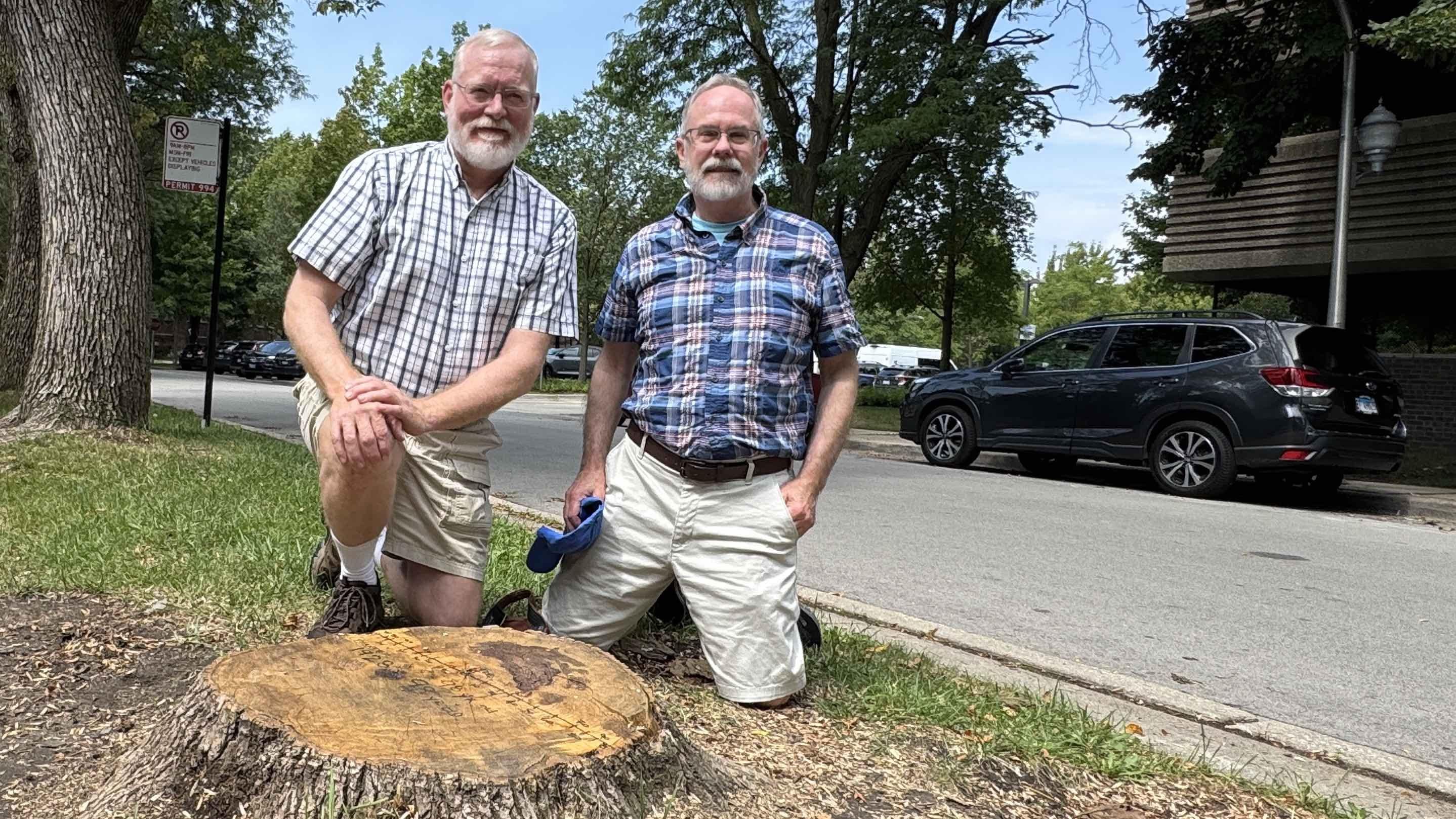 Bruce Wexelberg (left) and Matt McDermott are planning on requesting replacement parkway trees, but haven’t decided what kind they want. (Patty Wetli / WTTW News)
McDermott was in his 20s when he bought the house at the corner of Mozart and Carmen.
“It seemed like everyone was really old,” he said of his neighbors at the time.
Now he’s the elder statesman, having witnessed young couples snap up homes on the block and raise children he’s watched grow from infants to high schoolers. Many of the modest bungalows have sprouted second stories. The hospital down the street has been renamed twice in the last decade, and its parking garage, directly opposite his house, has added multiple floors over the years.
One constant has been the trees.
They’ve been a barrier between the house and the street — and the parking garage — softening the view, whether looking out the window over the kitchen sink or from the dormer upstairs. “It’s like being in a treehouse,” Wexelberg said.
Even with the recent damage, the couple hasn’t soured on trees.
The tree-ring stump “memorial” isn’t meant to be permanent, they said. Eventually it will be uprooted and a new sapling will take its place. Same for the other ash trees, if and when they’re inspected and removed.
“We are very much aware that those trees need to be replaced and we’re putting a lot of thought into what we’re going to request,” Wexelberg. “We have some ideas, we’ve been looking. When we’re driving around, we’re like, ‘Oh, there’s a sycamore tree there. There’s a dawn redwood — that’s what that’s going to look like.’”
Whatever their choice, these new neighborhood sentinels will have deep roots to fill.
Contact Patty Wetli: [email protected]