Health
Pediatricians Sound the Alarm on Trump Executive Order Targeting Childhood Vaccine Schedule
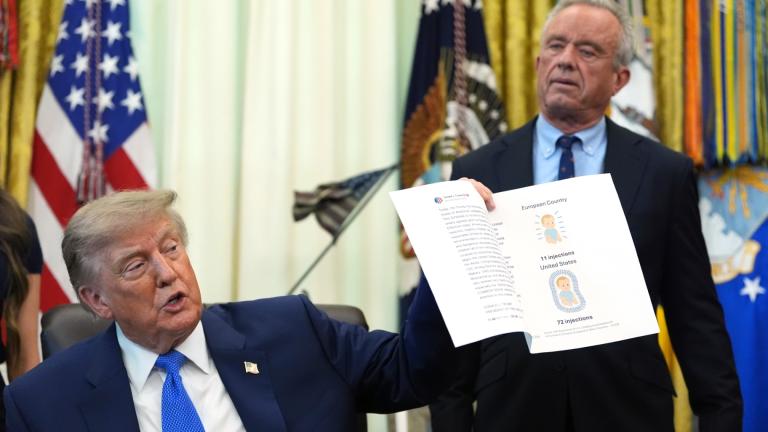
As their kids head back to school, parents are navigating conflicting messages about childhood vaccines after President Donald Trump signed an executive order earlier this month recommending changes to the federal vaccine schedule.
The executive order recommends splitting the measles, mumps and rubella, or MMR, vaccine into three separate shots and reducing the number of vaccines recommended for all children from 18 to 11.
The Trump administration said the order is based on “gold-standard science,” but medical professionals have been quick to dispute the changes, arguing they could endanger children’s health.
Dr. Julia Rosebush, an associate professor of pediatrics at the University of Chicago and pediatrician at Comer Children’s Hospital, said the order isn’t based on science.
“This upended decades of science,” Rosebush said. “There was no new science that prompted this change. I was very concerned and am still concerned that this is going to lead to a lot of confusion amongst providers and also amongst our patients and their families.”
Dr. Anita Chandra-Puri, a pediatrician at Northwestern Memorial Hospital and president of the Illinois chapter of the American Academy of Pediatrics, said splitting the MMR vaccine into separate shots would undo years of progress.
“There is no separate measles, mumps and rubella vaccine in the United States,” Chandra-Puri said. “There hasn’t been a production of separate measles, mumps, rubella since 2009. We’ve been using MMR as a vaccine for decades very successfully, very safely.”
Single-antigen vaccines for measles, mumps and rubella aren’t widely available in the U.S. and could take years and tens of millions of dollars to develop. The executive order also recommends administering the vaccines at separate medical visits, potentially requiring families to make multiple trips to the doctor.
“As a practicing pediatrician, there’s no viability to what they suggested we do,” Chandra-Puri said. “There’s no practical way to actually implement that executive order.”
The order also recommends that several vaccines, including those for hepatitis A, hepatitis B and meningitis, be given only to high-risk groups rather than all children.
Vaccines for rotavirus, COVID-19 and influenza would be moved to a shared decision-making category, meaning parents and doctors would decide together whether children should receive them.
Rosebush said the changes would result in fewer children getting what have long been considered safe and necessary vaccines.
“Some of those vaccines that have now been moved to shared decision-making status have eliminated diseases from the general public on account of those vaccines,” Rosebush said. “Things like rotavirus, which used to be a huge contributor to childhood morbidity, is now rarely seen owing to vaccination. Meningococcal vaccine that prevents bacterial meningitis could be a deadly disease amongst children. … Not having those vaccines as part of the required and routine schedule really puts children in a precarious position.”
The order comes after years of vaccine skepticism from both Trump and Health and Human Services Secretary Robert F. Kennedy Jr., who have erroneously linked vaccinations with a rise in autism diagnoses.
Trump has also scrutinized vaccine mandates for children to attend public schools.
“... most peer nations maintain high childhood vaccination rates through public trust and education,” the order reads. “In the United States, by contrast, individual States set mandatory vaccination requirements that children must meet to attend school.”
Chandra-Puri said patients should ask questions about which vaccines their children are getting, but ultimately have trust in the expertise and experience of healthcare providers.
“We encourage conversation with your pediatrician,” Chandra-Puri said. “But appreciate that we are the people who have spent time researching this, studying this, understanding this and reading about this. It’s our lane.”
The order isn’t legally binding and won’t immediately require drugmakers to develop individual measles, mumps and rubella vaccines. But it does direct HHS to present a plan for implementing the recommendations within 90 days.
Even if adopted, the recommendations would not change vaccine requirements for public school attendance, which are set by individual states.