Health
Illinois Reaffirms Existing Childhood Vaccine Schedule After Trump’s Executive Order Calling for Changes
 (Cunaplus_M.Faba / iStock)
Illinois Department of Public Health officials reaffirmed their endorsement of the current childhood vaccine schedule Tuesday in response to an executive order signed by President Donald Trump.
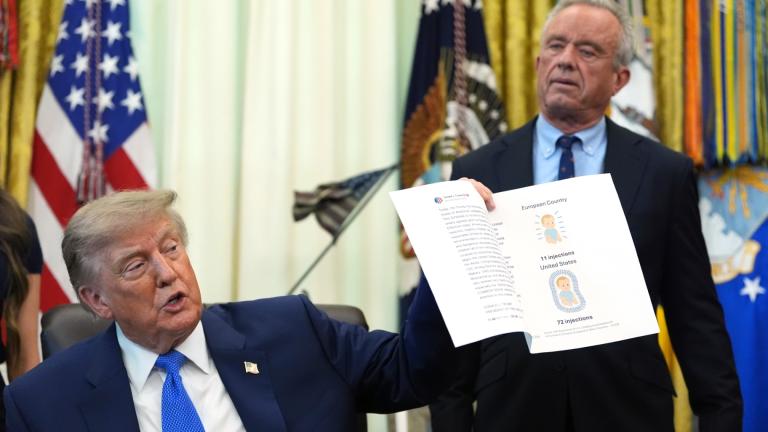
That order issued Monday calls for changes to vaccine guidance in order to align with Trump’s long-held, but discredited, theory that childhood shots should be spaced out into separate medical visits.
IDPH said that it does not recommend adjustments to the childhood immunization schedule based on the recent executive order and that the department continues to endorse the immunization schedule put forth by the American Academy of Pediatrics.
“A thoughtless piece of paper does not reverse decades of research and scientific evidence about protecting kids,” Gov. JB Pritzker said in a Tuesday statement. “While the president tries to confuse and distract the American public, Illinois will continue to follow the science-based guidance that keeps our children safe from serious illness.”
Following Monday’s executive order, American Academy of Pediatrics President Dr. Andrew Racine said in a statement there is no new evidence to justify significant changes to childhood immunization guidance.
“The only purpose of this announcement is to sow confusion so that more people doubt the importance of vaccines,” Racine said in a statement. “Delaying or skipping shots is risky, especially as measles continues to spread and children go back to school.”
Trump’s order advocates separating the measles, mumps and rubella (MMR) vaccine into three different single-disease shots and administering all childhood immunizations at separate appointments whenever possible. Trump called the announcement a “major victory for parents’ rights, religious and constitutional rights, and for the gold standard science.”
Trump repeatedly suggested Monday the number or timing of vaccines could play a role in rising rates of autism spectrum disorder, even as scientific consensus and decades of studies have firmly concluded there is no link.
IDPH Director Dr. Sameer Vohra said in a Tuesday news release that requiring shots to be split up among multiple visits would increase the burden on parents and caregivers, as it would require additional doctor’s appointments, costing time and money, while offering no proven health benefit. Vohra said splitting the MMR vaccine into separate shots is not supported by scientific evidence.
During the 2025-26 school year, nearly 97% of students in Illinois were vaccinated against measles, according to IDPH. The state continues to see low case counts of measles, even as nationwide numbers have soared to their highest levels since measles was declared “eliminated” in 2000, according to the department.
“IDPH will continue to be guided by science and work closely with clinical and community leaders to provide recommendations that allow Illinoisans to make the best choices to keep themselves and their families safe and healthy,” Vohra said in a statement.
IDPH’s endorsement of the American Academy of Pediatrics’ childhood vaccine schedule is unanimously supported by the state’s immunization advisory committee, Vohra added.
In December, Pritzker signed a law that allows IDPH to create and publish vaccine guidelines for residents based on the state’s own immunization advisory committee instead of relying on the CDC’s vaccine advisory committee.
Health Secretary Robert F. Kennedy Jr., an anti-vaccine activist before he entered politics, fired the entire 17-member vaccine advisory committee at the CDC, installing replacements who made far more restrictive recommendations that have since been halted by a federal judge. He also directed the CDC to abandon its position that vaccines do not cause autism, without supplying any new evidence to support the change.
The Associated Press contributed to this report.
Contact Eunice Alpasan: [email protected]