Arts & Entertainment
‘Voices Through Art’ Examines Identity With Chicago’s Immigrant, Refugee Storytellers
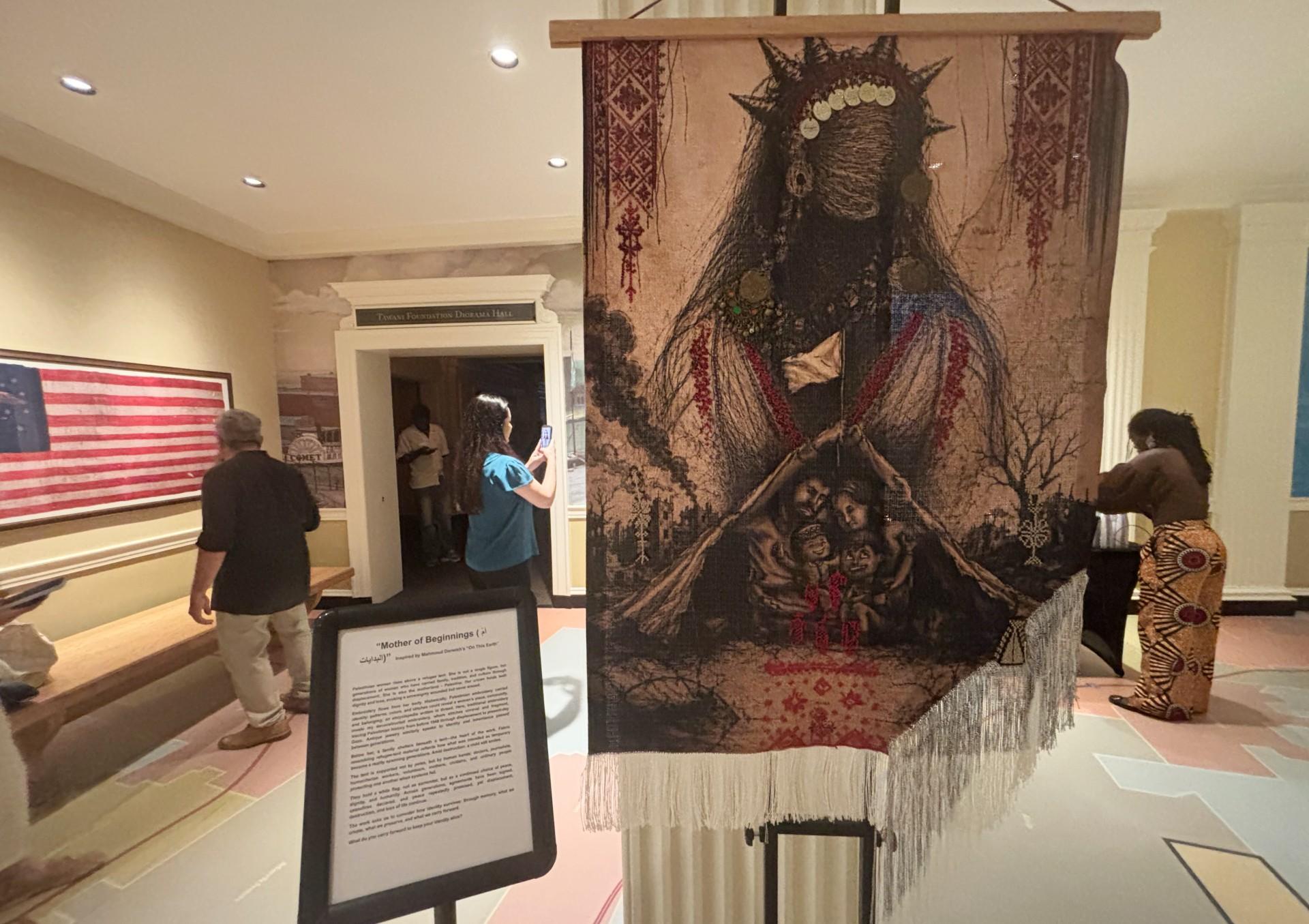 “Mother of Beginnings” by Hama Hinnawi is pictured at “Voices Through Art” on Aug. 20, 2026, at the Chicago History Museum. (Shelby Hawkins / WTTW News)
How do you identify? What do you carry forward to keep your identity alive? Where are you and how did you get there?
These were questions posed during the second annual installment of “Voices Through Art,” an event that highlights the art and stories of Chicago’s immigrant and refugee communities. This year’s theme was the personal, complicated and at-times controversial term denoting both one’s unique and unifying qualities: identity.
In the auditorium of the Chicago History Museum, four storytellers took the stage Thursday night to share their interpretations of how identity shows up and shapes their lives. One artist was Hama Hinnawi, a Chicago-based Palestinian-Jordanian fashion designer who created the work “Mother of Beginnings,” an embroidery of a woman rising above a refugee tent who also represents Palestine — the author’s motherland.
“She’s wearing her crown of pain, existence, resistance, resilience, freedom,” Hinnawi said, referring to the handmade embroidery. “With her thobe (traditional Palestinian dress), she’s holding a tent for her civilians. The tent is made of hands. Those hands are protecting this family. Those hands are of humanitarians, of doctors, of journalists, that are protecting this family. They are also all holding the white flag, but it’s not representing surrender; it represents calling for peace. All these people, including the motherland, were always asking for peace but it was a broken promise that was never given.”
“Voices Through Art” is the brainchild of Ali Tarokh, the director of development and communications at the Syrian Community Network, who sought refuge in the United States from Iran more than a decade ago after being imprisoned for political persecution.
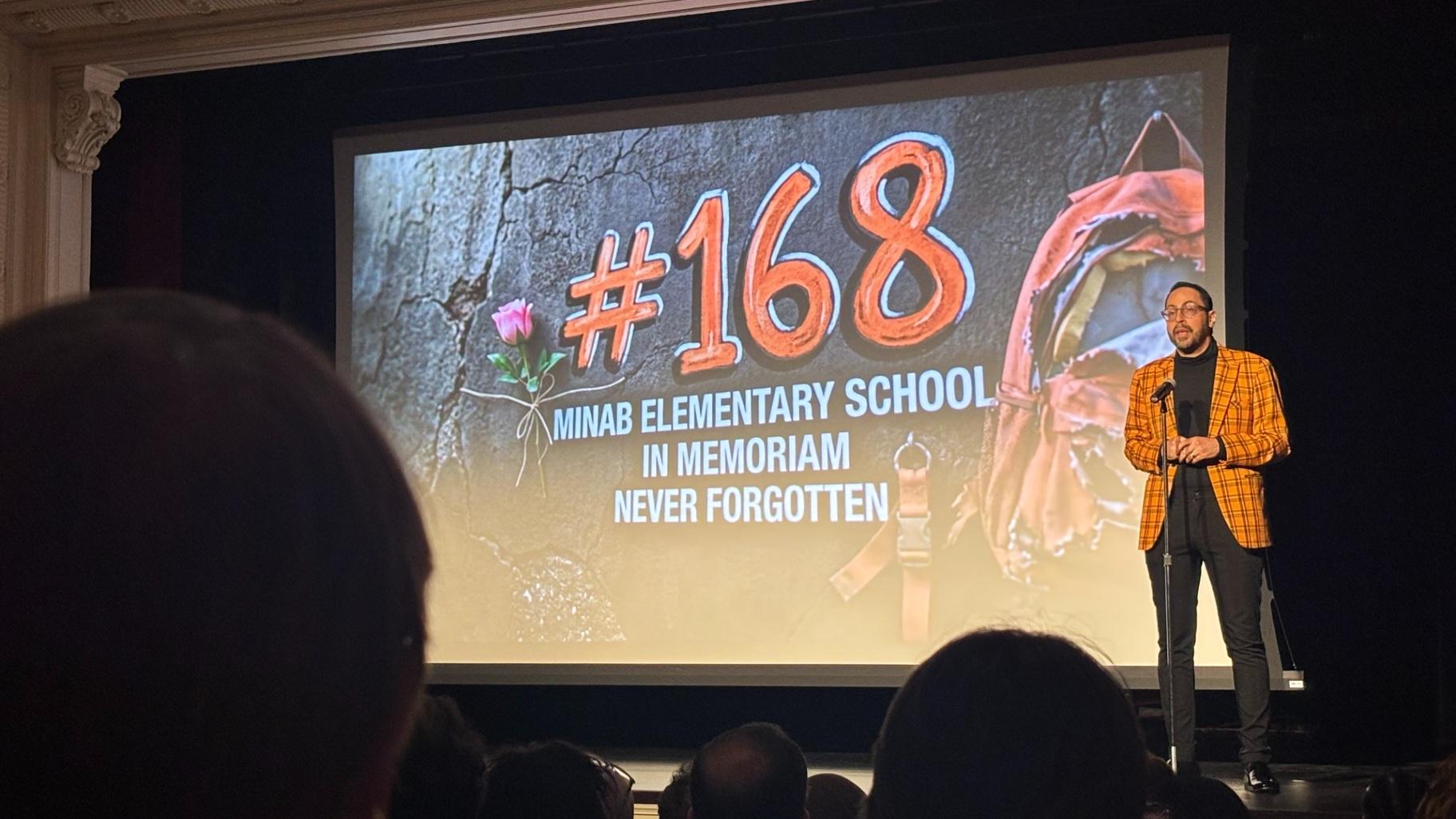 Ali Tarokh on stage at the “Voices Through Art” event, Aug. 20, 2026, at the Chicago History Museum. His presentation honored the lives lost from the U.S. missile strike that destroyed the Shajareh Tayyebeh Elementary School in Minab, Iran. (Shelby Hawkins / WTTW News)
Tarokh said that as a refugee he’s often felt like “an invisible man” and found himself in situations trying to prove that while he may have been at “the lowest moment in my life,” he’s not a “low” person.
“I found that one of the best ways to raise awareness and do advocacy is storytelling,” Tarokh said. “Refugees and immigrants don’t get that much of a chance to share their stories. It’s all about reminding each other that we are human. We need to take care of each other.”
He said it was important to platform “ordinary people with compelling stories.” The organization sent out a call for storytellers, gave them a theme and then chose from the pool of applicants.
Selected storytellers are part of a cohort that receives assistance building out their narratives before the celebratory night, which acts as a graduation ceremony of sorts.
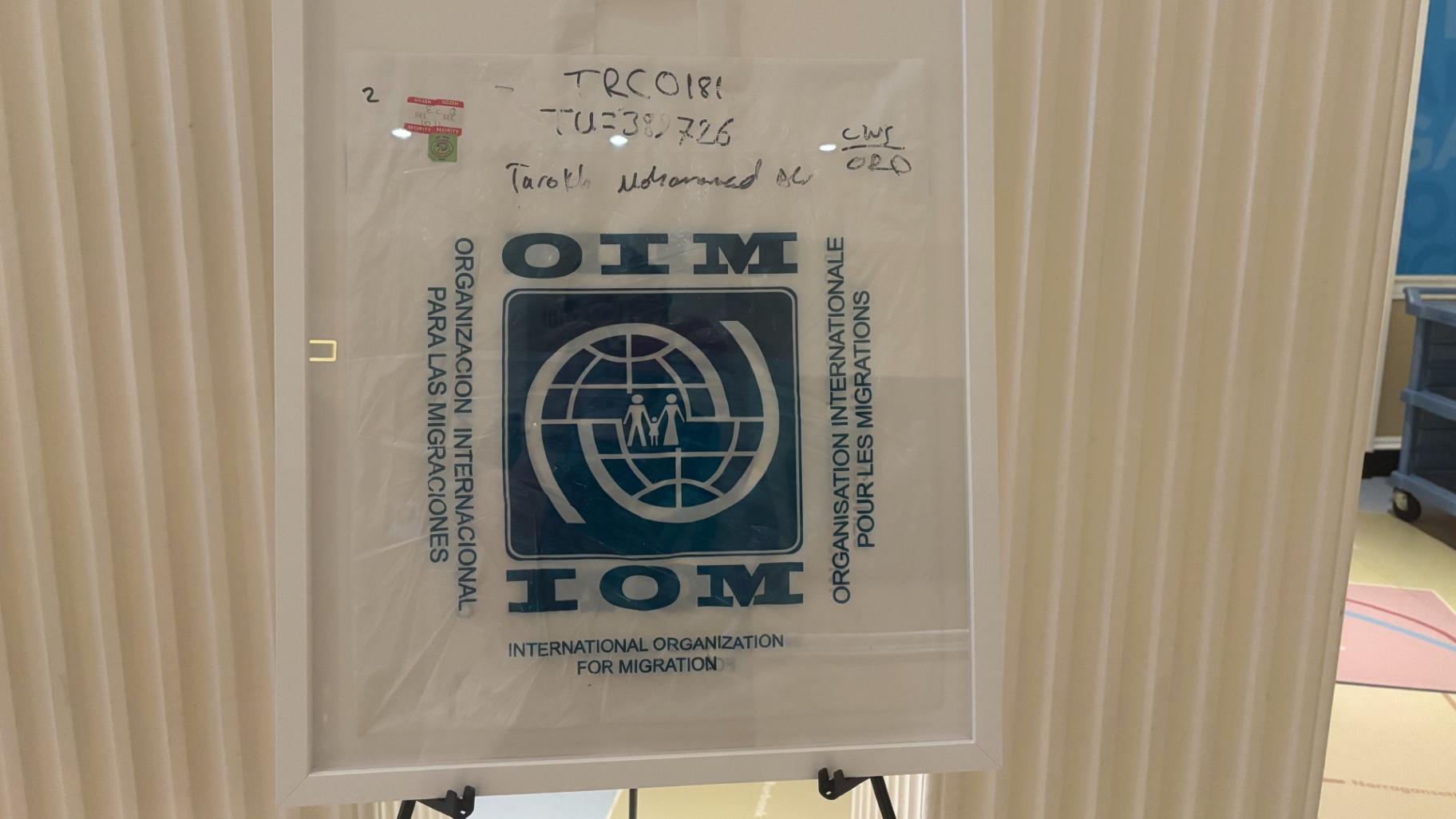 “My IOM Bag – What I Carried With Me” by Ali Tarokh. At “Voices Through Art” on Aug. 20, 2026, Tarokh displayed the bag he received from the International Organization for Migration when he first arrived in the United States. (Shelby Hawkins / WTTW News)
Another storyteller from the 2026 cohort is Kadie Afrik, a designer who was born in Sierra Leone and raised in Senegal before immigrating to the United States to study fashion design.
Afrik decided to examine the theme of identity through a visual exploration of her family’s multicultural background via a creative take on a family tree, called “hyphen&me.” Afrik shows her and her sibling’s identities — Sierra Leonean, Senegalese and American — down to their children using clothing as a canvas because “before we even say a word, what we wear is always communicating something.” In Afrik’s case, her daughter’s “branches” include identities based in a West African and Lithuanian lineage.
“Apparel felt like the natural choice for canvas to create a platform that celebrates my identity, your identity, our identity, outside of the box,” Afrik said. “Like so many immigrants, I arrived carrying languages, traditions, family history, memories, ways of seeing the world and everything that had shaped me long before I stepped on American soil. But almost immediately, I encountered something that was completely new to me. In the forms, applications, surveys, I encountered some version of the same instruction: Check one box. Black, African American, Other, you know the boxes. I remember thinking, ‘Just one box?’ None of those boxes felt large enough to hold my whole story.”
She hopes the installation will push people to dig deeper and ask themselves: What happens when we stop choosing one part of ourselves over another?
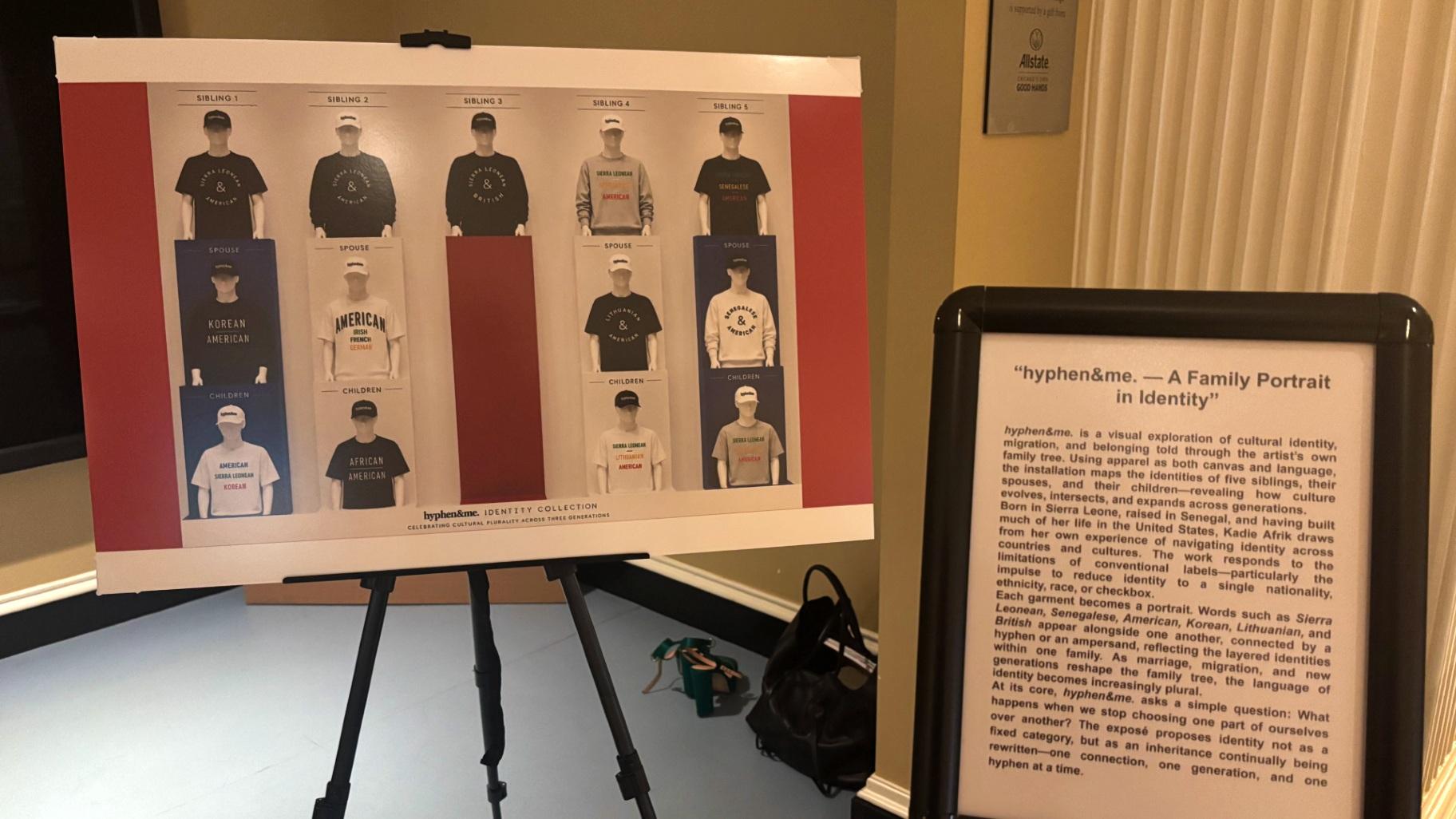 “hyphen&me – A Family Portrait in Identity” by Kadie Afrik is on display at “Voices Through Art” on Aug. 20, 2026, at the Chicago History Museum. (Shelby Hawkins / WTTW News)
The theme is already chosen for next year’s event. It will focus on employment and all the barriers that come with being an immigrant, having a non-Anglo name and speaking in accented English.
WTTW News arts coverage is supported by the JCS Arts, Health & Education Fund of the DuPage Foundation.