Arts & Entertainment
Domestic Violence Survivors Tell Their Stories Through Art: ‘Giving Up Was Never an Option’
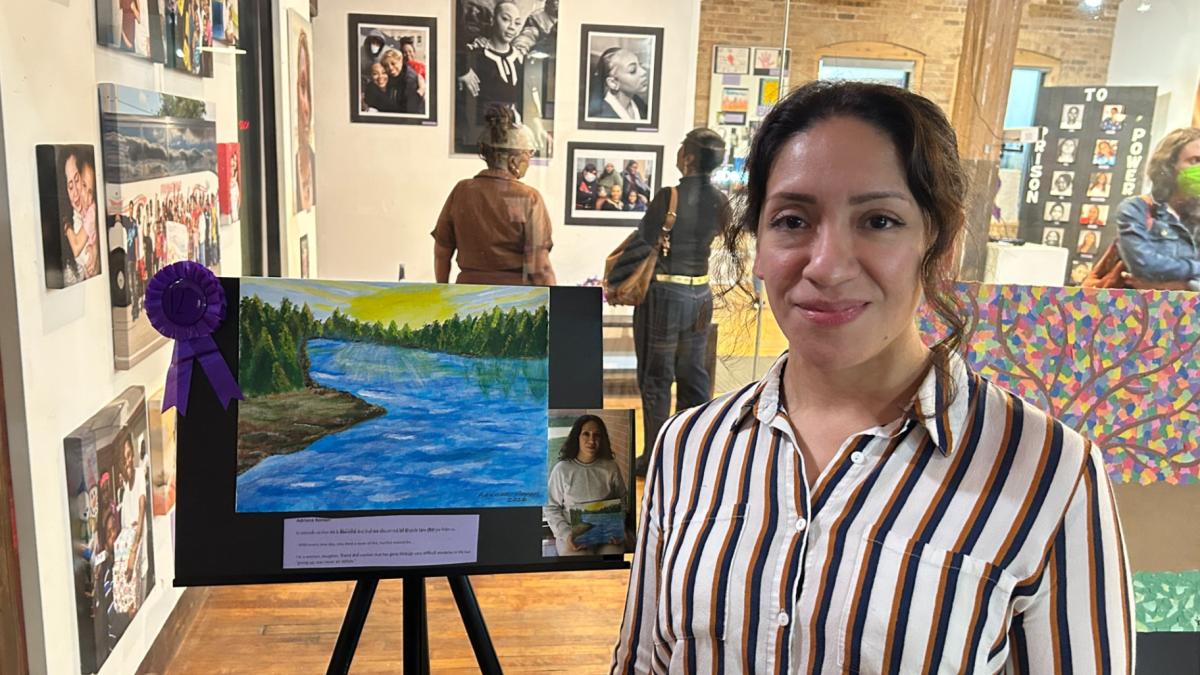 Adriana Roman stands alongside the painting she made for the Women’s Justice Institute’s annual “Look at Me” art show, celebrating survivors of domestic violence, Oct. 29, 2026. (Blair Paddock / WTTW News)
While Adriana Roman was incarcerated at Logan Correctional Center in central Illinois two months ago, she painted a scene of a wide river in Colorado, surrounded by pine trees and covered in light from the sun’s bursting rays.
It depicts a memory she shared with her mother: After Roman left an abusive relationship, the two went to Colorado together for a fresh start, Roman said. Just days ago, her mother passed away.
“It has more meaning, because she always said giving up was never an option,” Roman said. “She instilled that in my brain, so that’s for my mom.”
Roman, now on work release, reflected on her artwork at the Women’s Justice Institute’s annual “Look At Me” program held last Thursday at the organization’s Pilsen office. Her piece won 12th place in the art show, which gathered work from women incarcerated at Logan and Decatur correctional centers and Cook County Jail. The organization holds the art show every October in honor of Domestic Violence Awareness Month.
In one gallery, a woman named Rachel stood in front of a photograph of herself taken by artist Melissa Grace Kreider.
“You can see the pressure in my face,” said Rachel, who asked to be identified by her first name.
The photo shows Rachel awaiting trial, where she said she was prosecuted for killing her abuser. Just weeks ago, she was found not guilty. She’s in the process of getting her record expunged.
When people view her portrait, Rachel said, she wants them to feel they don’t have to be ashamed of what they may be going through, and that it’s not burdensome to share your story.
Adjacent to Rachel’s portrait is a photograph of Shanice Page. She sits with her hands on her lap, surrounded by the hands of others on her shoulders.
“(The photo) says to me that I have a support system, … that I am loved,” Page said.
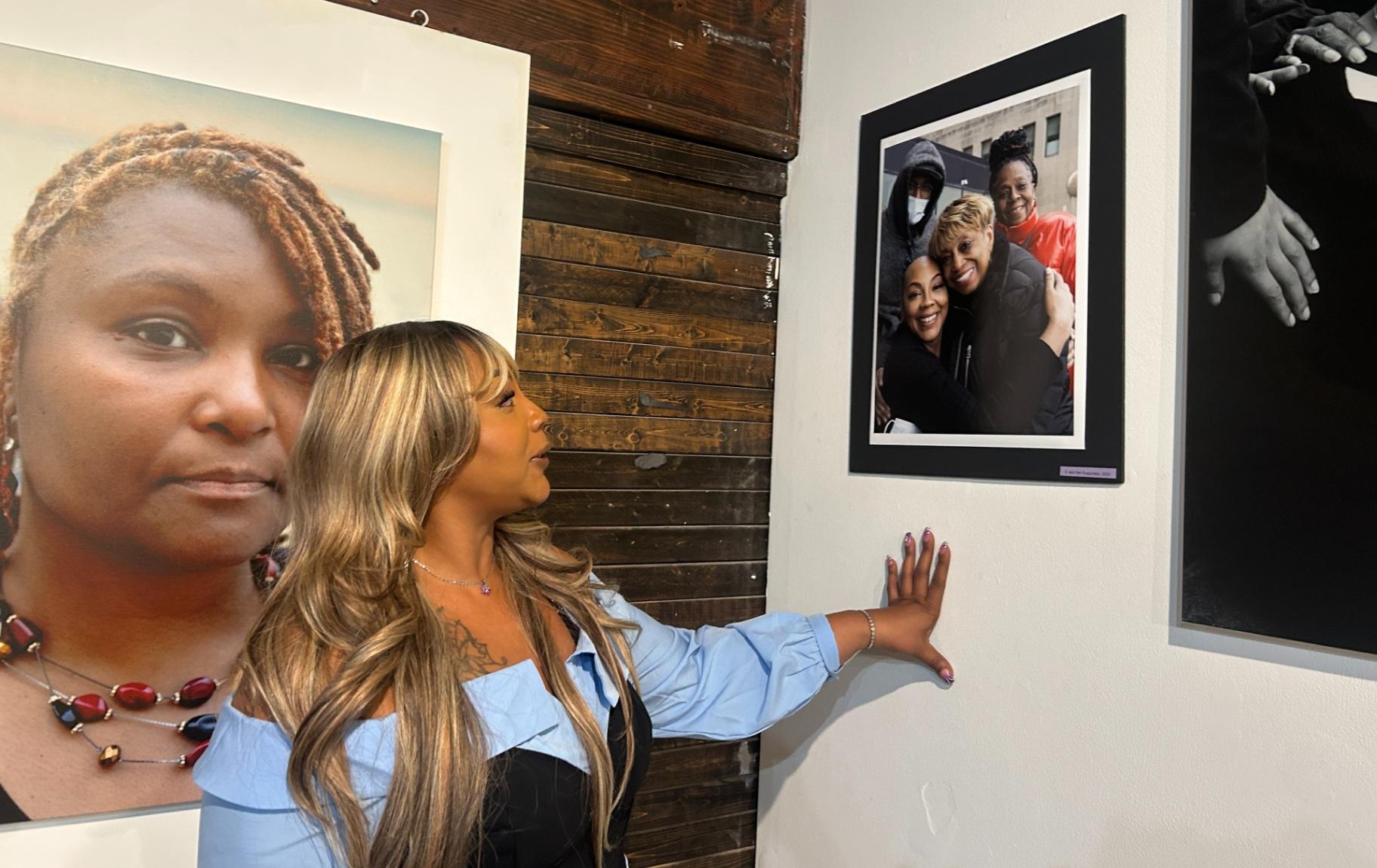 Curator Shanice Page on Oct. 29, 2026, looks at a photo taken during her trial, surrounded by family. The photo is by Melissa Grace Kreider. (Blair Paddock / WTTW News)
Kreider also photographed Page throughout her trial, where she was convicted of second-degree murder for killing her abuser while pregnant. Page curated the photography show and now works at the Women’s Justice Institute as a senior care coordinator, supporting “ladies that have been in the same situation,” she said.
Nationwide, more than 70% of women incarcerated in prison and jails report experiences of intimate partner violence victimization, according to a 2024 report from the nonpartisan research organization the Council on Criminal Justice.
“I want (viewers) to see that these women aren’t just numbers, and they aren’t just what people think they are,” Page said. “They’re human, they’re people, and they need healing and support instead of prison.”
Later in the evening, attendees gathered to watch a video of the play “Look At Me: Hear Her Hear Us,” written and performed by women incarcerated at Logan Correctional Center. The in-person crowd was joined by incarcerated women video calling from Logan and Decatur correctional centers and Cook County Jail.
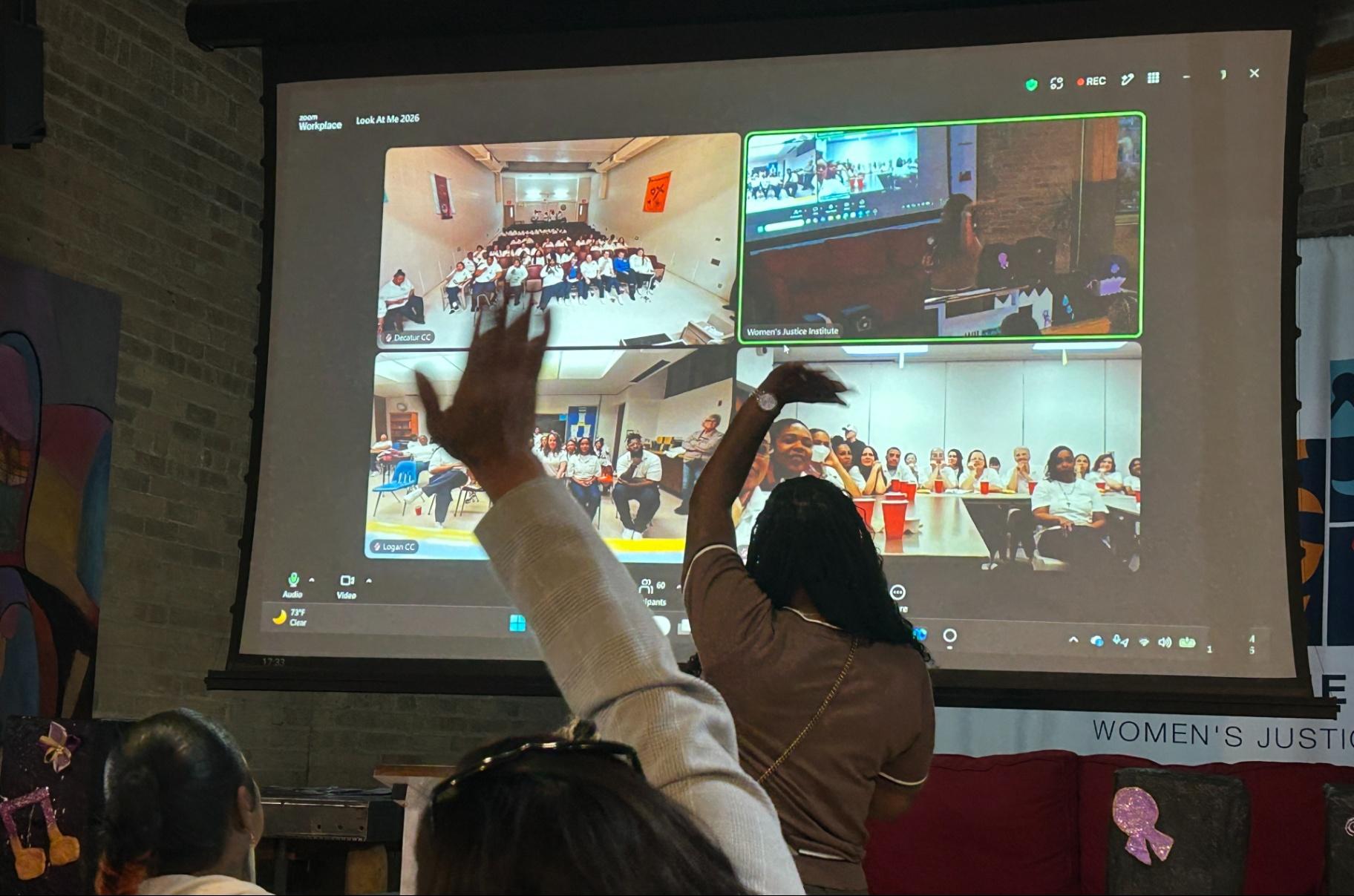 Incarcerated women from Logan and Decatur correctional centers and Cook County Jail on a video call to the Women’s Justice Institute’s “Look At Me” art show, celebrating pieces from survivors of domestic violence, Oct. 29, 2026. (Blair Paddock / WTTW News)
The filmed play opens with a pair of women slowly rising from behind a couch. One puts her hands on the other’s neck, shoving her over the couch. That woman attempts to flee, and a chase ensues.
As the couple’s quiet pursuit continues, the silence is cut by an actor sitting nearby: “In order to feel like a woman you must avoid being raped. You can’t be sorry for rape or worry about those within the vicinity of rape. You must learn to forget about being violated. Then learn to never again be rape’s captive.”
Erika Ray, who’s incarcerated at Logan and one of the lead writers of the production, said the film recounts the story of her own assault. Other writers included scenes of waiting rooms at abortion clinics or their own experiences in abusive relationships.
“See, when I learned about love, it was in response to a companion from childhood in high school who also didn’t know that love or violence could be the educator to the bodies of women,” an actor said in the performance. “I had labeled, then dismissed rape as the malevolence of a stranger.”
“I wanted to bring to light consent and relationships with people that aren’t strangers,” Ray told WTTW News. “If a woman is not saying anything, then that means there should be an automatic no, an automatic stop.”
Throughout rehearsals, Ray, other writers and actors had to take frequent breaks. The text often brought them to tears. They began creating speaking circles during each rehearsal, checking in with one another and speaking up if the play’s script triggered difficult emotional responses.
“I compartmentalize really well,” Ray said, “and so I kind of push things down when it comes to emotions. It’s a very unhealthy thing to do. But I couldn’t do it now.”
Ray said she had to push through the difficult emotions the play elicited. In reflecting on her own experience, she wanted to show audiences that people can have delayed responses to harm. Trauma may happen, but it doesn’t mean that “five years from now, that energy won’t come out if you don’t deal with it in a healthy way,” Ray said.
“That’s one of the things that I think is super important this year, which is paying attention to your body, to your emotions, to your mental wellness, and being able to say this is connected to that. How can I move through that?” Ray said.
“Without rape and complicated pressure, we might have been a little more human and ordinary, but rape taught us all about the many ways and reasons why we deserve to survive,” an actor reads as the last line in the performance. She faces the crowd with dozens of women behind her, as they raise their fists in unison.
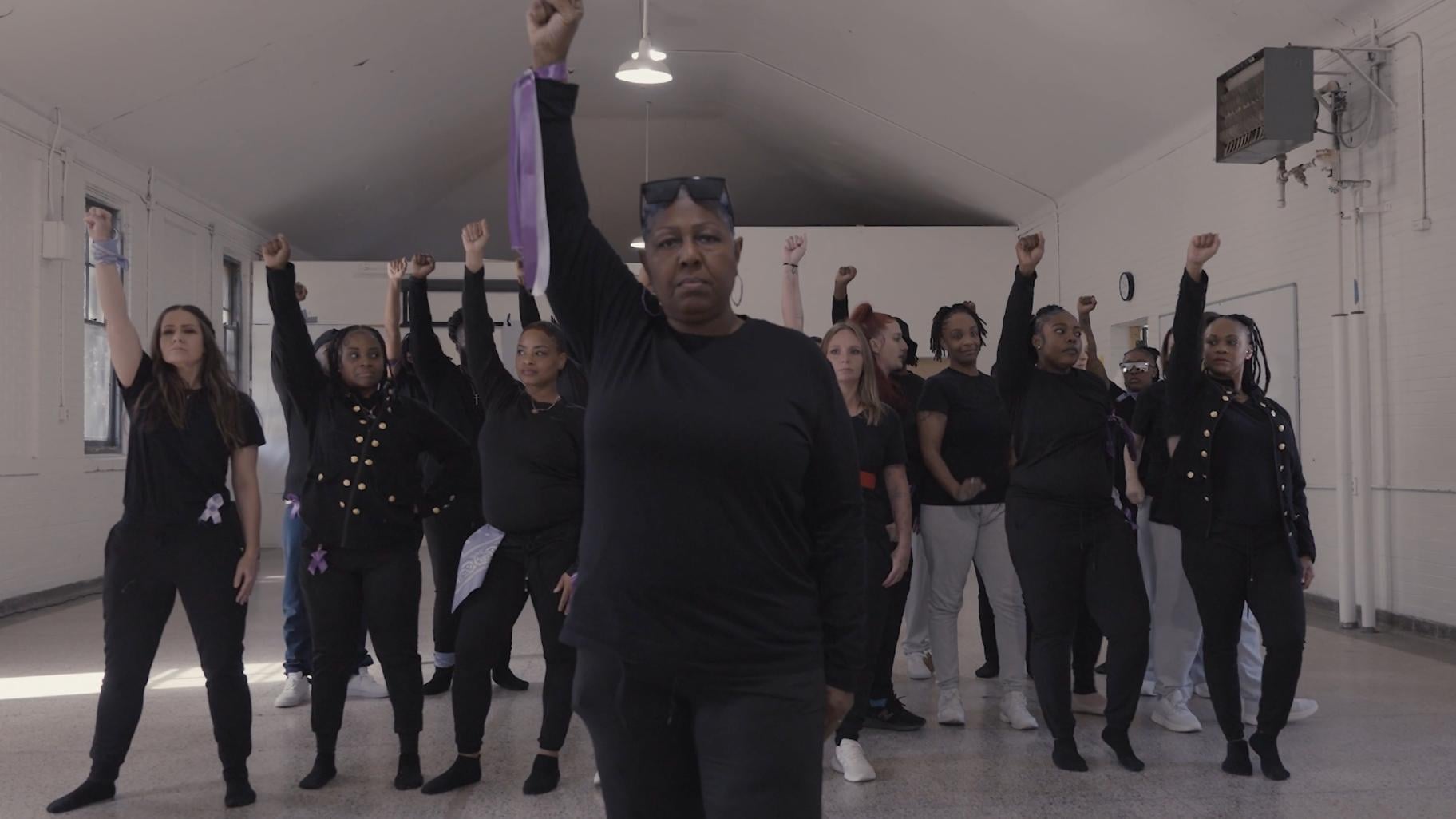 Incarcerated women at Logan Correctional Center perform their piece “Look At Me: Hear Her Hear Us,” which was played as part of the Women’s Justice Institute’s annual event for Domestic Violence Awareness month, Oct. 29, 2026.
From the back of the room, Roman watched the performance. One of the first dancers is her roommate, and several of her incarcerated classmates at Northwestern University’s Prison Education Program are featured. After hearing about the production for several months, she was touched to see the final product.
“It’s real, it’s the story told from the other side,” Roman said. “You hear about it, but these are the women that have been through it.”
Contact Blair Paddock: @blairpaddock.bsky.social | [email protected]
WTTW News arts coverage is supported by the JCS Arts, Health & Education Fund of the DuPage Foundation.