Politics
Historians Warn Trump’s Crackdown on Smithsonian Museums Could Have a Chilling Effect
Historians and researchers are sounding the alarm about President Donald Trump’s plans to scrutinize museums.
Trump recently expanded his criticism of the Smithsonian National Museum of African American History and Culture to include additional museums.
But specialists in the field said these actions could potentially “erode the public’s trust in shared institutions,” not just in Washington, D.C., but around the country.
On social media, Trump complained that at the Smithsonian museums, which are free to visit and get most of their money from the government, “everything discussed is how horrible our Country is, how bad Slavery was, and how unaccomplished the downtrodden have been — Nothing about Success, nothing about Brightness, nothing about the Future.”
He described the Smithsonian as “OUT OF CONTROL” and said “The Museums throughout Washington, but all over the Country are, essentially, the last remaining segment of “‘WOKE.’”
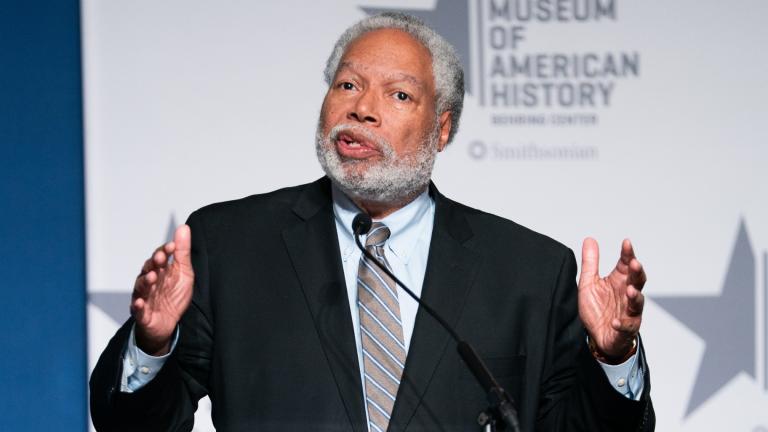
In a letter sent Aug. 12 to Smithsonian Institution Secretary Lonnie Bunch III, the White House laid out in detail the steps it expects the organization to take as part of the announced review. The examination will look at all public-facing content, such as social media, exhibition text and educational materials, to “assess tone, historical framing, and alignment with American ideals,” according to the letter.
“This initiative aims to ensure alignment with the President’s directive to celebrate American exceptionalism, remove divisive or partisan narratives, and restore confidence in our shared cultural institutions,” the letter said.
“If you pretend that you don’t make mistakes, I think you end up with a very shallow understanding of who you are, and your identity is inaccurate,” said Cesáreo Moreno, visual arts director and chief curator at the National Museum of Mexican Art. “I think that a lot of times the words patriotism and Americanism, people that use those words are oftentimes simplifying it. The simplification of those terms is a negation of the beauty that they actually are.”
The National Museum of Mexican Art was founded in 1982 by a group of Chicago Public Schools teachers who noted the lack of Mexican history and culture included in the curriculum.
Moreno said the museum is a first-voice institution intended to present culture for everybody.
The review of the Smithsonian will initially focus on eight museums: the National Museum of American History, the National Museum of Natural History, the National Museum of African American History and Culture, the National Museum of the American Indian, the National Air and Space Museum, the Smithsonian American Art Museum, the National Portrait Gallery and the Hirshhorn Museum and Sculpture Garden.
The Trump administration argues the current content and history displayed at museums perpetuates a negative narrative of the U.S. and keeps the country divided.
“This is a very simplistic take on historians and museum professionals, this idea that they are looking to create a divide, or that they are creating a bad history to point fingers at someone — that is not the point,” said Leslie Harris, professor of history and African American studies at Northwestern University. “The point is to make sure that we have a fair representation of all the people who have committed to creating the United States, to creating the present that we live in, and to think about things that maybe we do want to replicate in the future and things that we don’t want to replicate in the future. Those aren’t divisive issues. That’s historical information that actually can give people a greater sense of a common goal moving forward.”
Trump instructed his lawyers to go through museums and start the same process that has been done with colleges and universities.
“When we talk about leaders in this country, I certainly don’t think of government officials,” Moreno said. “Leaders, to me, are sometimes it’s the pastor, sometimes it’s the principal, sometimes it’s the teacher, sometimes it’s an artist who’s working at a festival. Leadership and leaders are throughout the community.”
The review ordered by the White House directs the museums to submit materials from exhibits and drafts for upcoming events within 30 days. Within 120 days, the letter said, museums will be expected to take corrective action, “replacing divisive or ideologically driven language with unifying, historically accurate, and constructive descriptions.”
“More importantly, it’s not clear to me that this administration can reach down into all of those communities and destroy this history,” Harris said. “It’s going to be tough. I have no illusions about that, but we remember. And more people than ever, Black, White, every group that makes up a part of this nation, knows the truth, and more and more knows the truth, and we are not here for these lies.”
The Associated Press contributed to this report.
Note: This article has been updated to correct a quote from Leslie Harris.