Politics
Migration Mass Casualty With At Least 1,000 Birds Injured or Killed This Weekend in Chicago and on Northwestern’s Campus
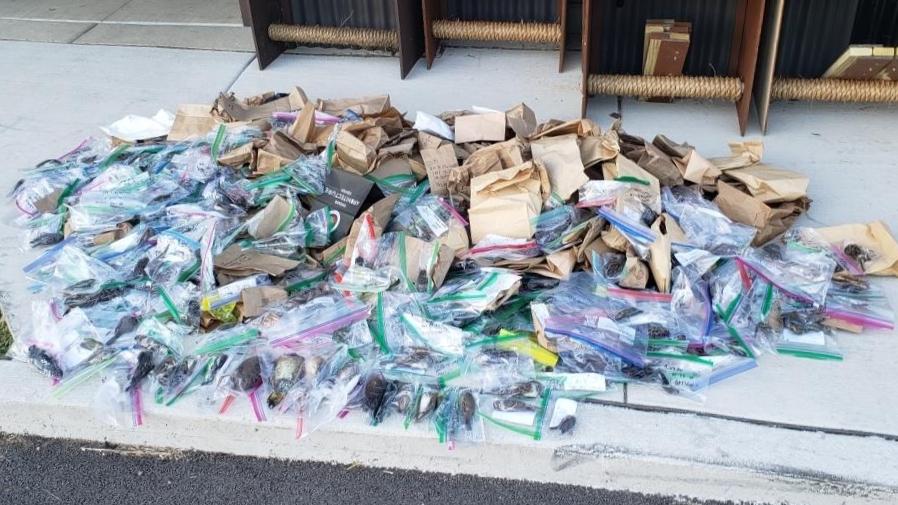 Dead and injured birds gathered by Chicago Bird Collision Monitors on October 17, 2026. The group filled multiple carloads with the birds. (Courtesy Chicago Bird Collision Monitors)
Changing temperatures and favorable winds saw more than 5 million birds pass over Cook County last Friday night into Saturday morning.
Most Chicago birders look forward to peak migration in the fall, enjoying the opportunity to view visiting species not normally found in the region. But for Annette Prince, director of Chicago Bird Collision Monitors, the season is full of apprehension, and that dread proved well founded.
From 6 a.m. to 6 p.m. Saturday, monitors patrolled routes in downtown Chicago — “We did not stop,” Prince said — and ultimately collected more than 1,000 injured or dead birds.
It was one of the deadliest single days in recent memory, according to Prince, and the worst since 3,000 birds were killed or injured in October 2023, including 1,000 at McCormick Place Lakeside alone.
Prince noted the weekend’s numbers largely only apply to the two square miles of Chicago that monitors routinely check.
And “we only find what’s on the ground,” Prince added. How many more birds are lying unseen on rooftops or awnings, or have been scavenged by predators or run over by cars before monitors can reach them?
“We don’t even know the full extent and that’s very sobering,” she said. “What’s heartbreaking to us is this happens year after year.”
Jennifer Bell, who’s been a monitor since 2023, routinely covers areas in River North. On Saturday, she hit the streets at 6:30 a.m., with a trainee in tow.
“We walked and drove around and every five seconds, there would be a bird,” said Bell. “People were flagging us down.”
Her shift was supposed to end at 9:30 a.m., but Bell and her trainee didn’t clock out until 12:30 or 1 p.m. At that point, they had accumulated more than 40 birds, half of them dead, half wounded.
“I looked over at her (the trainee), holding her first dead bird. She was even more determined,” Bell said.
After heading home to walk her dog and get something to eat, Bell headed back out, this time to the Fulton Market area, which isn’t an official monitoring site but is quickly becoming one of Chicago’s most dangerous areas for bird collisions.
She picked up another 16 birds and only called it quits when it became too dark to see. Her trainee had gone back out, too, retreading their morning route and finding close to 10 more birds.
“It’s very emotionally draining,” Bell said of the work, but she’s compelled to keep at it.
“I stop everything. I can’t help myself — it’s the right thing to do,” Bell said. “(Birds) have no voice. They have a right to migrate and travel without having a glass building kill them.”
Though Chicago Bird Collision Monitors focuses on downtown for its regular monitoring routes, bird collisions can and do happen throughout the region. The danger isn’t so much the height of buildings but the glass, said Prince.
One of the deadliest sites over the weekend was the Keller Global Hub on the Evanston campus of Northwestern University.
Volunteers reported collecting more than 40 injured birds at the building, with countless dead beyond their reach.
“Kellogg is glass top to bottom,” said Prince. “There’s so much glass, it’s hard to know where to start.”
The university has retrofitted other deadly structures with bird-safe film, namely the Francis Searle Building and Mudd Library, and those efforts have successfully eliminated the vast majority of bird collisions, Prince said.
But at Kellogg Global Hub, a retrofit only covered the glass on the first three floors on the east facade, and birds were colliding higher up over the weekend, volunteers reported.
In a statement emailed to WTTW News, the university said it has been “implementing active and passive strategies to reduce bird collisions on campus” for the past decade and in the last year has installed a more advanced bird-friendly film on sections of the Global Hub.
“Despite these efforts, there regrettably was an increase in bird strikes at some of our buildings over the weekend, which we believe was due to a windstorm. We continue to monitor the situation,” the university said.
‘Shame on Them’
The tragedy on top of the tragedy for Prince is that the birds injured and killed over the weekend weren’t sick or weak.
“The birds we pick up are beautiful,” she said. “Migration is an epic marathon and the ones that get to Chicago from northern Canada are fit and strong. We are taking out the best members. They were doing everything right.”
Given its well-known position along the Mississippi Flyway — one of the most popular migratory routes for birds — Chicago should be stepping up protections for birds, Prince said, but instead City Council has yet to pass legislation that would mandate bird-friendly building requirements for new developments.
“We know how to prevent collisions,” she said, but Chicago’s Department of Planning and Development has made those mitigations voluntary, in the hope that people will do the right thing.
“So, shame on them,” she said, as the most recently proposed ordinance continues to languish in committee without a hearing.
“Birds cannot adapt,” said Bell. “We have to adapt our buildings.”
Until then, she’ll continue making her rounds. Since September, Bell has rescued more than 350 birds — “And that’s just me,” she emphasized — and many of the injured have been taken to the DuPage Wildlife Conservation Center. (The center reported an intake of 250 birds on Saturday.)
“Even if we’re able to save 20% of them, it’s worth it,” she said.
Bell recently began volunteering at the conservation center, as well, and has participated in birds’ release back into the wild after rehab.
“Far away from glass buildings,” she said.
Contact Patty Wetli: [email protected]