Crime & Law
Do You Feel Safe on the CTA? New NORC/WTTW News Survey Shows How Chicago’s Racial, Geographic Divides Affect Experience
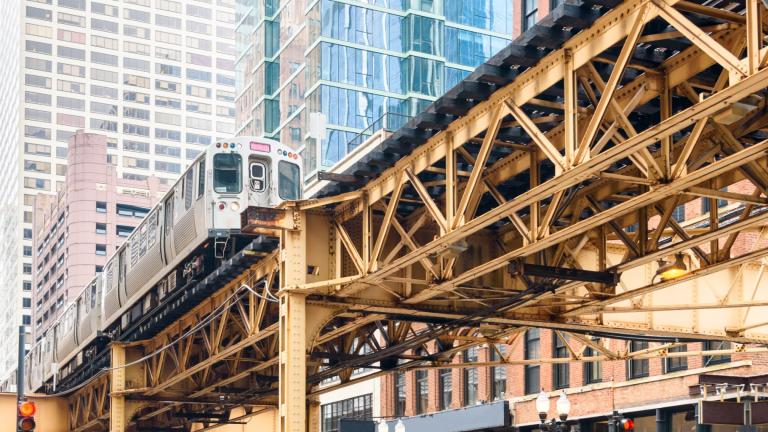
 File photo of a CTA train. (Richard Wellenberger / iStock)
Chicago’s long-standing racial, ethnic and geographic divides have a dramatic impact on how safe passengers feel while riding the CTA, a recent public opinion poll shows.
The survey, conducted by the nonpartisan research organization NORC at the University of Chicago and commissioned by WTTW News, asked more than 1,100 adults how safe they feel on CTA buses and trains. It comes as transit officials and law enforcement have touted major improvements in public safety and mapped out big changes in the years ahead — and after years of high-profile incidents, wavering public perception, and attacks from the Trump administration alleging failures to protect passengers and employees.
White respondents reported the highest levels of feeling safe (65% on buses and 51% on trains) compared to Black respondents (23% on buses and 16% on trains) and respondents identified by the survey as Hispanic (28% on buses and 27% on trains).
Geography also highlights the differing feelings of safety among transit riders. Respondents from the North Central region reported feeling safest (64% on buses and 48% on trains) while those from the South (24% on buses and 15% on trains) and Southwest (32% and 26% on trains) were the lowest.
The poll was conducted Sept. 13-23, using a sample drawn from NORC’s probability-based ChicagoSpeaks Panel, which is designed to be representative of the Chicago population. The margin of sampling error is plus or minus 4.1 percentage points.
“Every rider and employee deserves to feel safe on public transit, regardless of their ZIP code, ethnicity, or travel needs,” Northern Illinois Transit Authority Interim Executive Director Jamie Rhee told WTTW News in a statement. “NITA is taking critical steps to restore rider confidence and make meaningful investments in public safety. … Improving safety will take sustained effort, but these initiatives represent concrete steps toward making transit safer and more welcoming for everyone.”
For its part, a CTA spokesperson told WTTW News that in 2026 the agency “has implemented an expanded safety approach that’s designed to help every rider feel welcome on public transit. This includes the increased presence of both law enforcement and non-law enforcement social services outreach teams, and physical and environmental upgrades at stations.”
Among those efforts is a new security plan rolled out in the spring amid attacks from the Trump-appointed leader of the Federal Transit Administration, which threatened to withhold funding from CTA and alleged that the agency failed its responsibility to “creat(e) a safe, reliable transit system.”
And thanks to additional state funding secured as part of the law that created NITA, CTA said it’s been able to increase policing hours on buses and trains by 75% in partnership with the Chicago Police Department and Cook County Sheriff’s Office Police.
The Sheriff’s office said so far it’s netted 276 arrests, including 160 felony arrests and nearly 11,000 blocked attempts to evade paying a fare. Cook County Sheriff Tom Dart told WTTW News that fare jumping is a likely indicator of other antisocial behavior.
“If that’s your initial step in your journey, what do you think the chances are that person’s overly concerned about smoking on the train, drinking on the train, using loud music on the train?” Dart said earlier this year in an interview about the new transit missions. “It all sort of feeds into it.”
For its part, the Cook County State’s Attorney’s Office has also made transit crime a priority, seeking pretrial detention for those accused of violent acts on public transportation and standing up a new task force with specialized training.
“The task force is comprised of state’s attorneys from across the office, all who have specialties in different disciplines,” Yvette Loizon, chief assistant state’s attorney of policy and external affairs, said in an April appearance on “Chicago Tonight.” “The idea is that we will have those state’s attorneys specially trained so that they know all of the information that they need to to effectively and efficiently prosecute CTA crime.”
Increased police presence on transit has been the subject of much public outcry, in particular after several high-profile incidents on the system.
In November of last year, Bethany MaGee was doused in gasoline and set on fire on a Blue Line train in an apparently random attack. Last month, CTA janitor Julian Mobley was fatally stabbed at the Damen Green Line station.
Tom Kotarac, chair of the NITA Board of Directors, told WTTW News that Mobley’s killing is “an absolute wake-up call to all of us across the system to make this the top priority. We are not doing enough and we need to do more, and the General Assembly acknowledged that and the governor acknowledged that when they created the Northern Illinois Transit Authority.”
“Our investment in police has been under what was necessary,” said Roberto Requejo, a senior fellow at the Center for Community Investment and a former member of the CTA Board of Directors. “When you compare with other cities around the world, it was a very limited presence of police in the system — and also very little, almost no partnerships with community-based organizations, social service organizations, and other approaches that are not law enforcement.”
To that end, NITA’s proposed 2027 budget includes more than $54 million in safety improvements that include a Ride Safe incident reporting app; creating an Office of Transit Safety and Experience; launching the transit ambassador program; and better coordination between law enforcement and social service providers.
Requejo said CTA has come a long way in developing partnerships with outside groups, including social service organizations launching direct outreach missions to people sheltering on trains. And the agency just launched a Safe Ride Specialist pilot program aimed at de-escalating potentially dangerous situations and aiding riders with mental health or substance use issues.
But Requejo stressed that law enforcement and non-law enforcement interventions alike must take into account Chicago’s racial and geographic segregation.
“For any approach to safety, you have to lead with an equity lens, and what that means is that you cannot have a one-size-fits-all approach. It has to depend on the type of community, the type of riders that you are working to keep safe,” he said.
Overall, respondents to the survey reported feeling safer on buses (42%) than on trains (33%). Respondents aged 60 and older reported the lowest levels of feeling safe (35% on buses and 21% on trains). A majority of male and female respondents reported feeling safe on buses but unsafe on trains; a higher percentage of male respondents than female reported feeling safe on both forms of transit.
The results may also demonstrate that taking transit more regularly can affect feelings of safety.
NITA shared results of its own quarterly panel survey, which factors in whether someone is a regular rider, and said its second quarter results showed an average 9.5% increase on public safety metrics from the end of last year. (The NORC and WTTW News survey did not ask respondents about how often they take buses and trains.)
Audrey Wennink, a senior director at the Metropolitan Planning Council, said the increase in law enforcement transit missions has been driving results, with officers focusing on areas of particular concern as a guiding principle.
“I think there’s going to be a real focus on making data-driven decisions, creating the systems where problems that are reported are followed up on and progressive changes are measured,” Wennink said.
She also touted the transit ambassador program rolling out next year, which is mandated by the law that created NITA.
“We need various different types of professionals to deal with very different situations,” Wennink said. “We want people to be safe and we want crime not to happen on transit, but we also don’t want to over-police transit and have people feel like they’re in a kind of police state either. So it’s a delicate balance.”
Kyle Lucas, executive director of Better Streets Chicago, said CTA has made important strides in recent years to address public safety and rider experience. And while transit can play a role in addressing violent crime, homelessness, or substance use problems, Lucas cautioned that it needs to be a shared responsibility.
“It really cannot be all up to the transit agencies to solve all of society’s problems,” Lucas said. “All of these are situations that are happening across the city of Chicago, whether it’s in transit or not. It’s just a convergence of societal issues … our housing crisis, or (the) mental health crisis in the city, and so I think it’s really important that our city, county and state leaders step up.”
Transit advocates also said that improving the physical environment can make riders and employees safer — and that doesn’t just mean clean, bright and welcoming stations and stops. Requejo told WTTW News it’s important to think about the communities that surround stations, many of which have vacant land.
“You cannot quantify that, but you clearly feel safer in a place where there’s good lighting, and there is greenery, and there is a restaurant nearby or there’s a coffee shop, versus waiting at a station or a bus stop where there’s a vacant lot or derelict property,” said Requejo, former executive director of Elevated Chicago, which advocates for equitable transit-oriented development.
2027’s NITA budget has money set aside to encourage development around transit, which Requejo is encouraged by — but he cautioned that money alone doesn’t constitute a development strategy.
“I do encourage NITA to take this as seriously as they are taking safety or frequency or cleanliness, and establish an agenda for development that is a model for the region and for the country, and not an afterthought,” Requejo said.
While CTA has touted significant improvements in ridership and reductions in crime, the public perception of safety on transit can be a difficult needle to move. Lucas said clear, consistent messaging is key, both from transit leaders and advocates. And he added that as passengers start to see things like safe ride specialists and transit ambassadors, they’ll likely feel a shift in their daily commute.
“People’s perspective didn’t change overnight about whether or not transit was safe,” Lucas said. “It’s something that will take time.”
WTTW News coverage of policing and police reform is supported by The Joyce Foundation.
Contact Nick Blumberg: [email protected] | (773) 509-5434 | @ndblumberg