Politics
Army Has Detonated Explosives Stockpile in Iowa, Cloud of Lead Dust Expected to Reach Missouri
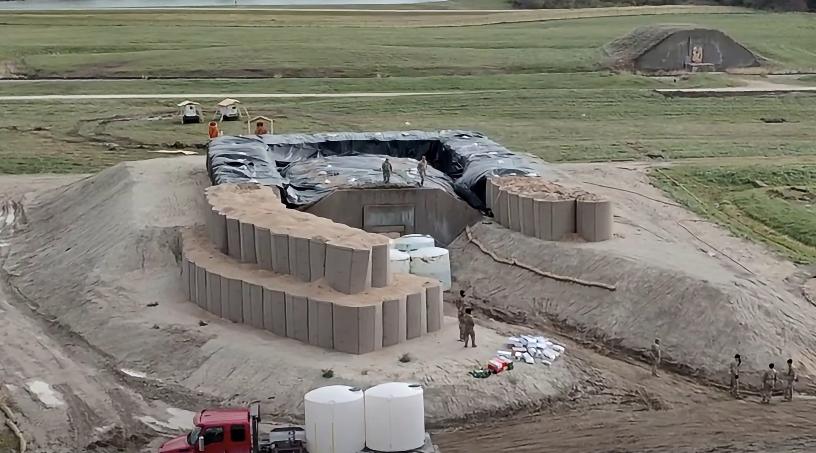 Preparations are underway for a controlled explosion of lead azide in Middletown, Iowa. (U.S. Army)
The U.S. Army has conducted a controlled detonation of nearly 10,000 pounds of explosive lead azide Wednesday at approximately 9 a.m. at a munitions plant in Middletown, Iowa.
Residents closest to the blast site were told to evacuate, and there is a potential for lead dust to spread southwest into neighboring Missouri. A shift in wind direction from the original detonation date of Nov. 20 has taken Illinois out of the path of dispersal.
The detonation did not produce an earth shaking event or release a large cloud of debris, with observers on the scene heard asking, “That was it?” during a livestream. Local reporters with KCCI-TV in Des Moines said the blast was “not as visible as maybe we expected.”
A New York Times reporter positioned a half-mile from the site described the sound as “dull booms,” like thunder. An initial cloud of smoke dissipated quickly.
Lee Zeldin, administrator of the Environmental Protection Agency, told CNN in a live interview the Army was “very happy” with the results.
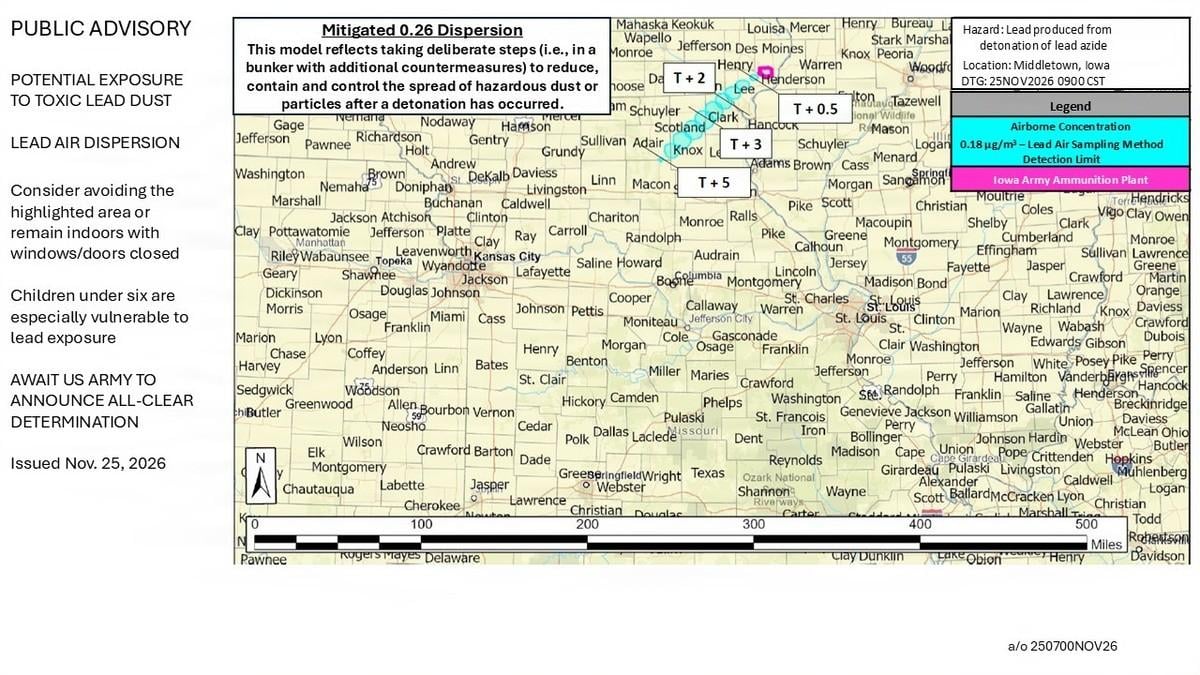 The U.S. Army has issued an updated map for the potential dispersal path of the detonated lead azide. The plume is expected to reach into Missouri. (U.S. Army)
Earlier this year, inspectors identified degradation of the lead azide, making it ultra-sensitive to minimal friction, vibration, heat or shock, creating a risk of an unexpected explosion.
After an “exhaustive evaluation” of alternatives, the decision was made to carry out a controlled detonation, Maj. Gen. Eric Shirley, who is leading the operation in Iowa, said at a news conference Tuesday.
That decision was communicated to residents of Middletown, but the information was not widely shared elsewhere. Many Iowans, Illinois and Missourians were caught completely off guard about the potential for lead exposure when the U.S. EPA issued a permit for the blast's initial detonation date.
Public outcry and legal filings pushed the detonation back, but Army officials have maintained throughout that the blast is the safest way to neutralize the lead azide.
“I’ve seen the reporting on the chemical neutralization agent. That proved to be an unsafe method,” Col. Aaron Teller, group commander, 71st Explosive Ordnance Disposal, told the media. "We’ve observed a significant accumulation of crystallized lead azide on the exterior of the barrels, including the barrel lids. It prevents those barrels from being able to be moved. It prevents us from removing the barrel lids. That’s why they can’t be treated, and that’s why you can’t open the lids to treat it with a chemical neutralization agent.”
In advance of the detonation, the EPA has sent hundreds of staff to the area and has collected more than 1,200 total samples of soil, dust, air and water to test for lead levels and will monitor conditions during and after the explosion. EPA’s air monitoring will be reporting data points every five minutes, the agency said.
In response to a query from WTTW News, the EPA said it is fielding numerous requests regarding whether this sampling protocol had been in place prior to the original detonation date. The agency did not provide an answer.
The U.S. Army has ramped up its mitigation efforts in recent days as well.
— The barrels are stored in concrete bunkers barricaded with sand-filled barriers two stories high;
— Aqueous foam blocks, two walls of four 16,000-gallon water tanks, and gel blocks adjacent to the bunkers are expected to absorb thermal energy and reduce airborne particulate emissions directly at the blast source.
— PFAS-free suppressing foam is being applied over containment screens and tarps to submerge the structures. High-volume industrial misting units and water sprayers will thoroughly saturate the soil and airspace before and during detonation, ensuring escaping particles are immediately weighed down by water and deposited back onto the soil inside the secure installation footprint.
Adam Telle, acting secretary of the U.S. Army, told the Associated Press that the Army is reviewing its weapons storage facilities to ensure something like this never happens again.
This is a developing story. Check back for updates.
Contact Patty Wetli: [email protected]