Science & Nature
Tests Show Chronic Gastro Disease in 2 Rescued Belugas That Died at Shedd Aquarium
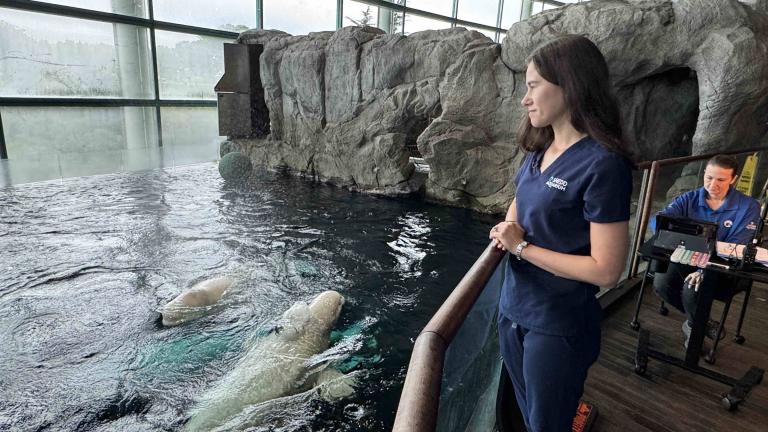
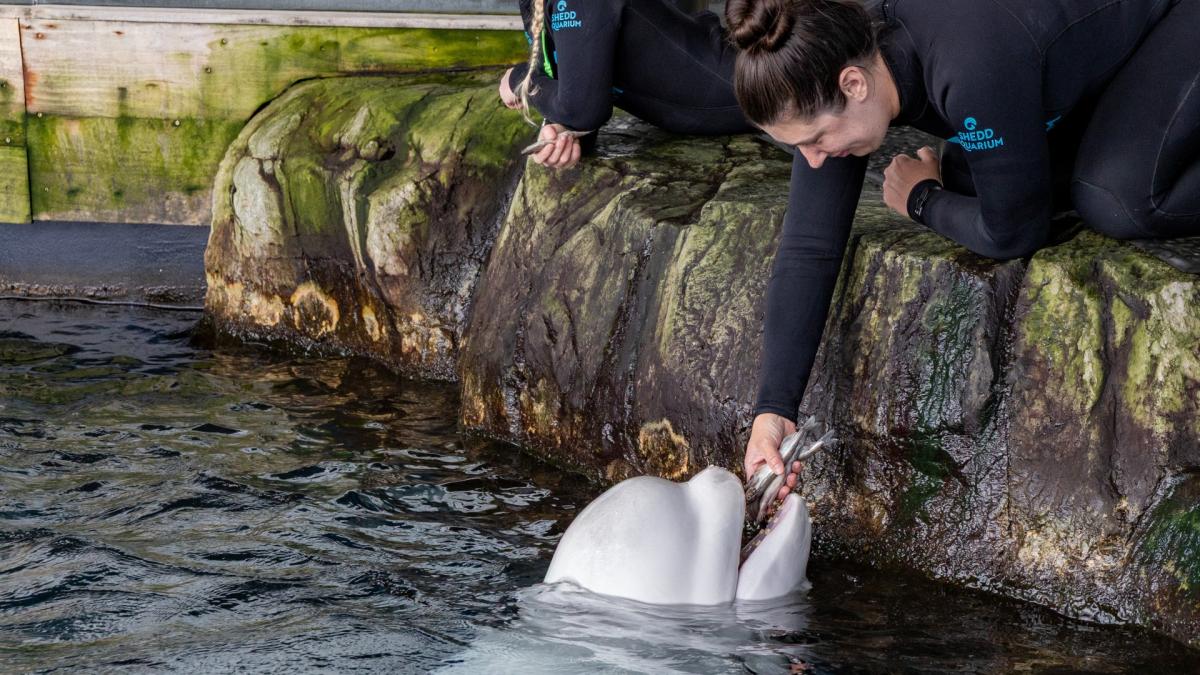 Peekachu, a rescued beluga seen with her caretakers at Shedd, suffered from gastrointestinal disease that likely contributed to her death, according to test results. (Courtesy of Shedd Aquarium)
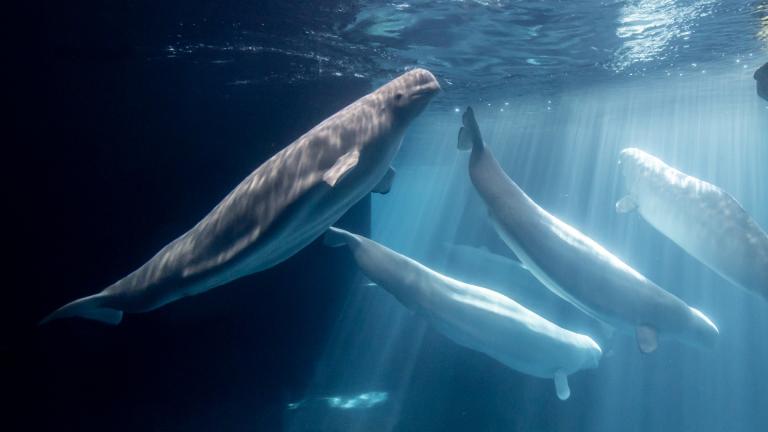
Preliminary medical findings released Friday are pointing to chronic gastrointestinal disease as a contributing factor in the deaths of two rescued beluga whales at Shedd Aquarium.
Peekachu and Rain both arrived at Shedd this summer from the defunct Marineland aquatic park in Canada. Peekachu died in late August and Rain died in early September.
An examination of tissue and organ samples from both whales revealed inflammation within their gastrointestinal systems, as well as indications that the conditions had been present before the belugas were transferred to Shedd, rendering them more vulnerable.
“Both whales came to Shedd from a facility where (Canadian) provincial authorities had repeatedly documented environmental concerns,” aquarium officials said in a statement. “Those records do not establish what caused the disease found in Peekachu and Rain, but they are part of the broader context in which Shedd understood that some whales could arrive with serious, long-standing health needs that could in no way be fully assessed before the rescue.”
The Canadian legal advocacy organization Animal Justice called Shedd’s findings “deeply troubling.”
The evidence of chronic health issues, along with the discovery of foreign material in the belugas’ stomachs, underscored Marineland’s neglect, Animal Justice said in a statement.
“These sick belugas deserved far better than a rushed transfer to clear the way for Marineland’s lucrative land deal to go through,” said Camille Labchuk, lawyer and executive director of Animal Justice. “Instead, there should have been efforts to improve the belugas’ health enough so they could withstand the stress of transport and a new, unfamiliar environment.”
Necropsy results were also shared for 34-year-old Beethoven, a longtime member of Shedd’s resident beluga pod, who died this month as well.
Officials said he had age-related health issues, including changes affecting his cardiovascular system. Shedd’s veterinarians, along with outside specialists, are still analyzing Beethoven’s test results to get a clearer understanding of what contributed to his death.
To date, there’s no evidence of a shared infectious disease or a common environmental factor connecting all three deaths, officials said.
Prior to the rescued belugas transfer to Shedd, they were screened for known communicable diseases and none were present. The aquarium is conducting additional testing for a broad range of fungal, bacterial and viral pathogens, according to officials.
Results are not yet available for Osiris, also a rescued beluga from Marineland, who died earlier this week at Shedd.
A necropsy, or a postmortem examination of an animal, begins with experts looking for visible signs of injury, disease or other abnormalities, Shedd officials explained. From there, tissue sample are sent to specialized labs where they’re examined under a microscope for inflammation, infection and disease.
Additional findings from the necropsy revealed foreign objects in Peekachu’s stomach contents, including feathers, sticks and large porous rocks. Flecks of what might be paint were found in Rain’s stomach.
While Shedd officials said these items likely weren’t directly related to the belugas’ deaths, they are part of a broader picture of possible gastrointestinal stressors.
“Even before receiving these initial results, our teams had begun providing treatments intended to ease suspected gastrointestinal irritation in the rescued belugas. Those decisions were based on close monitoring of the whales’ behavior and inconsistent appetites,” Shedd said.
None of the rescued whales are where Shedd staff wants them to be, medically speaking, officials said. In particular, Secord and Caspian are of greatest concern; these two are the remaining members of a group of four rescued female belugas that arrived at Shedd in August.
In total, 30 belugas and four dolphins were rescued from Marineland, which closed to the public in 2024. Marineland had threatened to euthanize the animals, prompting an unprecedented international effort to find new homes for the cetaceans at accredited aquariums. Shedd is one of five institutions that received the animals, having taken in 10 belugas.
Oceanogràfic Valencia in Spain has reported the deaths of one of its rescued belugas, Jelly Bean, and a rescued dolphin, Echo.
These losses, Shedd officials said, is a “painful reminder of the complex health histories of the animals involved in this rescue, and why securing a path to continued, expert care for them was so urgent.”
Shedd’s surviving rescued belugas include five adult females and two young males.
Related Stories