Politics
After Another Year Defined by Trump and Steeped in Crisis, Mayor Brandon Johnson Looks Ahead
Mayor Brandon Johnson’s third year in office was much like his first two years at City Hall.
Steeped in crisis.
When Johnson took office in May 2023, the city’s police stations were filling up with migrants who had nowhere else to go, after being sent to Chicago on buses paid for by Texas Gov. Greg Abbott.
Just as that humanitarian disaster eased, President Donald Trump won a second term and spent much of his first year back in the White House trying to strip Chicago of more than $3.5 billion in federal aid.
The city has, so far, beat back those efforts, but there is no end in sight to the costly legal fight.
But those challenges paled in comparison to what happened after the Trump administration sent hundreds of federal agents to Chicago as part of an effort to carry out mass deportations of undocumented people.
After “Operation Midway Blitz” triggered intense protests and pushback, Trump attempted to deploy the National Guard to Chicago, only to be blocked by federal judges and ultimately the U.S. Supreme Court.
“We have endured quite a bit,” Johnson told WTTW News as part of a series of interviews with media organizations to mark the third anniversary of his inauguration. “It has been a barrage of just crisis after crisis that I’ve had to manage, but again, you know, I’ve made it very clear that it’s a lot more effective and easier to lead when you are leading with your values and your convictions.”
Johnson said he was proud that several other Democratic leaders had followed the path that he blazed by issuing a series of executive orders that banned federal immigration agents from city-owned property, sought to protect the right of Chicagoans to protest their actions and urged local law enforcement officers to probe agents’ conduct.
“This was a difficult time, not just for Chicago, but for the entire country,” Johnson said. “I mean, never, you know, in a million years, you know, did we ever believe that a sitting president would attack American cities the way the Trump administration did? And it was important that we stood on our values, right? What I was clear about was that I had to use every single tool that was available to me to protect Chicago.”
Johnson Buoyed by Historic Drop in Crime
For the third year in a row, no issue helped bolster Johnson’s political standing more than the significant and sustained drop in violent crime, defying repeated warnings from critics and conservative members of the City Council that Johnson’s failure to take a “tough on crime” approach would result in calamity.
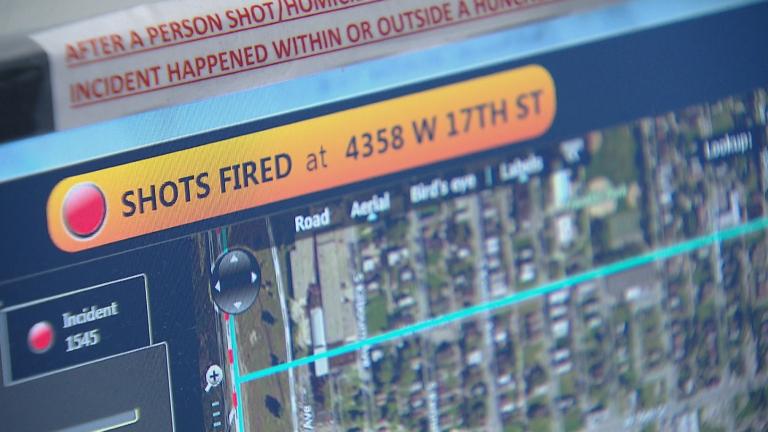
In 2025 the number of Chicago homicides hit a 60-year low, a fact that Johnson never misses a chance to mention to reporters.
Chicago’s homicide rate dropped by approximately 29% in 2025, as compared with 2024, according to Chicago Police Department data. The city’s overall violent crime rate decreased by nearly 23%, according to CPD data.
Despite that success, Johnson acknowledged that Chicagoans don’t necessarily believe he is responsible for the drop in crime.
“The people of Chicago, we’ve always been hard on mayors,” Johnson said. “In that regard, I’m not an exception.”
Although homicides are up 6% since the beginning of the year, the overall violent crime rate has dropped more than 8%, according to Chicago Police Department data.
Johnson said he would continue to focus the city’s resources on the root causes of crime and violence by expanding access to job programs and mental health care while funding violence prevention programs designed to break the cycle of crime and violence.
Johnson said he was pleased with the progress made by police leaders to reform the way CPD trains, supervises and disciplines officers in an effort to restore the public’s trust in the beleaguered department, which has faced decades of scandals, misconduct and brutality.
“If we lose trust between law enforcement and working people and the residents of this city, if that breaks down, that ruins our opportunity to build a safe community,” Johnson said.
By the end of 2025, CPD had fully complied with 25% of the court order that requires the department to stop routinely violating Black and Latino residents’ constitutional rights, according to the court-appointed monitoring team charged with keeping track of reform efforts.
“So 25% clearly that’s not nearly where we need to be,” Johnson said. “Am I grateful that we’ve made progress? Yes. I won’t be satisfied until we reach full compliance.”
According to Illinois Attorney General Kwame Raoul’s office, the significant increase in the number of times Chicago police officers have used force against members of the public since 2022 merits a “full-scale review” and threatens the progress CPD has made.
Focus Returns to Tipped Minimum Wage
With less than a year until all 50 members of the City Council are up for reelection, Johnson acknowledged that notching another significant legislative victory before Election Day on Feb. 23, 2027, is unlikely.
Johnson has not made any progress to fulfill his campaign promise to levy $800 million in new taxes on the wealthiest Chicagoans to fund new investments designed to boost working-class Chicagoans, particularly on the West and South sides.
State lawmakers are weighing Johnson’s request to give the City Council the authority to impose new taxes on digital advertisements, large corporations and deliveries that do not involve groceries or medicine, but will not give voters a chance in November to impose a 3% surtax on Illinois residents earning $1 million or more per year.
While Johnson frequently reminds Chicagoans that he pushed a measure through the City Council to ensure that Chicago workers get at least 10 days of paid time off, his other major legislative accomplishment hangs in the balance.
The City Council is set to vote Wednesday to keep the tipped minimum wage on the books until 2030 — and cancel planned raises for workers who earn tips this year and next year. In 2023, the City Council agreed to phase out the tipped minimum wage over five years while ensuring annual raises for workers who rely on gratuities.
Even though his office told reporters the mayor supported that proposal earlier this week, Johnson was less than enthusiastic about the measure, raising the possibility of another veto.
“I believe the five-year ramp was designed as a compromise to help small businesses, you know, develop a business model that could keep up with the cost of living,” Johnson said. “I’m going to look at this measure as closely as I possibly can. But my desire, of course, is to make sure that workers get their raises.”
In addition, Johnson has failed to fulfill a promise to put an end to what he called “literal sacrifice zones” — neighborhoods home to Black and Latino Chicagoans where industrial firms are allowed to pollute the air, water and soil with impunity, making residents sick and degrading their quality of life.
Johnson’s first spending plan reestablished the Department of the Environment. But his proposal to allow city officials to weigh the amount of existing air, water and soil pollution in a community — not just what a proposed project is expected to add if it is approved — when considering allowing additional polluting industries is mired in legislative limbo.
Another Budget Fight Looms
Chicago faces a likely budget deficit in 2027 of nearly $1.16 billion, according to the city’s most recent budget forecast, released in August. If the economy worsens significantly, that gap could swell to $1.7 billion, according to the forecast.
Johnson allowed Chicago’s $16.6 billion 2026 budget to take effect over his objections after a majority of the City Council rejected his push to tax large corporations based on how many employees they have.
In each of the last two years, negotiations over the city’s spending plan have spiraled out of the mayor’s control. The effort to craft a budget for 2027 is expected to be no different.
The city’s perilous financial condition is worsened by the fact that many alderpeople have little trust in Johnson’s financial acumen, a sentiment that has fueled the City Council’s continuing evolution into an independent legislative body no longer willing to serve as a rubber stamp.
Reelection Decision on Horizon
Johnson has declined to say whether he plans to run for reelection, and does not joke as often that he plans to serve as long — or longer — than former Mayor Richard M. Daley, who served as mayor for 22 years, winning six elections.
But Johnson told WTTW News he was not unprepared to wage a fight for a second term as an underdog, with many at City Hall writing off his chances.
“I’m always going to fight for the underdog, right?” Johnson said. “I know that position quite well. That’s the perspective and energy that I always bring into every single fight. You never count us out, right?”
Contact Heather Cherone: @HeatherCherone | (773) 569-1863 | [email protected]