Crime & Law
DOJ Appeals Sweeping Order Restricting Immigration Agents’ Use of Force Around Chicago
 Federal agents appear outside an immigration processing center in Broadview, Ill. (WTTW News)
The Trump administration has asked an appeals court to immediately stay a sweeping order issued by a federal judge in Chicago last week that restricts immigration agents’ use of force against journalists, protesters and others.
Attorneys with the U.S. Department of Justice on Monday filed their motion with the Seventh Circuit Court of Appeals, days after U.S. District Judge Sara Ellis imposed strict restrictions on Border Patrol and Immigration and Customs Enforcement agents, whom she found had violated Chicagoans’ First Amendment rights to free speech and free assembly to protest.
“This overbroad and unworkable injunction has no basis in law, threatens the safety of federal officers, and violates the separation of powers,” the DOJ attorneys wrote in their appeal.
Ellis last week said the force used by federal immigration agents in and around Chicago during the ongoing “Midway Blitz” enforcement operation “shocks the conscience” and “shows no sign of stopping.”
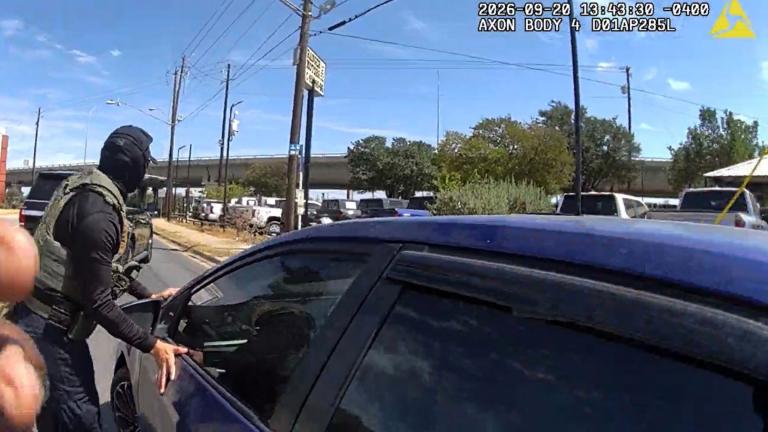
Witnesses in her courtroom testified during a daylong hearing about agents pointing firearms at them without provocation, being hit with pepper balls or tear gas and threatened simply for documenting immigration detentions.
Ellis last Thursday issued a preliminary injunction that orders federal agents to only use force when it is “objectively necessary to stop an immediate threat of the person causing serious bodily injury or death to another person,” and that two separate warnings must be given before force is used.
The judge also found that Border Patrol chief Greg Bovino and other federal agents lied about the threat posed by protesters and their conduct on the streets of Chicago. Federal agents “indiscriminately” fired tear gas at Chicagoans, tackled them, beat them, struck them with pepper balls and pointed weapons at them.
“I find the government’s evidence to be simply not credible,” Ellis said last week.
The hearing came as part of a lawsuit brought by the Chicago Headline Club, Chicago Newspaper Guild Local 34071, Block Club Chicago and other media organizations who’ve alleged immigration agents have engaged in a “pattern of extreme brutality” that’s part of a “concerted and ongoing effort to silence the press and civilians.”
The DOJ claimed Ellis’ order is “untethered from the constitutional and statutory provisions” cited in that lawsuit and called the injunction itself “unworkable in practice, transforming a single district court into a supervisory tribunal for adjudicating the lawfulness of federal officers’ day-to-day operations.”
In its appeal, the DOJ notes that already, plaintiff attorneys have alleged more than a half dozen violations of the court’s order since it was instituted Thursday.
After federal officials claimed shots were fired at immigration agents during a raid in Little Village on Saturday, masked agents, clad in camouflage uniforms and armed with military-style weapons, fired chemical agents at a crowd that flocked to the scene to protest agents’ attempts to detain at least three people, Ald. Byron Sigcho-Lopez (25th Ward) told WTTW News.
The Seventh Circuit has previously acted quickly after the DOJ asked for a stay of a separate order from Ellis, which required Bovino to meet with the judge in chambers for daily updates on his agents’ use of force.
The appeals court issued that stay a short time later.
Heather Cherone contributed to this report.