Politics
Brandon Johnson Takes Victory Lap After State Budget Green Lights Digital Ad Tax
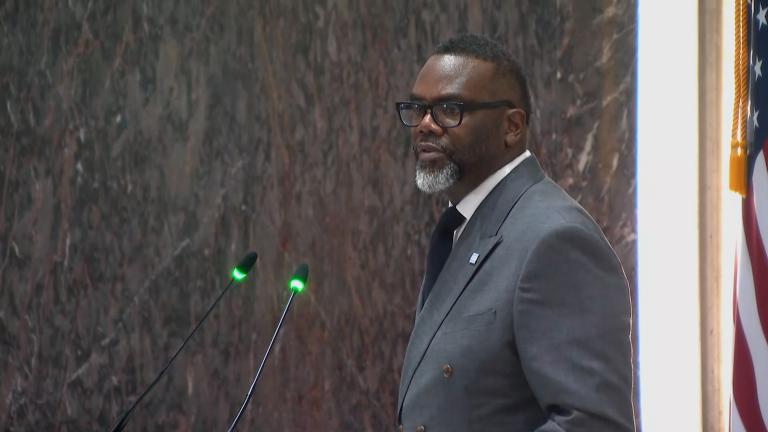
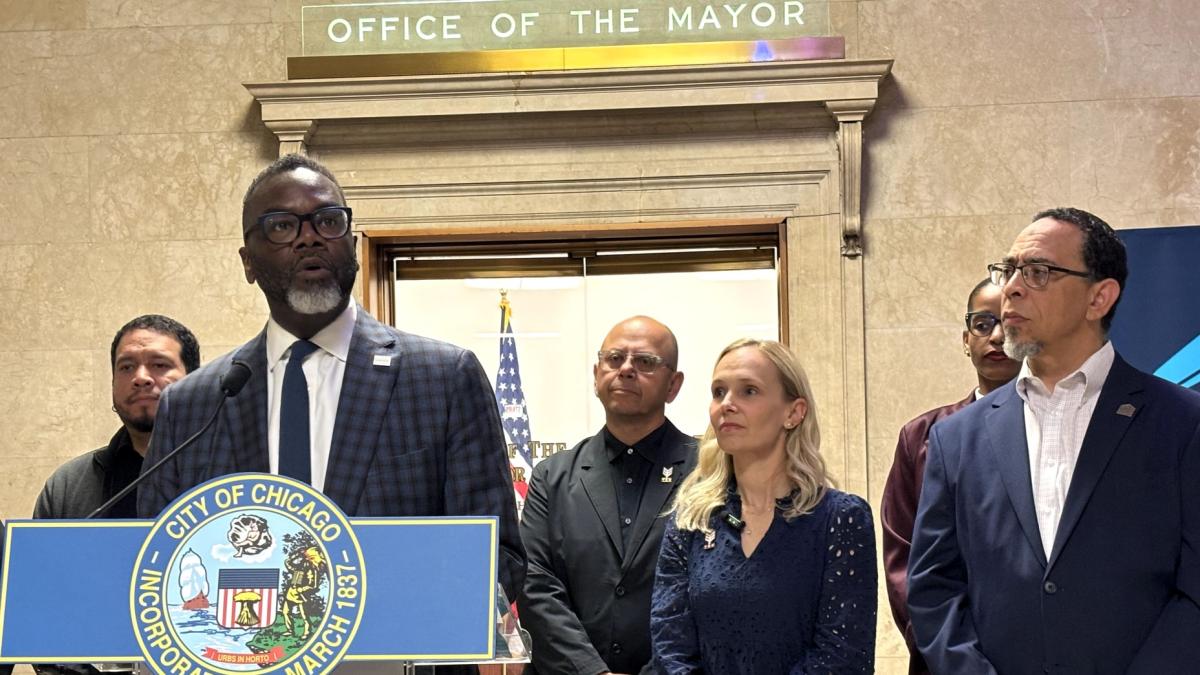 Mayor Brandon Johnson addresses the news media on Monday, June 1, 2026. (Heather Cherone / WTTW News)
Note: On Wednesday, city officials acknowledged the victory lap was premature, with the spending plan explicitly prohibiting the Chicago City Council from imposing a version of the digital ad tax that would send new revenue into the city’s cash-strapped coffers. Read the full story.
Mayor Brandon Johnson took a victory lap Monday, hours after the General Assembly passed a $56 billion budget that authorizes the Chicago City Council to impose a tax on digital advertisements seen by Chicagoans — finally heeding the mayor’s call for help filling the $1.16 billion projected gap in the city’s 2027 budget with new revenue.
“I have long fought for this kind of progressive revenue, and I am heartened to see it move forward at the state level,” Johnson said at a City Hall news conference. “As the economy continues to shift, and the digital medium becomes more dominant, it is essential that the big tech corporations earning untold billions through targeted advertising are part of the solution as we work to respond to the challenges our residents face on a daily basis.”
During his first three years in office Johnson found little success in Springfield, with state lawmakers and the governor frequently criticizing his office’s lobbying operation as ineffective and poorly orchestrated.
It is not clear how much revenue a new digital ad tax could raise, or whether it would withstand an all-but certain legal challenge. Johnson told WTTW News that he would work with the City Council and “community partners” to come up with “what is fair.”
Johnson also praised state lawmakers for heeding his call, along with the members of the Metropolitan Mayors Caucus, to reject Gov. JB Pritzker’s proposal to cut the share of income tax revenue the state sends to local governments.
That provision would have cost Chicago $12.7 million, Johnson said.
Johnson also praised state lawmakers for following the path blazed by Chicago in the city’s 2026 spending plan, which imposed a tax on social media companies of 50 cents per month for every active user after the first 100,000 users, under the city’s amusement tax authority, officials said.
That tax has been challenged in court. Johnson introduced a measure to amend that tax last month, in an effort to redefine what companies would be subject to the tax in an effort to align with a 1983 U.S. Supreme Court decision that prohibits governments from taxing news organizations based on their audience size as well as a federal law passed in 2015, according to NetChoice’s complaint.
“Although there is more work to be done, we’re thankful for members of the legislature, particularly members of the progressive caucuses, in both chambers, and the budget leaders,” Johnson said. “Although they didn’t prevail in every respect, this is meaningful progress in the fight that we have been leading to finally make the tax code work for working people. As leaders from across Illinois, we must continue to fight for full funding of vital public services, while challenging the ultra-wealthy and the largest corporations to pay their fair share of taxes.”
State lawmakers did not give the City Council the authority to impose a $1 fee on all deliveries that do not include groceries or medicine that the mayor had asked for. Nor did lawmakers grant Johnson’s request to give the City Council the authority to tax the payrolls of the largest corporations in the city.
Johnson was elected in 2023 on a campaign platform that vowed to levy $800 million in new taxes on the wealthiest Chicagoans to fund new investments designed to boost working-class Chicagoans, particularly on the West and South sides.
A measure that would have given the City Council the power to generate approximately $100 million annually by hiking taxes on the amount of real estate sales of more than $1 million was rejected by voters in March 2024. Despite promises to do so, Johnson has not renewed that effort.
Johnson’s proposal to levy a $33 per month per employee tax on companies with 500 or more employees in order to generate $82 million as part of the city’s 2026 spending plan was rejected by a majority of the City Council. Johnson allowed Chicago’s current budget to take effect over his objections, warning it was dangerously unbalanced.
Future of the Chicago Bears and Soldier Field
Johnson also celebrated the failure of the so-called megaprojects bill to make it out of the General Assembly, which was designed to encourage the Chicago Bears to build a domed stadium in Arlington Heights.
That bill would have likely reduced the football team’s annual tax bill by $39 million, for a total break of $1.5 billion by the end of the 40-year agreement, according to an analysis from Cook County Treasurer Maria Pappas’ office.
The Bears, an organization worth $8.9 billion, are also considering building a new stadium in Indiana.
Johnson said again that the best place for the Chicago Bears remains Soldier Field, and did not directly answer repeated questions from reporters about whether he was concerned the Bears would quickly announce a move to Indiana.
Johnson fully embraced the Bears’ 2024 vision for a reimagined Museum Campus and endorsed the team’s call for taxpayers to pick up approximately $2.4 billion of the total $4.75 billion cost of the project.
Pritzker said Monday that Johnson announced that plan in 2024 even though “he had no money to pay for” it.
“And that’s not something I was willing to do and, indeed, the amount of money that the state is willing to put up is money that we would put up for a business in the state of Illinois for infrastructure alone, not building a stadium,” Pritzker said.
The Bears organization has repeatedly said they are no longer considering staying in Chicago.
The Bears organization has also asked state officials to agree to spend $855 million in public funds to build the infrastructure a stadium would need, including roads, sewers and utilities. The mayors of Rolling Meadows, Schaumburg and Palatine pressed lawmakers to hold off on approving those funds until the Bears complete a long-promised study of the traffic a new stadium is sure to generate.
Johnson has repeatedly said that it does not make sense for the state to spend so much on making it possible for the Bears to build new stadium in Arlington Heights that could threaten Soldier Field’s future.
If the Bears leave Solider Field, a Chicago Park District plan pegs the cost to transform it from a National Football League stadium into a multi-use venue, capable of hosting a variety of concerts, festivals and events, at $630 million.
The Bears pay $6.48 million annually to use Soldier Field, under the terms of a lease set to expire in 2033 that can be terminated early as long as the team pays a penalty.
A bill that passed the Illinois Senate in the early morning hours of Monday would have allowed five Cook County municipalities that have populations of more than 70,000 to set up a local stadium authority. That measure stalled in the Illinois House.
Johnson’s proposal would fund a new stadium on the lakefront through the Illinois Sports Facility Authority using hotel taxes, even as it still has $567 million in outstanding debt at Soldier Field from renovations that were completed in 2003.
“While questions remained about the legislation’s design, legislators ultimately reached the same conclusion the city reached in 2024: the strongest proposal for a new stadium centers public ownership, the use of a sports authority and a commitment to public infrastructure,” Johnson said
Johnson has also dismissed concerns that a new lakefront stadium would violate the city’s Lakefront Protection Ordinance, which does not allow “further private development be permitted east of Lake Shore Drive.”
The Bears have said they plan to decide where to build a new stadium by late spring or early summer.
Pritzker acknowledged the Bears could announce they are leaving Illinois at any time.
“As much of an emotional connection as many of us have to the Bears, and to keeping them in the city of Chicago and the state of Illinois, No. 1 principle is we’re not going to foist this on the taxpayers of the state of Illinois,” Pritzker said.
Johnson said he would not attempt to predict what the Bears will do — and declined to point fingers — or accept any of the blame — at who Chicagoans should hold responsible if the team moves across the border.
Contact Heather Cherone: @HeatherCherone | (773) 569-1863 | [email protected]