Politics
‘Megaprojects’ Bill Would Mean a $39M Annual Property Tax Break for Bears: Cook County Treasurer’s Office
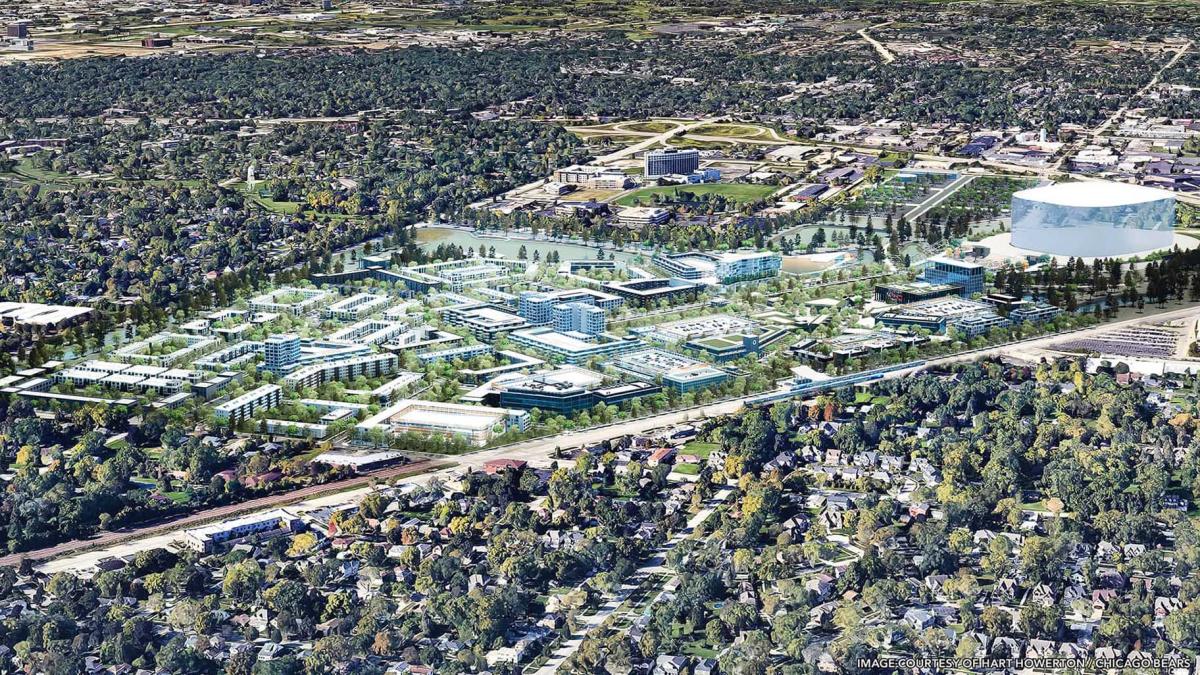 An aerial view from the southwest of a proposed Chicago Bears stadium and entertainment district in Arlington Heights. (Credit: Hart Howerton / Chicago Bears)
A proposal under consideration by state lawmakers that would grant the Chicago Bears a property tax break on a stadium in Arlington Heights to keep the team from moving to Indiana would likely reduce the football team’s annual tax bill by $39 million, according to a new analysis from Cook County Treasurer Maria Pappas’ office.
That would translate into tax breaks of more than $1.5 billion during the 40-year term of the agreement, under the terms of the so-called “megaproject” bill, according to the analysis.
With five days left in the Illinois’ General Assembly’s spring session, the fate of the legislation appears uncertain, even as Gov. JB Pritzker told reporters before the Memorial Day holiday weekend that he was optimistic lawmakers would approve a plan to keep the Bears in Illinois.
The new analysis from Pappas’ research team is the first to attempt to put a price tag on the proposal that advanced through the Illinois House a month ago, only to face intense opposition from Mayor Brandon Johnson, who has continued to push for the Bears to stay in Chicago and blasted lawmakers’ focus on the megaprojects bill, calling it a “mismatch” with what residents want them to concentrate on.
Pappas is unopposed in her bid for reelection as Cook County treasurer in November and is weighing a bid for Chicago mayor in 2027.
Both the Bears organization and Pritzker said last week the team is certain to leave Soldier Field and Chicago — with the only question being whether the team will build a brand-new, 70,000-seat domed stadium in Indiana or the northwest suburbs.
The analysis released by Pappas’ office relies on an estimate of the market value of an Arlington Heights stadium crafted by Geoffrey Propheter, an associate professor at the University of Colorado Denver, an expert on publicly financed stadiums, but acknowledges that is hard to pinpoint “because there’s nothing else like it in Illinois.”
According to Propheter, a “conservative” estimate of the market value of a new Bears stadium would be $675 million, according to the analysis.
That would translate to an annual property tax bill of approximately $53.2 million, based on Arlington Heights’ current tax rate, according to the analysis.
The heart of the bill being negotiated by state lawmakers would allow the Bears or other developers planning to invest at least $100 million in the effort to negotiate a payment in lieu of taxes, better known as PILOT, with local taxing bodies.
That would freeze the developer’s property tax bills for up to 25 years.
Developers that invest $500 million could negotiate an agreement to freeze their property tax bills for 30 years.
Firms that plan to invest at least $1 billion — like the Bears — in a new development could lock in property taxes for 40 years, according to the proposal.
If the megaprojects bill becomes law, the Bears would pay less than $4 million per year in property taxes on the former Arlington Heights racetrack, according to the treasurer’s analysis.
After a year-long dispute with two Arlington Heights school districts, the team agreed to pay $3.6 million per year in property taxes on the defunct racetrack site through 2027.
“Assuming the Bears negotiate to pay a $10 million PILOT on top of their $4 million frozen bill, the team would get an annual tax break of more than $39 million — or more than $1.5 billion over 40 years,” according to the analysis.
In 2023, the Bears, an organization worth $8.9 billion, paid $197.2 million for the 326-acre property.
The Bears have pledged to spend $2 billion on the stadium, and told state officials the surrounding entertainment district and new residential development will have an annual “economic impact” of $1.3 billion on Illinois’ economy. The stadium would create more than 9,000 permanent jobs and generate $60 million in local and state taxes, according to the Bears proposal.
The bill that passed the Illinois House calls for half of the negotiated payment paid by the developers of megaprojects to be earmarked for property tax relief.
Sixty percent of those funds would be used for property tax rebates for nearby homeowners, with the remaining 40% deposited into the state’s property tax relief fund.
That would mean most Illinois residents would see less than $1.50 annually in relief, according to Pritzker’s office.
If the proposal becomes law, and the Bears build their new home in Arlington Heights, every Cook County homeowner would get approximately $5 in relief each year, according to the analysis from the treasurer’s office.
The proposed bill would also exempt construction materials used to build the stadium from state and local sales taxes, according to the analysis.
“Huge real estate projects can create jobs, boost sales tax revenue and provide other benefits to their surrounding communities,” according to the analysis. “But property tax breaks for megaprojects would for decades severely limit one key goal of economic development: expansion of the property tax base that provides relief to other taxpayers who get no tax certainty.”
The Bears organization has also asked state officials to agree to spend $855 million in public funds to build the infrastructure a stadium would need, including roads, sewers and utilities. The mayors of Rolling Meadows, Schaumburg and Palatine pressed lawmakers to hold off on approving those funds until the Bears complete a long-promised study of the traffic a new stadium is sure to generate.
Johnson has told state lawmakers that it does not make sense for the state to spend so much on making it possible for the Bears to build new stadium in Arlington Heights that could threaten Soldier Field’s future.
If the Bears leave Solider Field, a Chicago Park District plan pegs the cost to transform it from a National Football League stadium into a multi-use venue, capable of hosting a variety of concerts, festivals and events, at $630 million.
In addition, there is $567 million in outstanding debt at Soldier Field from renovations that were completed in 2003, according to data provided to the treasurer’s office by the Illinois Sports Facility Authority.
The Bears pay $6.48 million annually to use Soldier Field, under the terms of a lease set to expire in 2033 that can be terminated early as long as the team pays a $90 million penalty.
Contact Heather Cherone: @HeatherCherone | (773) 569-1863 | [email protected]