Crime & Law
Judge Dismisses Lawsuit Challenging National Guard Deployment in Illinois Months After Troops Removed
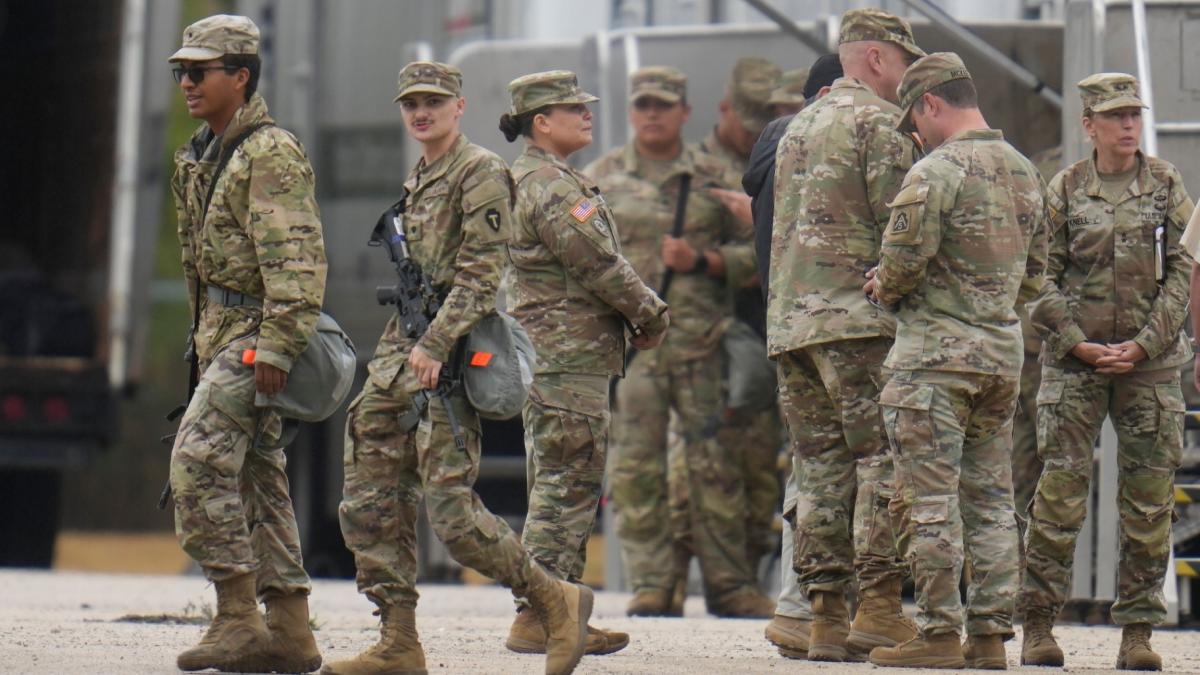 Military personnel in uniform, with the Texas National Guard patch on, are seen at the U.S. Army Reserve Center, Tuesday, Oct. 7, 2025, in Elwood, Ill., a suburb of Chicago. (AP Photo/Erin Hooley)
A federal judge has agreed to toss out a lawsuit brought by Illinois and Chicago officials last year that sought to bar the Trump administration’s plans to deploy National Guard troops into the state, finding the case is now moot after the U.S. Supreme Court refused to allow such a deployment.
U.S. District Judge April Perry on Monday granted a motion brought by the Trump administration to dismiss the case, even as President Donald Trump has threatened to “come back … perhaps in a much different and stronger form” after withdrawing National Guard troops from Illinois and other states.
“It is undisputed that all federalized Illinois National Guard troops have been de-mobilized, all National Guard troops from other states have been withdrawn from Illinois, and no National Guard troops remain deployed in the state for the Federal Protection Mission,” the Trump administration argued in its motion to dismiss. “Because of those developments, the case is moot.”
Perry agreed, finding the lawsuit is now moot and dismissing it with prejudice.
Hundreds of troops from the Illinois, Texas and California National Guards were mobilized and sent to Illinois last fall after Trump repeatedly vowed to use troops to fight crime in Chicago, which he has denigrated as a “hell hole” and a “war zone.”
State and city officials filed suit in October, and Perry blocked the troop deployment — a ruling that remained intact after an appellate court refused to step in and the Supreme Court declined the Trump administration’s emergency request to overturn it.
“At this preliminary stage, the Government has failed to identify a source of authority that would allow the military to execute the laws in Illinois,” the Supreme Court wrote in its December 2025 ruling. “The President has not invoked a statute that provides an exception to the Posse Comitatus Act.”
Those troops have since been demobilized, and because no members of any state’s National Guard remain deployed in Illinois, the Trump administration argued that the lawsuit has been rendered moot.
But just days after the troops were removed, Trump posted on social media that “We will come back, perhaps in a much different and stronger form, when crime begins to soar again - Only a question of time!”
Because of that threat, attorneys for Illinois and Chicago denied that their lawsuit is moot.
“Even now, Defendants could rescind their orders and offer declarations to this Court renouncing their threats to ‘come back’ uninvited,” they wrote in a March court filing. “Because they haven’t and won’t, the case continues.”
Gov. JB Pritzker on Monday again called the planned troop deployment a “reckless and illegal abuse of power,” adding that he was “grateful to the court for siding with our communities and slowing the erosion of our democratic norms.”
Pritzker also said he expects the Trump Administration will “continue to test the limits of its power no matter the cost to our communities.”
“Communities should not have to live in fear of masked federal troops occupying their neighborhoods, and our brave National Guard members should not be used as political props,” he said in a statement. “These are foundational principles of any healthy democracy, and the result in this case validates that belief.”
The Trump administration previously claimed the deployment is necessary as federal agents in Illinois have been met “with prolonged, coordinated, violent resistance that threatens their lives and safety,” telling the Supreme Court this has become part of a “disturbing and recurring pattern.”
But federal officials had only a “flimsy pretext” to deploy military officials to Chicago, according to the state and city’s lawsuit, which argued that deploying National Guard troops to Chicago “will cause only more unrest, including harming social fabric and community relations and increasing the mistrust of police.”
“The American people, regardless of the city or state in which they reside, should not live under threat of military occupation simply because they live in a jurisdiction that has fallen out of a president’s political favor,” Illinois Attorney General Kwame Raoul said in a statement Monday. “I am pleased that today, the court has declared the Trump administration’s unlawful orders defunct and said it is absolutely clear that the administration cannot use the Illinois orders to federalize or deploy National Guard troops in Illinois.”
Chicago’s Department of Law also issued a statement Monday saying it welcomes the court’s ruling today “that the Trump Administration’s deployment orders are no longer operational and cannot be used to federalize the National Guard.”
“There was never a lawful basis to deploy the National Guard into Chicago for federal immigration enforcement,” the department said. “The orders represented a federal overreach that threatened the local rule of law.”
Heather Cherone contributed to this report.