Science & Nature
Hundreds of Young Invasive Carp Found Closer to Lake Michigan Than Ever Before, Just as Work Has Stopped on Billion-Dollar Barrier
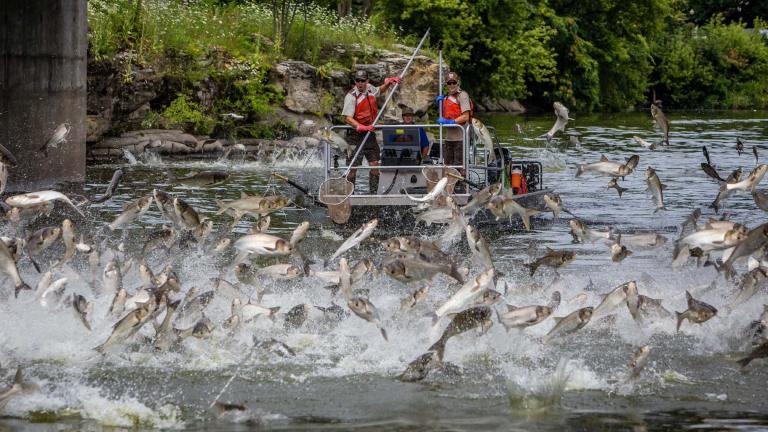
 Invasive carp are voracious feeders that grow and multiply rapidly. (Invasive Carp Regional Coordinating Committee)
Juvenile invasive silver carp were discovered last week further up the Illinois River than ever before, the Illinois Department of Natural Resources (IDNR) announced.
Sampling crews removed hundreds of small silver carp — 4 to 6 inches long — from the Marseilles Pool on a stretch of the river that’s just 80 miles from Lake Michigan, according to IDNR.
While adult invasive carp have previously been found that far north, the presence of young carp indicates a spawning event occurred, possibly even further upriver. Silver carp eggs float downriver for miles through their early life stages before reaching juvenile size.
Fish biologists consider invasive carp populations to be established in an area when multiple life stages of young and adult invasive carp are present.
In the years since intensive, multi-agency monitoring of the Illinois River began in 2010, established invasive carp populations have been detected in the waterway’s lower 240 miles from the Mississippi River up to Peoria. But north of Peoria, the stages of juvenile development had been absent.
Crews are now conducting electrofishing operations as well as additional monitoring surveys of the upper river and tributaries to assess the extent of the spawning event. They’ll also study the microchemistry of the captured silver carp to learn more about their origin, IDNR said.
So far, the forward progress of adult silver and bighead carp has been held to an area of the river approximately 50 miles from Lake Michigan. Partner agencies will ramp up monitoring in that section — called the Dresden Island Pool — as a precaution.
On the Illinois River, any indication of a change in the status or distribution of invasive carp triggers specific protocols among partner agencies, which include IDNR, the Illinois Natural History Survey, U.S. Fish and Wildlife Service, the U.S. Army Corps of Engineers and the U.S. Geological Survey.
The discovery of a sizable number of juvenile silver carp comes at a critical juncture in the effort to stop the invasive fish from entering Lake Michigan, where they could devastate the local fishery and recreation economies, as well as the aquatic ecosystem.
In late July, the Army Corps of Engineers issued a stop work order on construction of the Brandon Road Interbasin Project — a series of barriers and deterrents designed to halt the invasive carp from infesting the Great Lakes. The order noted the project was under administrative review.
“Every day we don’t have shovels in the ground at the Brandon Road project puts us a day closer to seeing invasive carp cause irreversible harm to the Great Lakes ecosystem and economy that our region depends on,” Joel Brammeier, president and CEO of the Alliance for the Great Lakes, said in a statement. “With carp spawning in the upper river, we don’t have any more time for administrative delay."
Invasive carp refers to bighead, silver, black and grass species. They were imported into the U.S. in the 1970s to help control algal growth in wastewater ponds, among other uses, and eventually escaped from captivity. These voracious feeders grown and multiply rapidly, outcompete native fish for resources, and have a tendency to jump several feet out of the water, endangering boaters.
Contact Patty Wetli: [email protected]