Crime & Law
Murder Solicitation or Neighborhood Gossip? Trial Underway in Case of Chicago Man Accused in Greg Bovino Murder-for-Hire Plot
 Border Patrol chief Gregory Bovino stands with federal immigration enforcement agents during a skirmish with protesters in Little Village neighborhood, Chicago Thursday, Oct. 23, 2025. (Anthony Vazquez / Chicago Sun-Times via AP)
When a Chicago man shared a Snapchat message with his brother and a friend, was he soliciting the murder of a high-ranking Border Patrol official or simply resharing neighborhood gossip he’d seen on social media?
That’s at the heart of the case against Juan Espinoza Martinez, a Little Village man accused of launching a murder-for-hire plot that allegedly targeted Border Patrol chief Greg Bovino last fall.
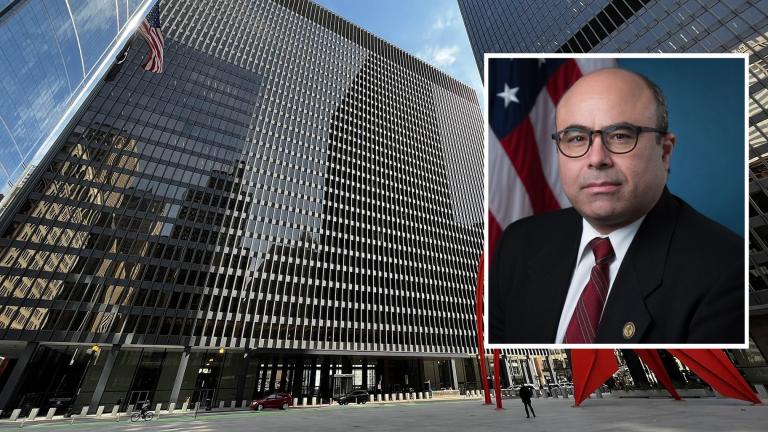
“In that message the defendant did not mince his words and neither will I,” Assistant U.S. Attorney Minje Shin said in his opening statements Wednesday morning at the Dirksen Federal Building in downtown Chicago. “This case is about the solicitation of someone’s murder.”
Federal prosecutors have alleged Espinoza Martinez, 37, posted a Snapchat message offering $10,000 for someone to kill Bovino, the controversial Customs and Border Patrol chief who has overseen several aggressive raids in and around Chicago in recent months.
Espinoza Martinez was arrested on the murder-for-hire charge in October, weeks after the Trump administration launched its “Operation Midway Blitz” enforcement plan targeting northern Illinois.
According to prosecutors, Espinoza Martinez posted a Snapchat message to two people that included a photo of Bovino along with the message “2k on information when you get him” and “10k if u take him down.”
That message was allegedly sent to Espinoza Martinez’s brother and another man, Adrian Jimenez, an acquaintance who had been secretly cooperating with law enforcement.
Jimenez provided a screenshot of that message to authorities and testified against Espinoza Martinez as the government’s first witness Wednesday.
Shin on Wednesday said Espinoza Martinez was “fixated” on Bovino, whom Shin described as “the face of the threat” to Espinoza Martinez’s Little Village community.
Shin told jurors the message was not a “joke” or Espinoza Martinez simply “blowing off steam behind a keyboard.” Instead, Shin argued, it included a "specific incentive for a specific action against a specific individual.”
But Espinoza Martinez’s defense attorney Jonathan Bedi instead argued the message was nothing more than Espinoza Martinez simply sharing rumors he’d heard on social media.
“He never intended to threaten anybody,” Bedi told jurors. “Repeating neighborhood gossip is not trying to commit a murder.”
According to Bedi, prosecutors have no evidence showing Espinoza Martinez intended for his message to be taken as a murder solicitation. Bedi said his client never followed up on those messages to seek further action, nor did he have anything close to $10,000 to offer anyone.
“This case is riddled with doubt,” Bedi said. “That doubt is reasonable because the government cannot point to anything that shows Juan’s intent.”
Prosecution, Defense Present Their Cases
Jimenez, a 44-year-old Chicago resident who owns a small construction company, testified Wednesday that he’s known Espinoza Martinez less than a year after he reached out to Jimenez over Snapchat about possible work.
The pair spoke “often,” according to Jimenez, who added he believed that Espinoza Martinez trusted him.
Jimenez told jurors he reached out to Homeland Security in early October, sharing with them photos he took of their Snapchat conversation regarding Bovino that Espinoza Martinez had sent almost immediately after receiving them.
Jimenez testified that he understood that message to mean that Espinoza Martinez was offering $2,000 “when they grab (Bovino)” and $10,000 “if you kill him.” He added that in another portion of the message where Espinoza Martinez wrote “LK on him,” he believed he was referring to the Latin Kings street gang.
Federal prosecutors initially identified Espinoza Martinez in a public statement and the initial criminal complaint as a “ranking member” of the Latin Kings street gang. But they’ve since changed course and U.S. District Judge Joan Lefkow has ruled that any testimony regarding Espinoza Martinez’s alleged connections to Latin Kings, gangs in Chicago or any ties to or affinity for gangs he may have will be excluded from trial.
Jimenez also testified that Espinoza Martinez never followed up to say he was joking or that his message was “just an FYI.”
Jimenez told the jury he’s been providing information to law enforcement since the mid-1990s, beginning with the Franklin Park Police Department. He’s also worked with the Drug Enforcement Administration and Homeland Security over the past 15 years, admitting that he has in the past been paid for passing them along information.
But he testified he was not paid or promised anything in connection with this case. He added that he was convicted of a felony some time around 2001 and served a prison term until 2006.
Jurors on Wednesday also viewed portions of Espinoza Martinez’s interview with Homeland Security investigators on Oct. 6, 2025. When asked by agents during that discussion about the messages he sent, he said he “didn’t mean it in a bad way” and added that he had “nothing to hide.”
Espinoza Martinez, who was speaking without an attorney present after being informed of his rights, denied threatening anyone and said he wasn’t looking to “hire” anyone to kill Bovino.
“I understand that,” he replied when one agent told him the message comes off as a “threat.” “It’s just a conversation, not threatening anybody.”
After calling a pair of Homeland Security special agents and walking jurors through a number of Espinoza Martinez’s text messages in which he expressed outrage at immigration operations in and around Chicago, the government rested its case Wednesday afternoon.
Espinoza Martinez’s defense team called just one witness in their own case — his younger brother, Oscar Espinoza, who testified that he’d seen Bovino’s photo along with the alleged “10k” offer posted by someone else on Facebook before his brother sent it to him.
When Espinoza Martinez did send it to him, Espinoza said he thought it was just a joke and that his brother had simply shared it to show him what other people were saying online.
“Do you commit murder for hire?” Bedi asked.
“No,” Espinoza replied, adding that he works as a union carpenter.
“Do you kill people for money?” Bedi asked
“No,” he answered again.
Espinoza later tried to find that post from Facebook, but said he was unable to do so.
With arguments finished, jury deliberations are set to begin Thursday.