Crime & Law
Trial of Chicago Man Accused of Placing Bounty on Head of Border Patrol Chief Greg Bovino Set to Begin Tuesday
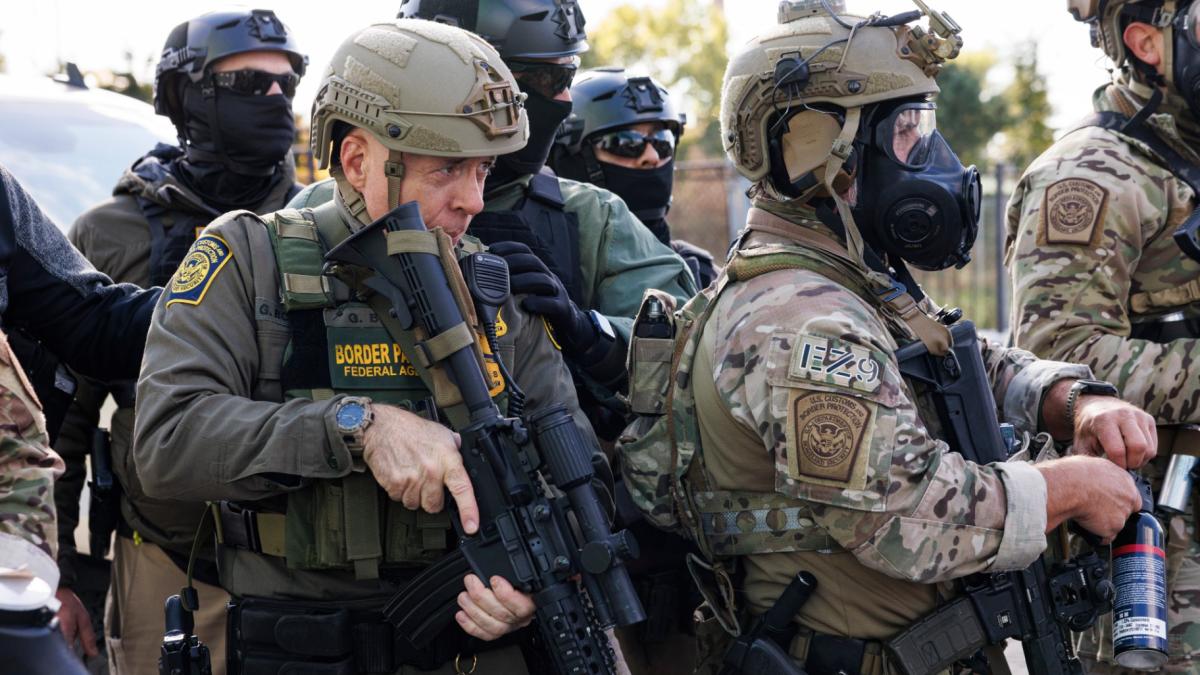 Border Patrol chief Gregory Bovino stands with federal immigration enforcement agents during a skirmish with protesters in Little Village neighborhood, Chicago Thursday, Oct. 23, 2025. (Anthony Vazquez / Chicago Sun-Times via AP)
A Chicago man is set to go on trial Tuesday on charges alleging he placed a bounty on the head of Border Patrol chief Greg Bovino amid the Trump administration’s expanded immigration enforcement efforts last fall.
While federal prosecutors initially claimed Juan Espinoza Martinez, 37, was a “ranking member” of the Latin Kings who posted a Snapchat message offering $10,000 to anyone who killed Bovino, the government has been barred from mentioning any gang affiliation or using the term “hit” before jurors at trial.
Espinoza Martinez was arrested on the murder-for-hire charge in October, weeks after the Trump administration launched its “Operation Midway Blitz” enforcement efforts in Chicago and the surrounding areas, which were led by Bovino.
The case has been fast-tracked through federal court after Espinoza Martinez demanded a speedy trial.
According to prosecutors, Espinoza Martinez posted a Snapchat message that included a photo of Bovino — who has largely been the face of the Trump administration’s expanded immigration efforts throughout Northern Illinois — along with the message “2k on information when you get him” and “10k if u take him down.”
A spokesperson for the Department of Homeland Security said at the time of his arrest that “depraved individuals like Juan Espinoza Martinez — who do not value human life and threaten law enforcement — do NOT belong in this country.”
While prosecutors initially claimed Espinoza Martinez was a Latin King, his defense attorney Jonathan Bedi argued the government produced no evidence “corroborating or supporting this bare-bone allegation.”
Bedi claimed that allowing the government to label his client as a gang member is irrelevant to the charges at hand and would be “extremely prejudicial” at trial.
“Any allegations involving the Latin Kings will no doubt arouse negative emotions from the jurors in this jurisdiction and automatically paint Mr. Espinoza Martinez as a deviant man engaged in criminal activity,” Bedi wrote in a pretrial motion.
While the feds had claimed a source informed them Espinoza Martinez had “dispatched members of the Latin Kings” to 39th and Kedzie on Oct. 4 following a shooting by a federal immigration agent in that area, court documents now show prosecutors changed course and instead intended to argue that Espinoza Martinez simply has an “affinity” for the street gang.
But days before the trial was set to begin, U.S. District Judge Joan Lefkow ruled that any testimony regarding the Latin Kings, gangs in Chicago, or any ties to or affinity for gangs that Espinoza Martinez may have will be excluded from trial.
“Without evidence showing that (Espinoza Martinez) is a member of the Latin Kings or that the Latin Kings instructed (him) to send the alleged murder-for-hire information, the prejudicial nature of such testimony outweighs any probative value,” Lefkow’s said in a written ruling Thursday.
Prosecutors had also asked Lefkow to allow the government source to testify without revealing their full name, claiming they were threatened by someone known to Espinoza Martinez through a social media post.
But Bedi argued the post was neither made nor directed by his client, that it wasn’t directed at the source and that it was “not a threat.” He also said the government has provided no evidence to substantiate their “bold claim” that the person who made the post has any connections to Espinoza Martinez.
Lefkow on Thursday ruled the source cannot testify anonymously, stating that the mere existence of a post interpreted as a threat “is insufficient to overcome the prejudice that would result” to Espinoza Martinez at trial by allowing the source to testify anonymously.
“The government does not represent that it has requested law enforcement to investigate the reported threat,” Lefkow wrote in her ruling. “If the government seriously considers the (source) to be in danger, it has a duty and the means to protect such a witness through security measures provided through the Marshals Service.”