Politics
CPD Officer Who Shot Teen in 2017 Won’t Be Fired — But Was Promoted After Costing Taxpayers $590K
 (WTTW News)
The Chicago police officer who shot a 16-year-old in September 2017 in what investigators ruled was an unjustified use of deadly force will not be fired, according to documents obtained by WTTW News.
In an unusual move, lawyers for the city dropped the charges that could have led to the termination of Officer Brian Collins, according to records published on Nov. 20 by the Civilian Office of Police Accountability.
A spokesperson for Corporation Counsel Mary Richardson-Lowry declined to answer detailed questions from WTTW News about why city lawyers prevented the Chicago Police Board, or an arbitrator, from deciding whether to fire Collins for shooting the teen in the back of their left upper arm as they ran from police with a gun in their waistband on Sept. 7, 2017, records show.
“As a rule, the Law Department cannot comment on specifics cases,” according to the statement. “Generally, the Law Department conducts a legal review, and based on its review, determines whether charges can be brought and/or prepares written charges to be filed at the Chicago Police Board. The filing of charges formally initiates proceedings at the Board.”
Since Collins shot and wounded the 16-year-old, Chicago taxpayers have paid $591,500 to resolve four lawsuits that allege he violated the rights of other Chicagoans, according to an analysis of city data by WTTW News.
Collins, who earns $134,292 annually, was promoted to sergeant in June 2025 and works in the Near North (18th) Police District, which includes Lincoln Park and the Gold Coast, according to a statement from a CPD spokesperson.
Collins did not respond to a request for comment from WTTW News.
Several Chicago officials and police accountability experts contacted by WTTW News said they were unaware of any other case where the Law Department dropped charges against an officer accused of serious misconduct before the Chicago Police Board could determine whether to fire them based on the results of a probe by COPA, the agency charged with investigating police misconduct.
It is unclear what legal authority the Law Department used to halt the disciplinary process Collins was facing from playing out as required by city ordinance.
Officers facing termination or a suspension of a year or more after a hearing before the Police Board frequently agree to serve a lesser penalty to resolve the disciplinary case against them, but it is unclear how many times lawyers for the city have simply dropped serious charges pending against an officer.
The Illinois Supreme Court will decide next year whether Chicago police officers accused of serious misconduct have the right to ask an arbitrator — and not the Chicago Police Board — to decide their fate, and whether those proceedings must take place in public.
Craig Futterman, a professor of law at the University of Chicago who represented the coalition of groups that sued the city in 2017 to force it to agree to judicial oversight, said it appeared Chicago’s police disciplinary system had broken down.
“The system cannot operate in a black box,” Futterman said.
A Long Process
The Department of Justice determined in 2017 that officers routinely violated the constitutional rights of Black and Latino Chicagoans and urged the department to adopt a policy regarding foot chases, which have repeatedly led to the deaths of Chicagoans fleeing the police.
That probe prompted the consent decree, the federal court order that requires CPD to change the way it trains, supervises and disciplines officers.
Six and a half years after the consent decree was implemented, CPD had fully complied with 22% of its requirements by the end of June, according to the court-appointed monitoring team charged with keeping track of reform efforts.
CPD’s foot pursuit policy was not finalized until 2022, more than a year after officers killed 13-year-old Adam Toledo and 22-year-old Anthony Alvarez after officers chased them.
Since 2017, CPD’s use of force policy has been completely overhauled, setting stricter limits on when, and why, officers can use deadly force against members of the public.
COPA started operating just days after Collins shot the teen in a North Lawndale alley. It replaced the Independent Police Review Authority, known as IPRA, amid widespread outrage and demands for reform after videos of the 2014 police murder of Laquan McDonald created a political firestorm.
Between 2007 and 2016, IPRA probed more than 400 police shootings. The agency determined just two were not justified.
COPA was supposed to usher in a new era of police accountability, with officials vowing to adequately fund the agency and staff it with professionals unafraid to bring disciplinary cases against officers found to have violated departmental rules.
However, immediately after its 2017 launch, COPA found itself hamstrung by the massive backlog of nearly 1,000 cases it inherited from IPRA.
COPA typically must complete disciplinary investigations within 18 months, and ensure punishment is in line with consequences faced by other officers with similar allegations.
It took COPA nearly four years to complete their probe of the shooting that wounded the teen, and it was more than seven years before officials announced that Collins would not be disciplined in connection with the shooting.
A Call of Shots Fired
The incident that led to the shooting of the 16-year-old began just before 10 p.m. on Sept. 7, 2017, a few blocks north of Douglass Park on the city’s West Side.
The teen was walking home from a store near Roosevelt Avenue and Whipple Street when he heard gunshots nearby, and saw a silver Ford Crown Victoria drive fast the wrong way down a one-way street.
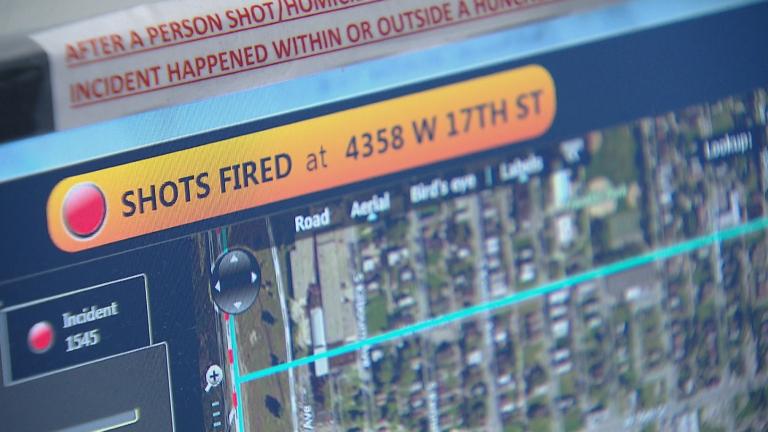
With Collins in the back seat of the unmarked police vehicle, a team of three officers were responding to a 911 call about the shots that the teen heard, and a ShotSpotter alert, according to the COPA probe. There is no evidence the teen fired those shots, records show.
When Collins saw the teen, he was already running, according to the probe.
“Officer Collins observed him running very quickly westbound, and Officer Collins stated that he had his hand on his right waist band, so he decided to give chase,” according to the probe.
The teen said he saw Collins just before he started running across a parking lot, and was wounded in the back of his upper arm just seconds later, officials said.
There is no evidence the teen heard Collins identify himself as a police officer or order him to stop, according to the probe. The teen did not point the gun he was carrying in his waistband at Collins before the officer shot him, according to Collins’ statement to investigators.
Collins said he fired his weapon twice at the teen four seconds after he saw him holding the gun and saw the teen look back at him while he was running, according to the probe. Collins said he ordered the teen to stop, according to the probe.
Collins told investigators the teen was running away from him when he shot him, according to the probe.
After the teen had been shot, Collins and another officer found the gun in the teen’s waistband, according to the probe.
“COPA finds it would be implausible for (the teen) to have been able to put the gun back into his waistband after being shot and while falling to the ground,” according to the probe. “It is more likely than not that (the teen) did not draw the firearm from his waistband.”
COPA investigators concluded that Collins’ decision to shoot the teen was not “objectively reasonable.”
“Department policy cannot and does not permit department members to use deadly force on any subject who flees with a firearm,” according to the conclusion of COPA’s probe. “Officers are only permitted to use deadly force where they reasonably believe the person threatens imminent harm to them with the firearm.”
Collins should be fired, then-Interim COPA Chief Administrator Andrea Kersten determined.
“The improper use of deadly force against a citizen is an egregious act requiring severe consequences,” according to the conclusion of COPA’s probe.
In keeping with rules that require COPA to redact the identity of those who file complaints against CPD officers, the teen is not named in their report.
The teen was charged with aggravated assault to a peace officer and aggravated unlawful use of a weapon, both felonies. Because the teen was a juvenile, it is not clear whether they were convicted of a crime in connection with this incident.
Former Chicago Police Supt. David Brown objected to COPA’s conclusion, saying the agency’s determination that the teen did not pose an objectively reasonable threat to Collins was “too speculative” and urged COPA to clear the officer of wrongdoing.
Kersten declined to change her recommendation.
That disagreement meant it was up to a randomly chosen member of the Chicago Police Board to determine whether Brown met “his burden of overcoming” Kersten’s recommendation.
Chicago Police Board President Ghian Foreman was randomly chosen to decide whether to uphold the superintendent’s decision or send the matter to the full police board.
In a three-page ruling, Foreman determined that Brown had not met his burden to overturn Kersten’s recommendation that Collins be fired.
Foreman’s decision should have required the Police Board to hold a hearing on the incident that led to the teen’s shooting, but the Law Department’s decision to drop the charges against Collins prevented that hearing from taking place.
Mayor Brandon Johnson has vowed to stop repeated instances of misconduct by the same officers, which cost Chicago taxpayers $295 million between 2019 and 2024, according to an analysis of city data by WTTW News.
Johnson has said the heart of that effort will be the long-delayed creation of a system designed to alert supervisors about which officers have been the subject of repeated police misconduct allegations.
“The system will support early, individualized interventions that improve performance, accountability and wellness — reducing misconduct, building community trust, and lowering litigation costs,” according to the mayor’s office.
CPD leaders will be required to submit monthly reports to the City Council on that push starting in 2026.
CPD must implement that system under the terms of the consent decree, which took effect nearly seven years ago.
The University of Chicago Crime Lab began work on the so-called Officer Support System, also known as OSS, in 2016, and began testing it in a South Side police district in September 2020, only to face repeated and lengthy delays, caused in part by decisions by CPD leadership to transfer the staff members assigned to run the system to patrol, according to a letter obtained by WTTW News through the Freedom of Information Act.
That system could have been rolled out citywide in May 2021, but it remains in use in only two of Chicago’s 22 police districts. CPD officials are developing a new system, officials have told the judge overseeing the reform push.
WTTW News' Jared Rutecki contributed to this report.
WTTW News coverage of policing and police reform is supported by The Joyce Foundation.
Contact Heather Cherone: @HeatherCherone | (773) 569-1863 | [email protected]