Politics
Federal Judge Imposes Strict Restrictions on Immigration Agents’ Use of Force Against Protesters, Media, Clergy
Finding that federal immigration enforcement agents repeatedly used force that “shocks the conscience” and then lied about their actions, U.S. District Court Judge Sara Ellis issued a sweeping injunction Thursday designed to permanently rein in agents’ use of tear gas, pepper balls and other crowd control measures.
Ellis ruled that there was ample evidence that federal agents had violated Chicagoans’ First Amendment rights to free speech and free assembly to protest what the Trump administration calls “Operation Midway Blitz” while also impermissibly preventing the free exercise of religion by targeting members of the clergy with force.
“The use of force shocks the conscience,” Ellis said. “This conduct shows no sign of stopping.”
A spokesperson for the U.S. Department of Homeland Security vowed to appeal Ellis’ order, calling her an “activist judge that risks the lives and livelihoods of law enforcement officers.”
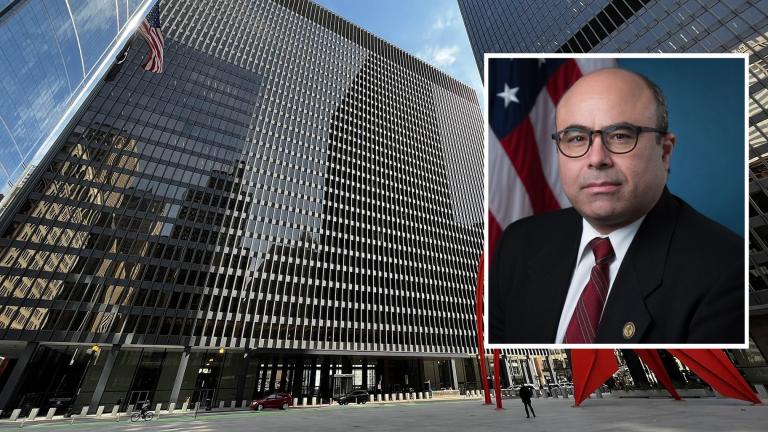
Speaking from the bench from her courtroom at the Dirksen Federal Building in downtown Chicago for nearly 90 minutes, Ellis painstakingly detailed instances across the Chicago area in which border patrol agents used force against residents in apparent violation of her temporary restraining order.
Despite that violence, Ellis said Chicagoans “have shown up for each other” and she watched hours of videos showing them exercising their Constitutional rights by “standing watch to protect the most vulnerable among us.”
“The government would have people believe, instead, that the Chicagoland area is in a vice hold of violence, ransacked by rioters and attacked by agitators,” Ellis said. “That simply is untrue. And the government’s own evidence in this case belies that assertion.”
Ellis repeatedly said that federal agents, including Border Patrol chief Greg Bovino, lied about the threat posed by protesters and their conduct on the streets of Chicago. Federal agents “indiscriminately” fired tear gas at Chicagoans, tackled them, beat them, struck them with pepper balls and pointed weapons at them.
“I find the government’s evidence to be simply not credible,” Ellis said.
To begin her order, Ellis read Carl Sandberg’s famed poem, “Chicago,” in full. That poem dubbed Chicago the “City of Big Shoulders.”
“And having answered so I turn once more to those who sneer at this my city, and I give them back the sneer,” Ellis read, pausing to look at the packed courtroom as she did so.
To conclude her order, Ellis quoted John Adams, who wrote to his wife Abigail in 1775 that “liberty once lost is lost forever.”
Ellis is now the second federal judge in the Northern District of Illinois to find that federal agents have presented unreliable testimony about their actions and the actions of Chicagoans in response to President Donald Trump’s mass deportation effort.
In a separate case challenging Trump’s deployment of 700 National Guard troops to Chicago, U.S. District Court Judge April Perry said she found federal officials’ assertions that federal agents had been subjected to serious and coordinated violence by protesters “simply unreliable.”
Just because some people broke the law while protesting the Trump administration does not mean that others lose their constitutional rights, Ellis said.
“Describing rapid response networks and neighborhood moms as professional agitators shows just how out of touch these agents are, and how extreme their views are,” Ellis said, referring to the now wide-spread use of whistles to alert everyone in hearing distance of the presence of federal immigration agents in Chicago.
Ellis said that Bovino, the commander of Operation Midway Blitz and the public face of Trump’s mass deportation push, repeatedly lied during his deposition.
Bovino admitted during a deposition to lying about whether a rock hit him before he used tear gas on Chicagoans in Little Village last month, Ellis said. In fact, he was not hit by a rock before lobbing a tear gas canister, without warning, at the crowd, Ellis said. Bovino fired a second canister at the crowd as people fled the area and posed no threat to anyone, Ellis said.
In addition, Bovino lied about his conduct outside the Broadview ICE facility, where video shows that he “obviously attacks and tackles” a man, Ellis said.
“But Mr. Bovino, despite watching this video (in his deposition) says that he never used force,” Ellis said.
The injunction orders federal agents to only use force when it is “objectively necessary to stop an immediate threat of the person causing serious bodily injury or death to another person,” and that two separate warnings must be given before force is used.
Agents are also ordered to wear “conspicuous identification” in two separate places and activate body-worn cameras while engaging in enforcement actions, Ellis said.
Ellis held an all-day hearing Wednesday where she heard testimony in the case brought by the Chicago Headline Club, Chicago Newspaper Guild Local 34071, Block Club Chicago and other media organizations.
Nearly a month ago, Ellis prohibited federal agents from deploying tear gas and other weapons against journalists, protesters and anyone not posing an immediate threat to immigration enforcement agents.
Since Oct. 3, federal agents have fired tear gas at Chicagoans seven times, along with pepper balls and other crowd control measures.
Federal agents also deployed tear gas against Chicagoans on Oct. 24. Video captured by body-worn cameras recorded one agent mocked the crowd as tear gas was deployed, saying twice, “have fun!” and laughing as they fled.
“The agent then yelled ‘throw another one’ and prepared a second canister,” according to a filing by attorneys for the plaintiffs. “Similarly, one agent told another, ‘Hey, throw it (tear gas) for fun.’”
Video of both incidents did not capture agents ordering the crowd to disperse or warning that they were going to deploy chemical agents, as required by Ellis’ order.
After those incidents, Ellis ordered Bovino to meet with her every weekday at 6 p.m. to discuss agents’ actions in Chicago. An appellate court panel overturned that order, saying that violated the separation of powers.
Ellis also ordered Bovino to obtain and wear a body-worn camera. Lawyers for the Trump administration said that he had complied with that order.
Attorneys for the plaintiffs told Ellis that federal agents repeatedly and brazenly violated the constitutional rights of protesters and reporters during aggressive immigration raids, which began two months ago.
“It’s about their practices targeting journalists, targeting clergy and people exercising their constitutional rights,” said Craig Futterman, an attorney for the media organizations. “We have children, parents and grandparents who will forever be afraid to exercise their very rights that make this country great, assaulted by the very people assigned to protect those freedoms.”
However, lawyers for the Department of Justice said agents had been prevented from carrying out their orders and enforcing federal law by protestors.
“This case addresses to what extent does the freedom of speech protect people throwing rocks, bottles, trespassing, pinning down law enforcement, slashing tires, wielding weapons,” attorney Sarmad Khojasteh said.
Matt Masterson contributed to this report.
Contact Heather Cherone: @HeatherCherone | (773) 569-1863 | [email protected]