Science & Nature
NASA Plucked an Asteroid From Space. Now Researchers at the Field Will Probe It for Signs of the Origin of Life
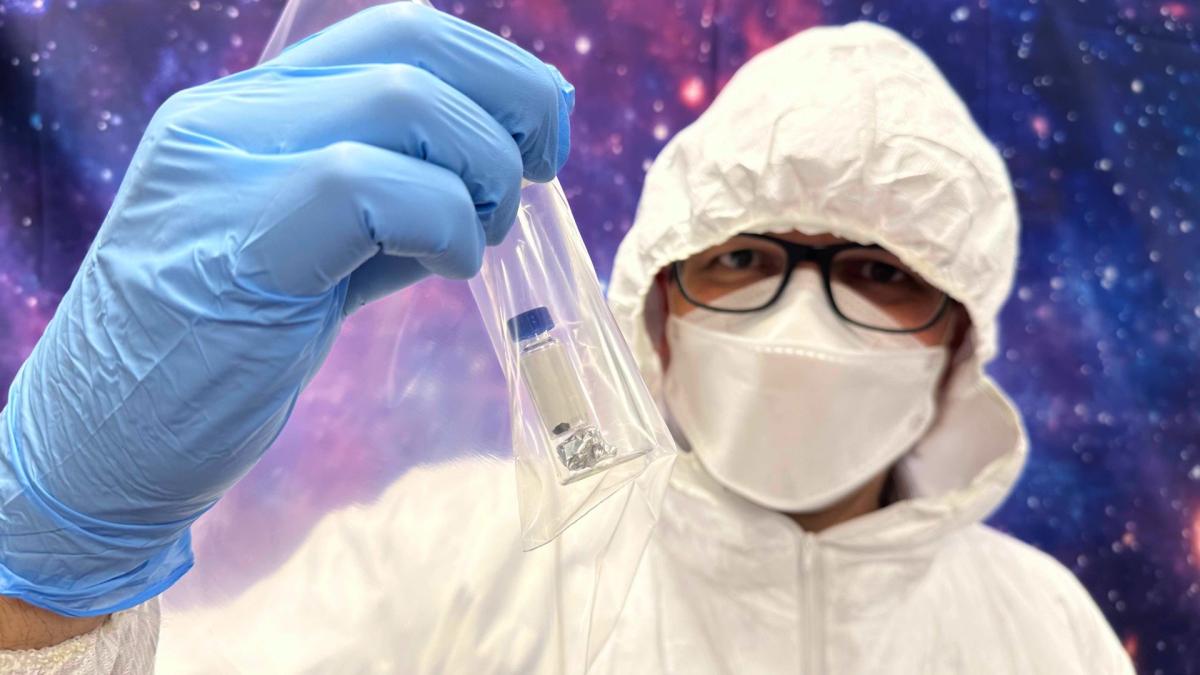 Philipp Heck, the Field Museum’s head curator of meteoritics and polar studies, holds up a fragment of the asteroid Bennu, collected by NASA. The space rock is the tiny black pebble, contained in a vial within a vial. (Courtesy of the Field Museum)
A space rock the color of coal and no larger than a pebble you’d shake from a shoe just arrived at the Field Museum, where scientists will spend the next two months probing this extraordinary specimen for clues to the origin of life on Earth.
“It’s the honor of a lifetime,” Philipp Heck, the Field’s head curator of meteoritics and polar studies, said of the opportunity to study the tiny 4.6-billion-year-old rock, which was retrieved by NASA’s OSIRIS-REx mission from the near-Earth asteroid Bennu.
Specimens from Bennu were collected in 2020 and delivered to Earth in 2023. Unlike meteorites that have fallen to earth, rocks gathered directly from space are pristine — untouched by Earth’s atmosphere, microbes or human DNA.
As such, they’re “very rare stuff,” said Heck as he met with members of the media Wednesday.
Fragments from Bennu are the first of their kind collected by NASA; Japan has previously retrieved samples from two different asteroids on separate missions.
The uncorrupted samples will give scientists a clearer picture of the compounds that were present in the earliest moments of the solar system’s creation.
“I always make the analogy with the soup and the pantry,” said Heck. “Essentially Earth is the soup … and Bennu is a sample of the pantry, of the ingredients that went into the soup…. These are the ingredients that went into the formation of Earth and went into the formation of life.”
Detective Story
Heck and his graduate student assistant, Yuke Zheng, are part of a team of roughly 200 scientists helping to put together the pieces of the Bennu puzzle.
“There’s so much to be done — so many different aspects of the asteroid that need to be studied — that one institution or one scientist alone, one group of scientists alone, cannot do it,” Heck said.
The Field partnered with Brown University on a research proposal that was ultimately accepted by NASA. The Chicago institution was well-positioned to be chosen as a member of the research collaborative, given its expertise in meteorites, having amassed one of the largest collections of meteorites in the world.
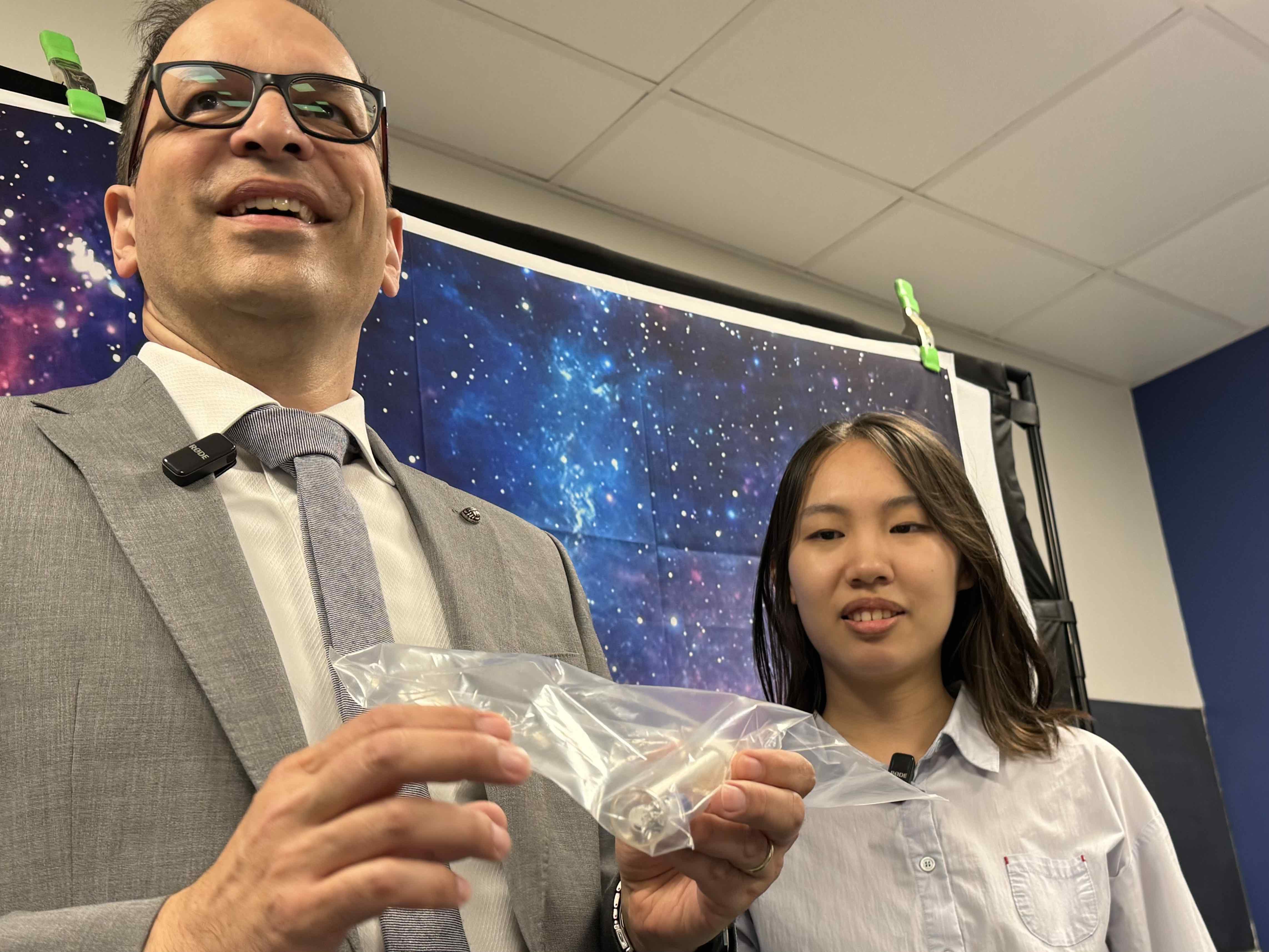 Philipp Heck and Yuke Zheng meet the press, announcing the loan from NASA of a pristine fragment of the asteroid Bennu. The space rock is sealed in a glass vial, within another glass vial, placed in a plastic zip-close bag to guard against contaminants. (Patty Wetli / WTTW News)
In advance of the Bennu fragment’s arrival, Zheng analyzed approximately 20 of the Field’s meteorites, specifically those with carbon-rich composition similar to the asteroid’s.
Those 20 meteorites come from different parent asteroids, found in different parts of the solar system, with slightly different geological histories.
Bennu is its own time capsule as well, Zheng said, and studying the fragment will help place it in the timeline.
“It’s like a detective story,” she said.
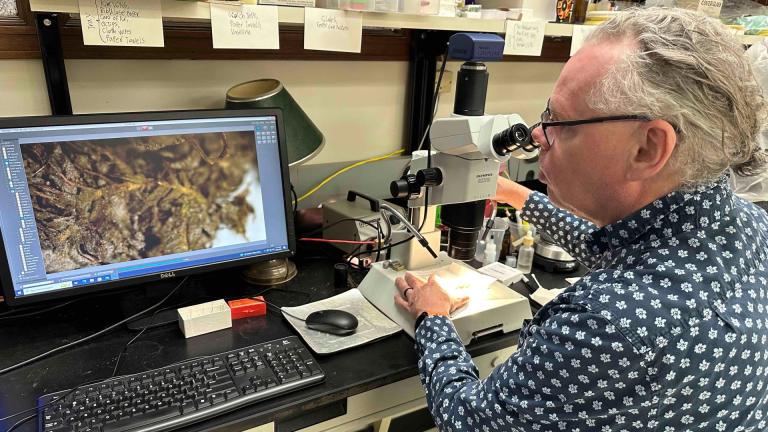
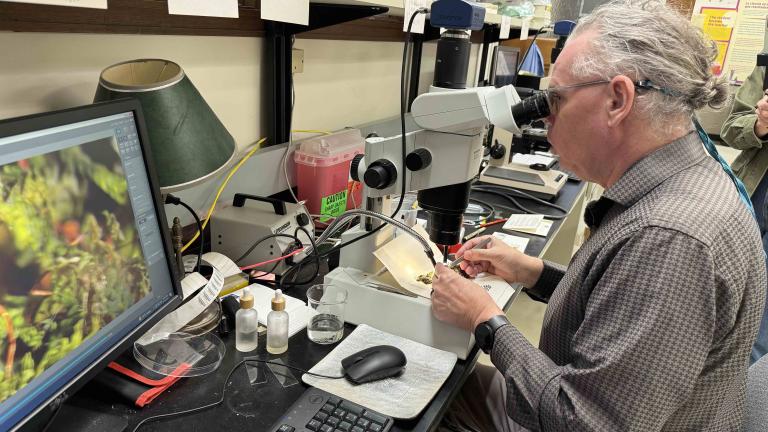
Using a scanning electron microscope — capable of magnification up to 1 million times the original — the Field will analyze the mineral composition of the asteroid fragment and will also examine the rock’s organic material at the macro-molecular level.
“So we would be able to see how the organic materials were modified when they were in the asteroid parent body,” Zheng said.
Meanwhile, their colleagues at Brown are investigating a little-understood characteristic of asteroids: their smell, in the form of volatile compounds.
“If a carbon-rich meteorite falls to Earth, we usually smell it. It smells like paint thinner or vanilla sometimes,” Heck said. “Who cares about smell? These volatiles … they’re also important because they arrived on Earth as well with meteorites before life formed.”
In other words, they’re part of the pantry, but one that hasn’t been studied much because volatiles are smaller molecules and are difficult to measure. So no one really knows what role volatiles play in Earth’s soup.
The team at Brown has developed a special technique to measure volatiles, which they will now get to test on Bennu.
It’s exciting, Heck said, to think about all the information this small rock contains, just awaiting discovery.
“This is a huge boulder for us,” he said.
“The cool thing about planetary science and cosmo-chemistry, one part is hypothesis-driven science," Heck continued. "We ask questions and try to address them. The other part is exploration, pure exploration. To go like a child into the forest and look under a rock…. It’s so important to keep our eyes open for unexpected things.”
We Are All Bennu, Bennu Is Us
Heck has been studying space rocks long enough to know the question on most people’s minds when it comes to his chosen field: What’s the point?
When it comes to Bennu, there’s an unusually practical application: The asteroid, which likely formed somewhere near Neptune, has since come to orbit the sun on a path similar to Earth’s. There’s a one in 2,600 chance the asteroid will hit Earth in the year 2182, so it would help to know what it’s made of, particularly if the highly fragile specimens indicate the parent rock would disintegrate before impact, Heck said.
On a more existential level, Zheng said, it’s as close as humans will come to reaching out a hand and touching space.
And what’s out there isn’t something “other” than or apart from humanity, Heck noted.
“We often forget that space is also part of nature…. And we want to better understand how we are connected to nature by studying the meteorites," he said.
“We share the same origin, so studying Bennu is actually our origin story, part of our origin story in deep time,” Heck continued. “We are part of the solar system. This is our ancestor material.”
The rock is on loan from NASA to the Field through August. None of the Field’s research techniques will in any way degrade the sample, but even still, NASA is only parceling out roughly 20% of the Bennu specimen it collected.
The rest is being saved for generations still to come as new technology becomes available, Heck said.
“They will have instruments we cannot even dream of,” he said. “We’ll do our best to get everything we can get, all the science we can get out of the sample, all the data we can, but then we will preserve the majority of the sample for the future.”
Contact Patty Wetli: @pattywetli | (773) 509-5623 | [email protected]