Science & Nature
Meet the Scientist Who’s Spent Decades Making Sure Birds Killed in Chicago Building Collisions Don’t Die in Vain
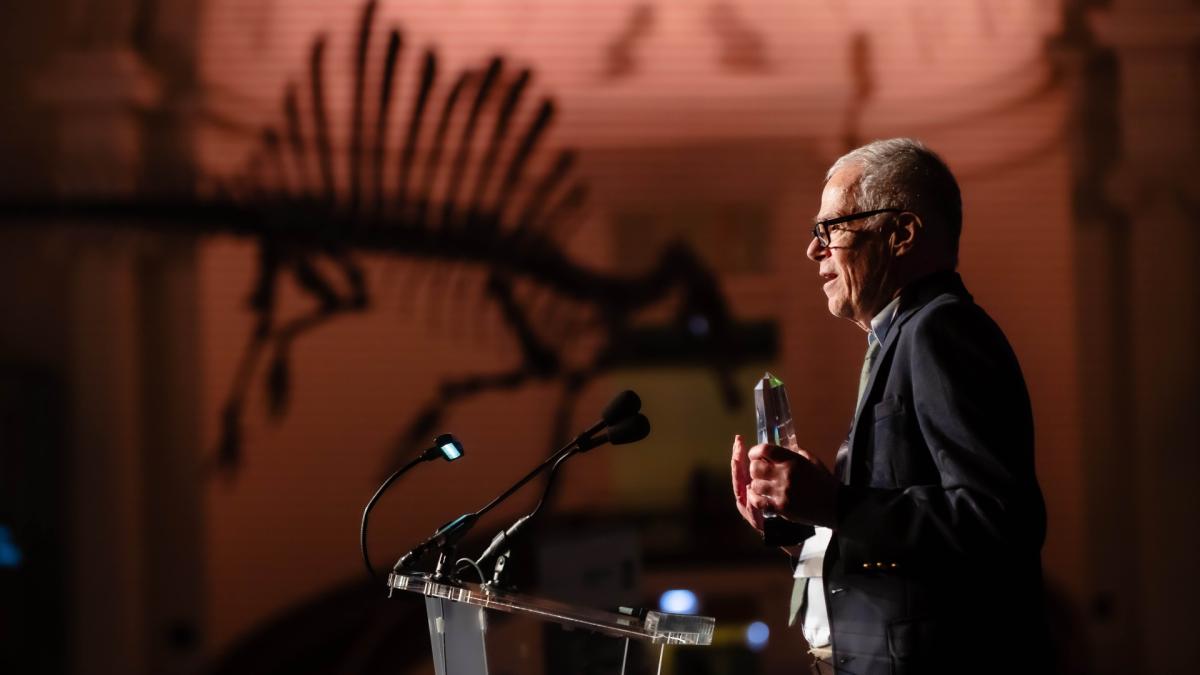 Dave Willard accepts the Parker/Gentry Award on Oct. 29, 2025, at the Field Museum. (Courtesy of the Field Museum)
In late October, Dave Willard, an adjunct curator at the Field Museum, found himself standing shoulder to shoulder with actor Harrison Ford.
The two were set to receive awards at the Half-Earth Day gala, hosted at the Field: the 83-year-old Ford for his environmental advocacy; and Willard, nearly 80 himself, for a career’s worth of achievements, including his tireless work documenting migrating birds’ deadly collisions with buildings in Chicago.
The men had exchanged a few pleasantries and if Dave Willard were anyone other than Dave Willard, he may have given in to the temptation to lean over to the movie star and say, “You know, I’m the real Indiana Jones.”
The mild-mannered ornithologist could have regaled Ford with stories of the time he helicoptered onto a “lost” mountain in Venezuela, led tours to Antarctica or discovered a new species of bird. He could have touted policy changes that his research directly influenced, like bird-friendly building design legislation.
Willard thought about it. His boss had egged him on. The words were on his lips.
“But I couldn’t do it,” Willard said, shaking his head.
Not one to enjoy being the center of attention, Willard went on to deliver a brief acceptance speech in the time he’d been allotted by the ceremony’s organizers — “I was glad it was only three minutes,” he said — and stepped back out of the spotlight.
The work, in Willard’s case, speaks for itself.
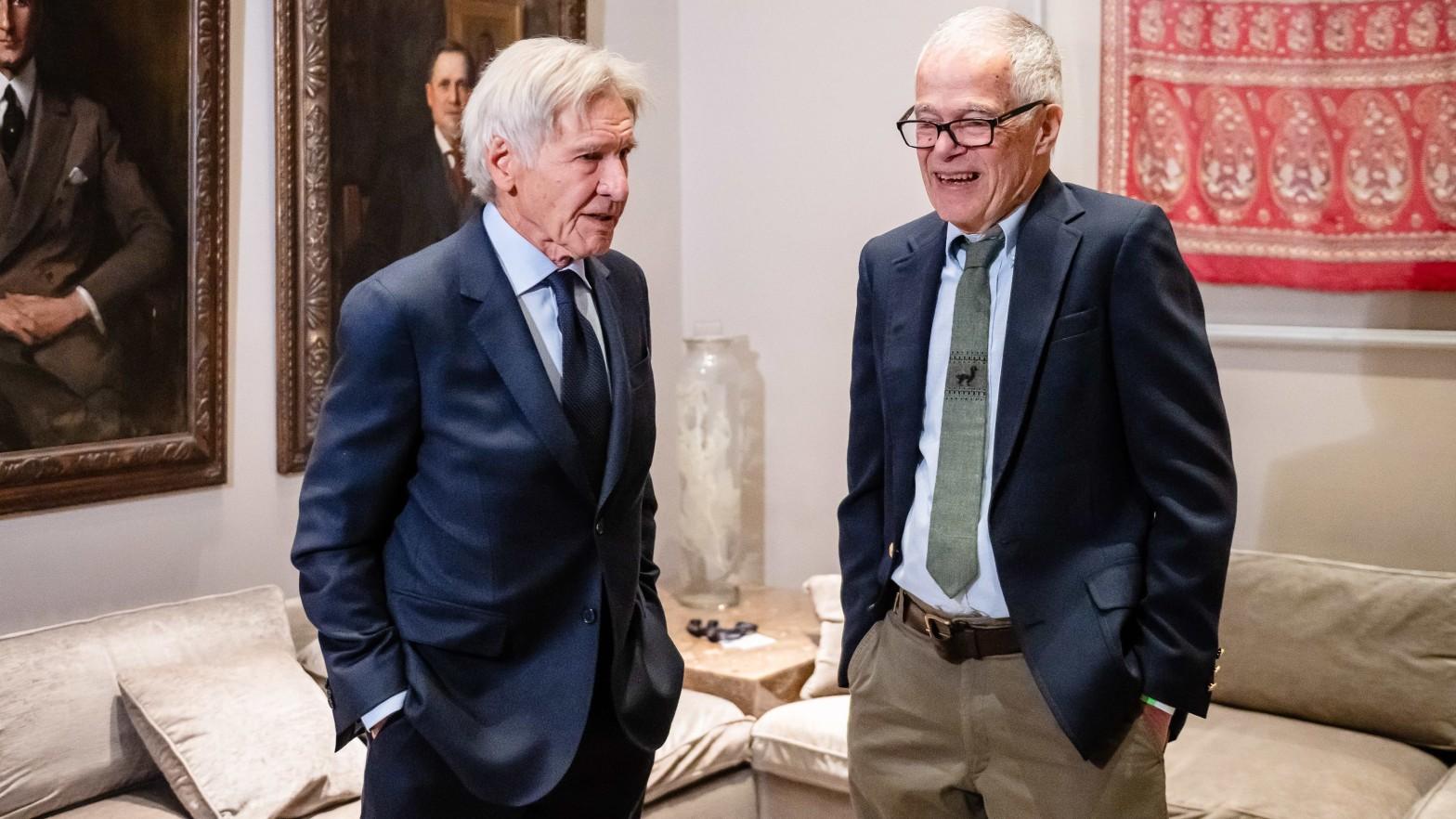 Who’s the real Indiana Jones here: Harrison Ford (l) or Dave Willard? The two met during October’s Half-Earth Day gala at the Field Museum. (Courtesy of the Field Museum)
When a bird dies after colliding with a building in Chicago, a few things can happen. It can get snatched up by a predator as food. It can get trampled underfoot or tires. It can be treated like garbage and tossed in the trash.
Or, if it’s retrieved by a volunteer with Chicago Bird Collision Monitors, its final destination is the Field Museum’s bird lab.
The lab is where a handful of staff members and a small group of volunteers turn dead birds into valuable scientific specimens. Willard started the program more than 40 years ago, almost by accident, and it’s since grown into one of the largest, longest-running datasets of its kind found in a natural history museum.
Each bird is carefully recorded by Willard in an old-school log book, where he notes, in his tidy, handwritten script: the bird’s species; the date and time it was collected; where it was found; the name of the person who collected it; and relevant anatomical measurements like wing, bill and tarsal length, weight and the condition of the skull, which can help determine the bird’s age.
“We’ve sort of said, ‘If it’s dead and it has data, it’s useful to us,’” Willard said.
Some of the birds will be meticulously preserved and stuffed, their near-lifelike forms held in collection drawers. Many more of the birds are reduced to skeletons (flesh-eating beetles in a sealed room adjacent to the lab will pick the bones clean) and are stored in small, jewelry-sized boxes. The rationale behind skeletons, Willard noted, is that it will make it easier for future scientists to compare things like changes in skull size over time.
Willard estimates he’s filled up some 50 notebooks over the years with this data. He’s up to page 148 in the current journal, with nearly three dozen birds per page. The math is staggering.
Assistant collections manager Tom Gnoske, who became Willard’s first assistant back in the 1980s, described the project as “relentless.”
“I think when Dave started … there was maybe 7,000-ish birds in the collection, and now there’s over 100,000 birds from all the salvage we have done,” Gnoske said. “You think in terms of all the birds that don’t get saved. You know there’s been millions and millions that hit windows since we’ve had high-rises and people sweep ‘em up.”
“There’s a sadness about it,” Willard conceded, in terms of the sheer volume of dead birds he’s handled, but it’s also fulfilling to give purpose to the birds, in terms of their contribution to scientific research, to ensure they didn’t die in vain.
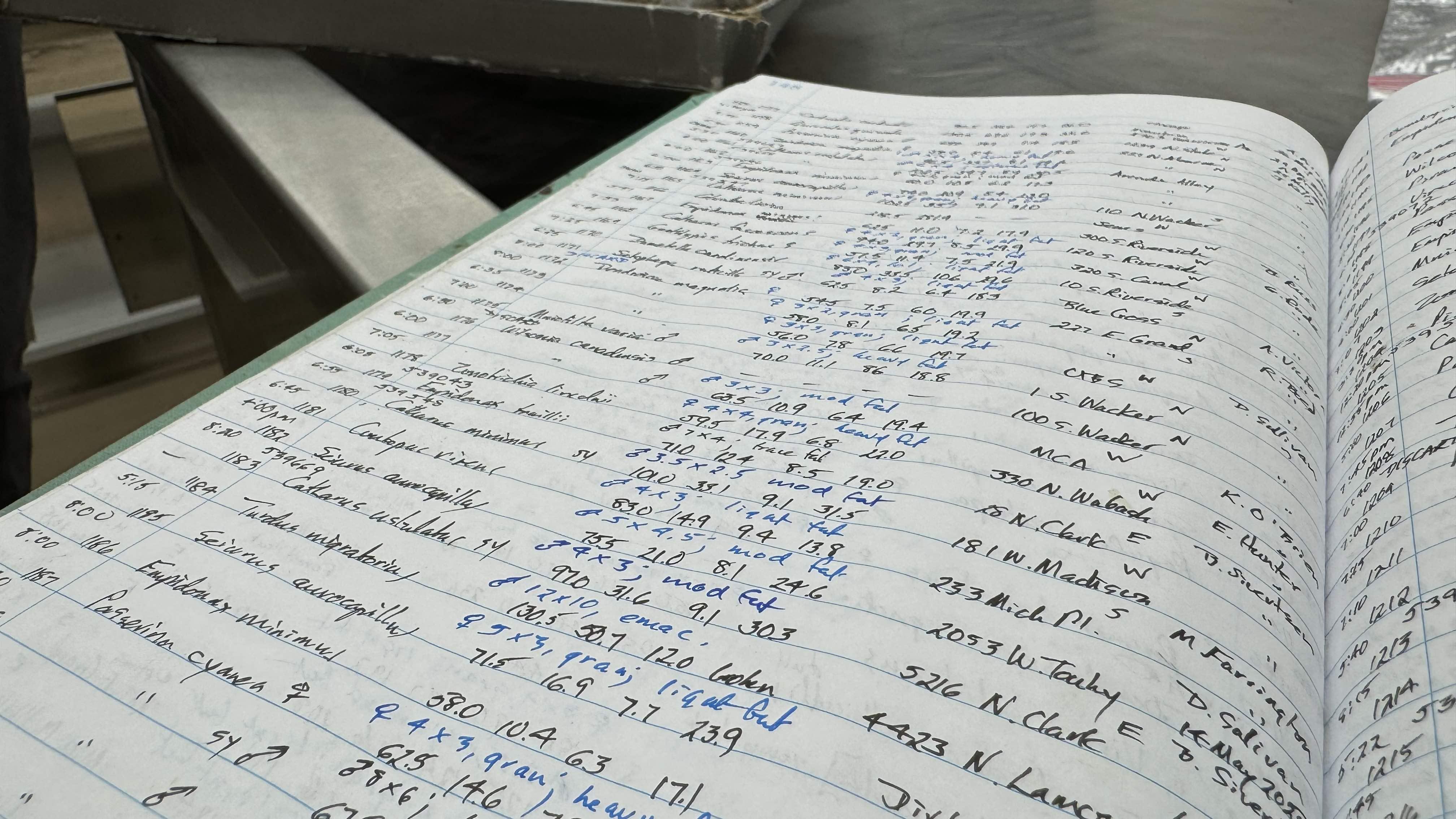 For more than 40 years, Dave Willard has kept meticulous records of every dead bird brought to the Field Museum, filling up an estimated 50 such notebooks. (Patty Wetli / WTTW News)
When Willard joined the Field in 1978, he didn’t set out to undertake a passion project that would consume the next 40-plus years of his life.
His original career goal?
“Well, my first thought was, ‘I need a job,’” Willard said.
A Ph.D. from Princeton University in hand, he’d applied for several academic positions with little success but caught a break when his friend, John Fitzpatrick, was hired as curator of the Field’s bird department.
Fitzpatrick — who Willard credits with having one of the best ears for birdsong — brought Willard on board to reorganize the museum’s bird collection, for what was originally pitched as a three-year job. Ten years later, Willard’s position was made permanent.
In those early years, there were trips to Peru, where the Field was helping to document species distribution up and down mountainsides. Then later, collecting expeditions to the Rwenzori Mountains on the border between Uganda and the Democratic Republic of Congo — the highest peaks in East Africa, known as the Mountains of the Moon.
Willard wouldn’t call himself a mountain climber, in the “pickaxe and things” tradition, but he has been to some pretty high places. “I like walking places, even if it’s straight up,” he said.
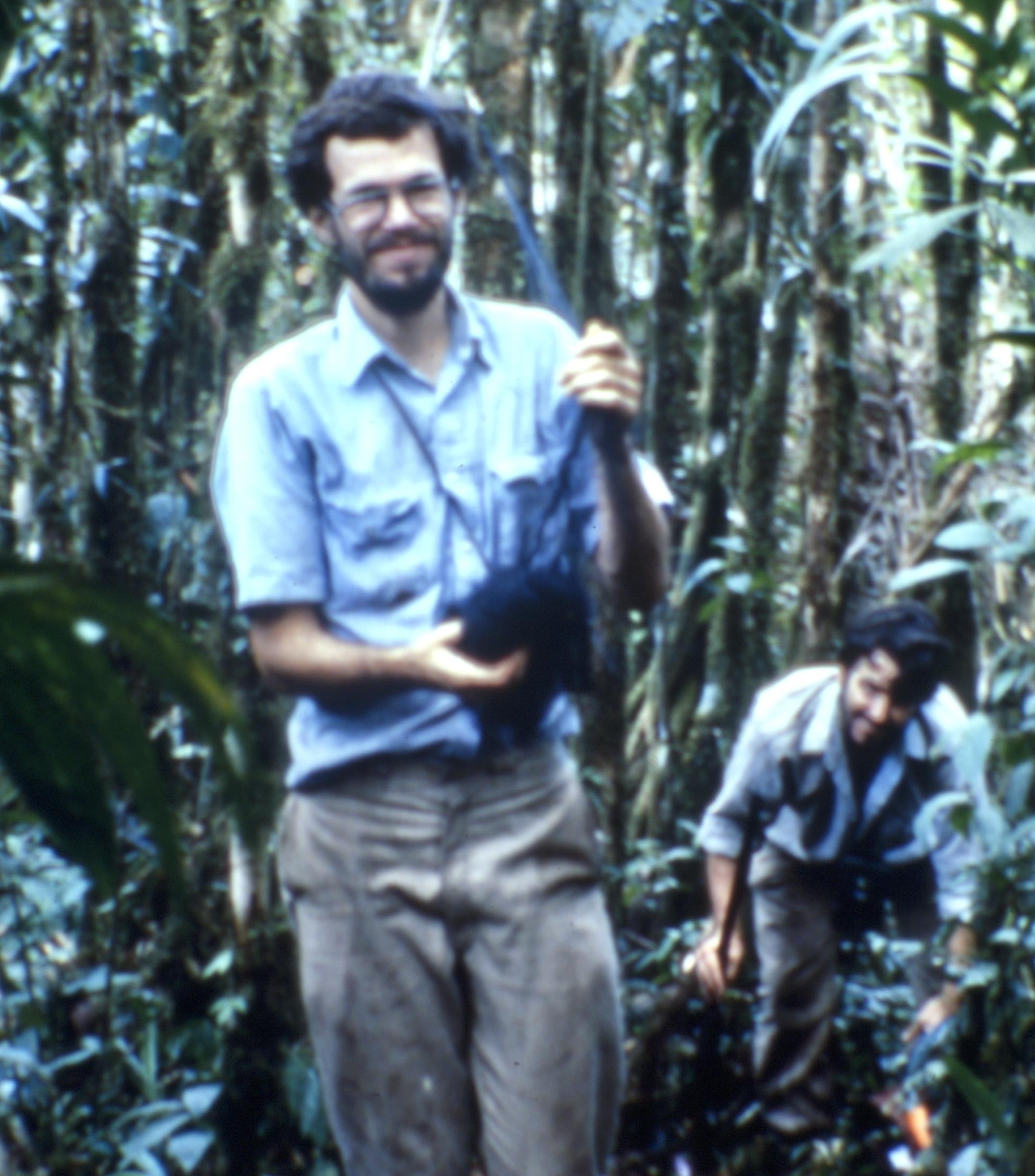 Dave Willard in the wild, in an undated photo. (Courtesy of the Field Museum)
Most memorably, some 30 or 40 years ago, he was part of a group dropped by helicopter onto a so-called lost world in Venezuela.
“That was a place where the mountain was so unexplored, we were wanting to just know what was there,” Willard said. “It was a mountain that had only been discovered in the ‘50s … because it is all shrouded in clouds. And with the technologies that were out there at the time, which wouldn’t have included as much satellite stuff, nobody knew really that this incredible massif was there.”
The National Enquirer even covered the expedition, printing an article accompanied by an image of a dinosaur. The reality was more “Nature” than “Jurassic Park.”
“I think that the herpetologist and the botanists may have been the ones who found the most new stuff,” Willard said.
Other missions proved more fruitful for what Willard calls the “bird people.”
The distinctively striped bar-winged wood-wren (Henicorhina leucoptera) and brilliantly blue-plumed royal sunangel hummingbird (Heliangelus regalis) — both native to southern Ecuador and northern Peru — list Willard as a co-discoverer in the late ‘70s.
A hundred years prior, such an identification might have earned a person naming rights. Willard’s bar-winged wood-wren has a certain alliterative ring to it.
But Willard has never been a fan of such nomenclature. “The idea that you have a possessive of a person’s name with something as nice as bird, there’s no reason,” he said.
Tip of the Iceberg
At some point in the late ‘70s Willard was at a social gathering and ran into William Beecher, the late director of what was then the Chicago Academy of Sciences (now the Peggy Notebaert Nature Museum). Beecher casually mentioned to Willard that birds sometimes were killed in collisions with the McCormick Place Lakeside Center.
“I went down before work one morning out of just pure curiosity and walked around it and found a few dead birds,” Willard recounted. “You know, if I hadn’t found something that morning, I’m not sure I would have ever gone back, and this story would not be told now.”
Originally, Willard began more or less patrolling McCormick Place with an eye toward picking up specimens that filled gaps in the Field’s collection. But he soon realized, he said, that he had stumbled onto the “tip of the iceberg of what was subsequently documented all over the country.”
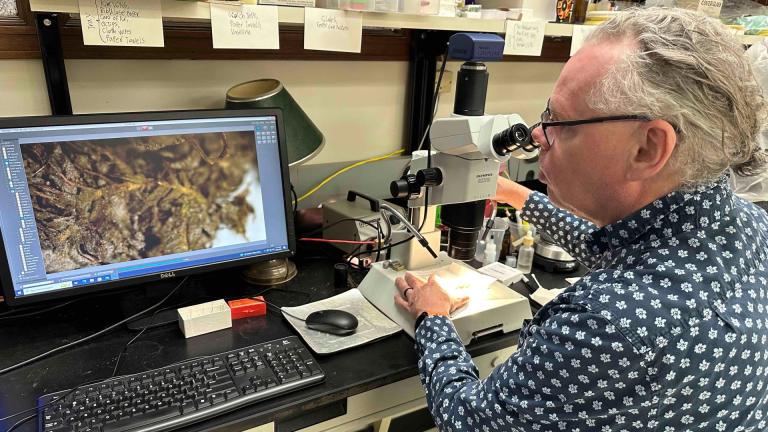
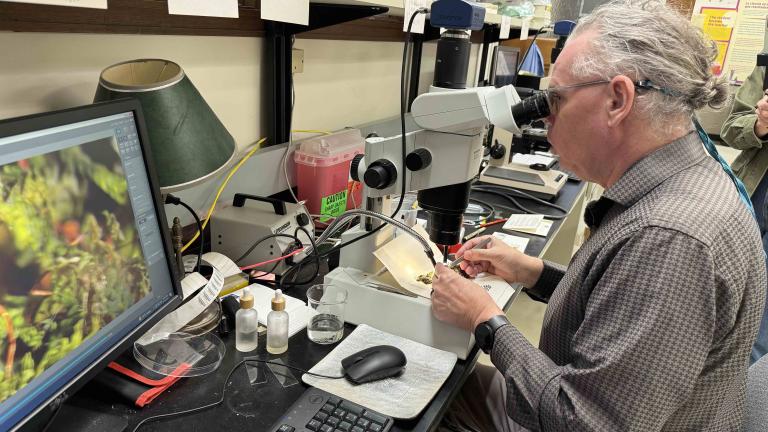
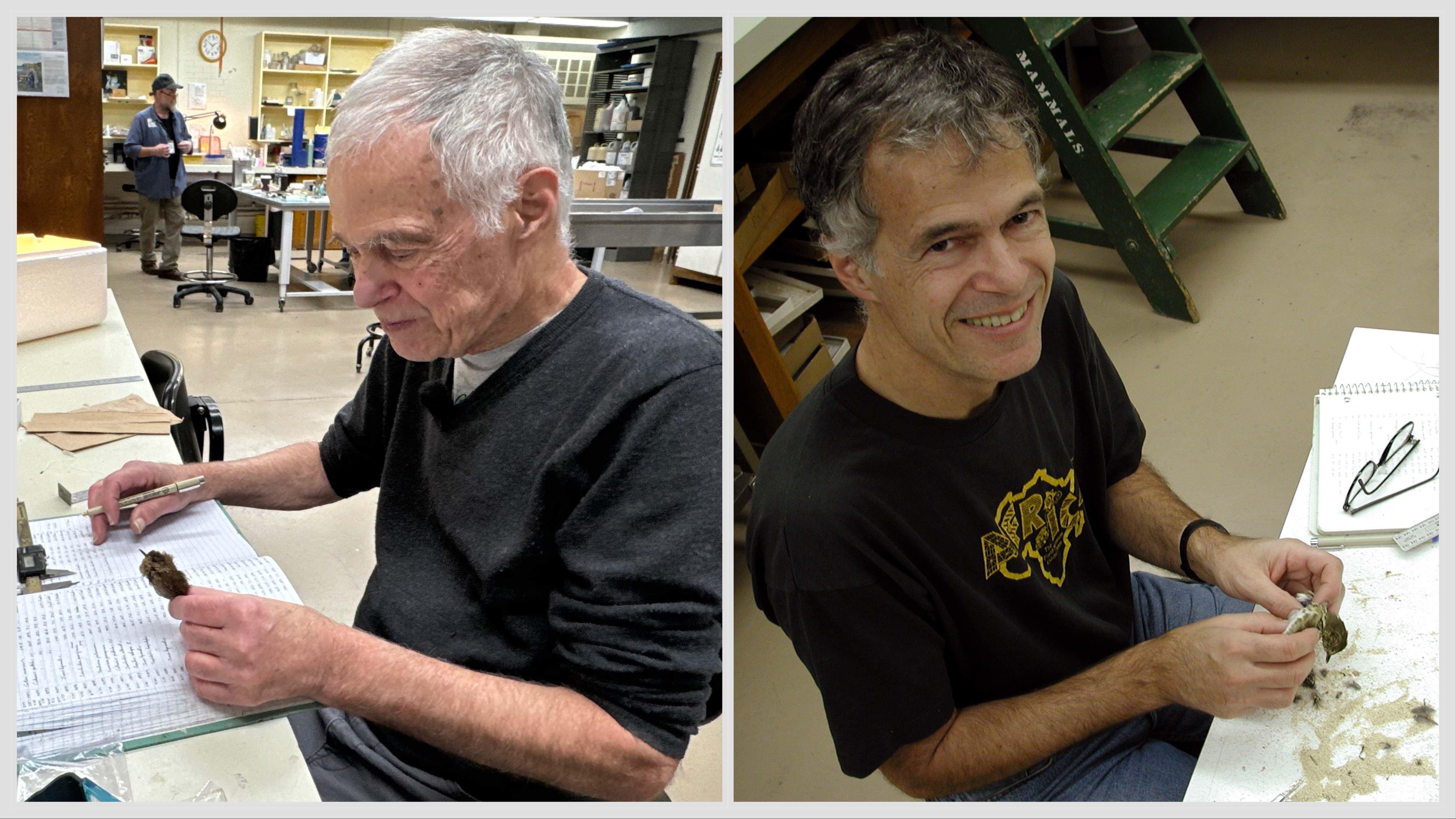 “There’s a sadness to it,” Dave Willard said of the decades he’s spent documenting birds killed in collisions with Chicago buildings. But his monitoring project ensures the birds didn’t die in vain. Here Willard is seen prepping specimens in 2025 (l) and 2001. (Credit: Patty Wetli / WTTW News; Field Museum)
Field staffers started making nearly daily trips to the lakefront convention center during spring and fall migration, ultimately tallying some 45,000 specimens at current count of birds that died after striking just that one building.
Those specimens have been invaluable when it comes to putting hard numbers and science behind what could otherwise be dismissed as environmentalists’ subjective impression that glass buildings are harmful to birds. The irrefutable evidence has helped bring about meaningful change, including the adoption of Lights Out programs in which buildings in urban centers along migratory flyways dim their lights at night for several weeks each spring and fall.
It was the public’s visceral response to a photo of 1,000 birds killed at Lakeside Center on a single day back in October 2023 that finally led to the convention center’s management installing bird-friendly window film on the building’s wide expanse of glass.
Daryl Coldren, a collections assistant at the Field, posted the now infamous image to a birding site, and reaction exploded around the world.
“What I’m proud about is having provided the data that showed there was a problem. And people who are better activists than I am screamed loud enough,” Willard said.
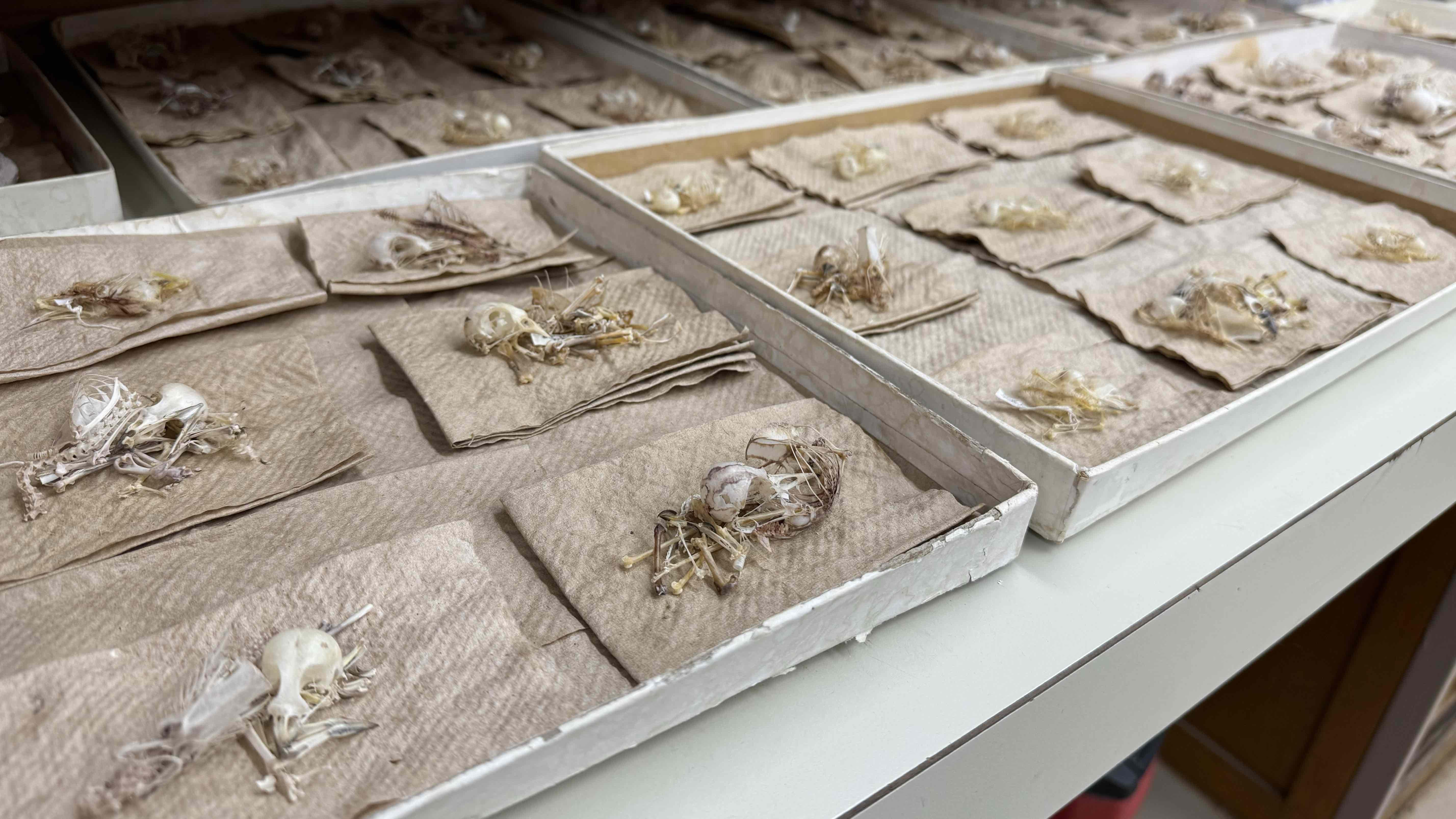 The skeletal remains of birds salvaged by the Field Museum will be used by researchers for years to come, with the potential to answer questions scientists don’t even yet know to ask. (Patty Wetli / WTTW News)
Willard technically “retired” from the Field more than a decade ago. He still shows up for work at the bird lab almost daily, the primary difference being, he said, that he now has the freedom to devote all his time to the projects he cares most about and can skip things like committee meetings.
“The thing for me, I had a hobby, I got a job where I was paid for that hobby, and now that I’m retired, I’m back to my hobby,” Willard said. “It’s like I landed in the perfect place.”
Coldren characterized Willard as a “powerhorse, or a power workhorse,” while Gnoske settled on “machine.”
“I only know what time he comes in sometimes because I stay overnight sometimes,” Gnoske said. “He gets in at like 4:55 (a.m.).”
What drives Willard is the knowledge that the massive project he set in motion has become bigger than he ever could have imagined, and there’s still so much to learn from the birds he’s rescued from oblivion. The breadth of both the number of species collected and the number of specimens of each species coupled with the length of time over which they been salvaged would be almost impossible to duplicate or replicate.
“I don’t think there’s another museum that has made such a point of preserving specimens from monitoring like this,” Willard said, “making them useful for any kind of scientific research or any subsequent studies. I think we’re probably at the forefront of that.”
Already, colleagues at the University of Michigan have discovered — courtesy of Willard’s painstaking measurements — that birds have gotten smaller in the years since the Field began collecting salvaged birds. And another study is underway looking at minute differences in the plumage of white-throated sparrows — some have whiter throats than others — and whether there’s anything to be learned about the distribution of that variation.
Years, decades or even centuries from now, as technology evolves, who knows what information future scientists will be able to unlock from the birds’ feathers, skin, bones and DNA.
“And if we stop (collecting), those questions can’t be asked,” Willard said.
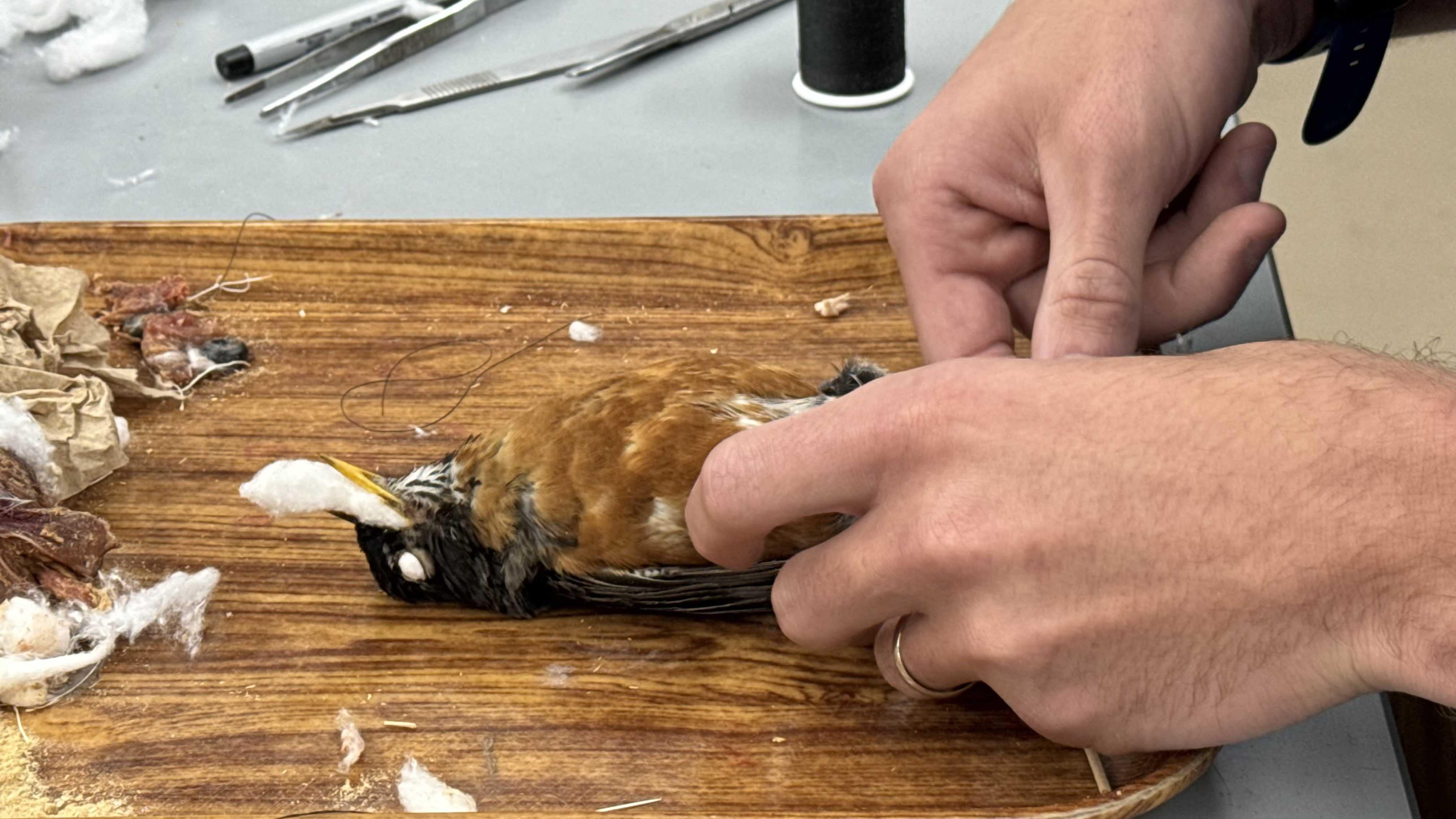 A specimen being prepped in the Field Museum’s bird lab. (Patty Wetli / WTTW News)
Ornithologists will often refer to the “spark” species that first piqued their interest in birds.
For Willard, it was more a matter of circumstances.
He grew up in Madison, Wisconsin, where his parents owned an apple orchard (now run by his brother). Every spring, the apples that hadn’t been sold were dumped in the woods, he said, and that mound of fruit attracted all sorts of visitors.
“I remember as a kid watching orioles and grosbeaks and tanagers and things coming down to this fermenting pile of apples. And my feeling was that they were getting almost tipsy,” Willard said.
Drunk or not, the birds were less skittish than typical, and Willard, who was maybe 8 or 9 years old at the time, could get close enough to observe the creatures without binoculars, “just being kind of amazed,” he said.
A series of children’s nature books by renowned conservationist and author Thornton Burgess, specifically “Bird Book for Children,” was another early influence.
For reasons Willard finds hard to articulate, it was learning the individual species names of birds that captured his imagination.
“I always would argue that knowing the bird’s name then connects it to all the things you’ve read about it, to the bird’s whole history,” he said.
 Dave Willard’s tireless work documenting bird collision deaths has led to policy changes including Lights Out programs and bird-friendly building legislation. (Patty Wetli / WTTW News)
It would have been beyond Willard’s childhood imagination to think birds would be his gateway to far-flung places like Australia, Zimbabwe, Botswana, Antarctica and Bhutan (more than once), where he’s traveled both for work and play — “play” boiling down to birding off the clock.
“I certainly as a little boy didn’t know where Bhutan was or that it existed,” Willard said. “But then, coming to work here (at the Field), you see the labels of birds from all over the world.”
Despite his globe-hopping adventures, Willard remains strongly rooted in the Midwest.
“I’ve never given up feeling like I’m from Wisconsin,” he said.
There’s still great birding to be had near the old family farm, where Willard recently bought a house. “The first thing I did was put bird feeders up,” he said. “For the first time in my life, I’m in a place I can have one.”
During his last visit, the feeder drew nuthatches, chickadees and tufted titmice, a scene that might just be the thing that convinces Willard to spend less time in the lab.
“What I was sort of envisioning is a couch you can put your legs up on and just watch birds through your window,” Willard said.
Contact Patty Wetli: [email protected]