Science & Nature
CSI: Moss Edition. Field Museum Researchers Say This Basic Plant Is a Valuable but Underused Forensic Tool
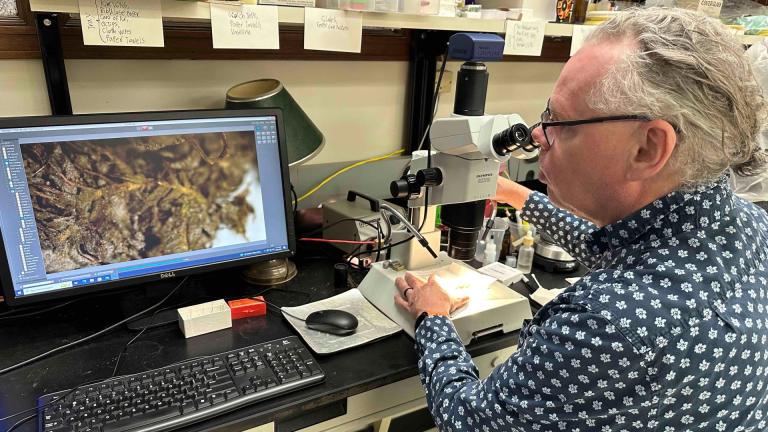
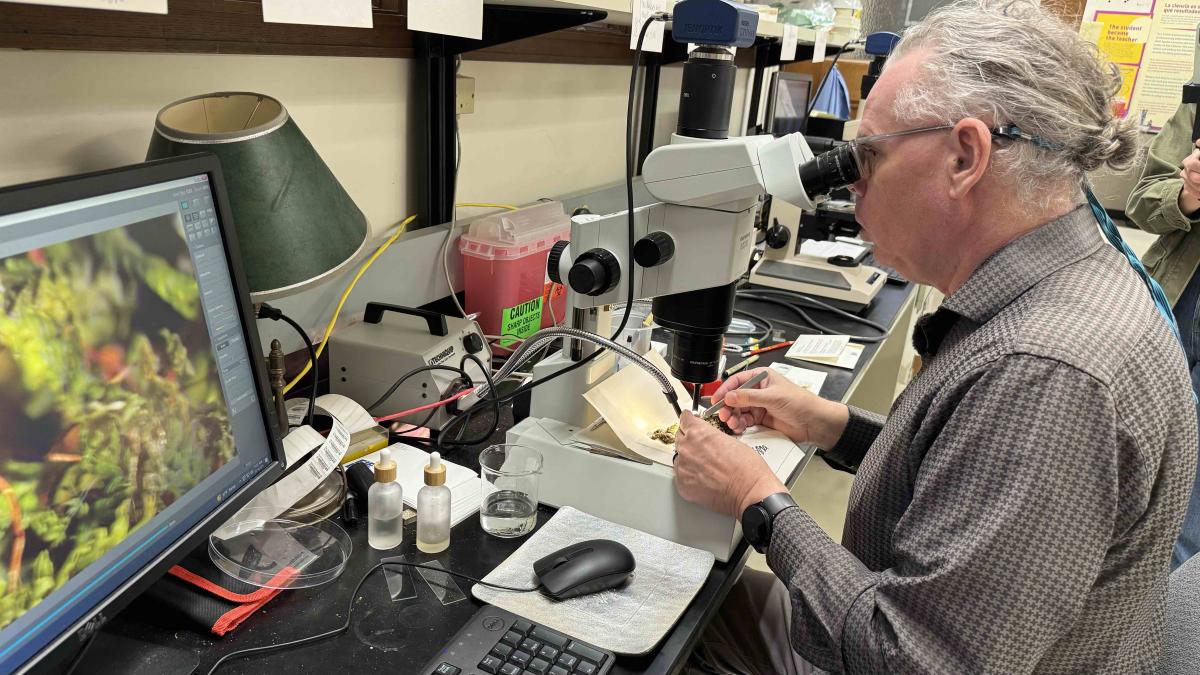 Field Museum research Matt von Konrat examines a specimen of moss under a microscope. (Patty Wetli / WTTW News)
Detectives are using all kinds of gizmos and gadgets to solve crimes these days, from cellphone pings to facial recognition software.
But they’re overlooking a low-tech — actually no-tech — source of clues that’s quite literally underfoot.
It’s moss.
At least that’s the conclusion of a newly published study, led by researchers at the Field Museum. Matt von Konrat, head of botanical collections at the Field, is lead author on the paper, with an assist from Jenna Merkel, who interned at the museum in 2024 and is among the co-authors.
They combed through 150 years of scientific literature looking for instances where moss may have helped crack a case, and they turned up roughly a dozen examples. The relatively small sample demonstrates the value of moss as a forensic tool, but also illustrates that it’s underutilized, von Konrat said.
“We wanted to highlight this to help law enforcement,” von Konrat said. “Hey, there’s microscopic evidence out there that we might be missing and that could be useful.”
Von Konrat isn’t just theorizing. He himself consulted on a case in 2013 in which moss was key to pinpointing the burial location of a murder victim in northwest Michigan.
A specific composition of plants, especially mosses, had been found on the soles of the suspect’s shoes. “There’s all sorts of fragments that you would never think of,” von Konrat said.
This is where a reference collection like the Field’s comes in handy, because there are hundreds of species of mosses in the Midwest alone. In the Michigan case, a half-dozen species were found on the shoes, which the Field was able to ID.
That information, in turn, allowed botanists, including von Konrat, to home in on the sort of micro-habitat where the plants could be found in combination.
“I describe it as we had several haystacks, and we could narrow the haystackwhere we were trying to find that needle,” he said.
Moss also supports other microscopic life — microorganisms, mites, insects, fungi and more — which can offer up additional clues.
") Mosses have the ability to "soak up water like a sponge," said researcher Matt von Konrat, "which then prevents soil runoff and erosion." (Patty Wetli / WTTW News)
Mosses have the ability to "soak up water like a sponge," said researcher Matt von Konrat, "which then prevents soil runoff and erosion." (Patty Wetli / WTTW News)
Von Konrat didn’t set out to become a sort of botanical Sherlock Holmes, but forensics work has become part of the job.
Pollen from flowering plants is a surprisingly common piece of evidence gathered by law enforcement because it gets onto and into pretty much everything, and it tends to stick around.
“It’s in our hair and our clothes,” von Konrat explained. “So that’s helped with murder inquiries, missing children and so on.”
Again, the Field’s pollen reference collection can help ID a species and a plant’s known range. Seized shipments of fentanyl are being tracked back to their source using this information, according to von Konrat.
“Pollen is found in the packaging,” he said. “It’s like a biological stamp.”
Now, if investigators take the time to look for and collect moss as evidence, who knows where it will lead?
The Field has more than 300,000 specimens of moss and moss-like plants in its herbarium collection, representing some 20,000 difference species.
“This is what’s really cool about natural history collections. We know right now we’re using them to address food security, discovering new species to science, helping understand biodiversity, conservation, land management, climate change. But we can’t even imagine 100 years from now how these specimens are going to be used,” von Konrat said. “What I find really exciting is just imagining how our natural history collections can be used in the future.”
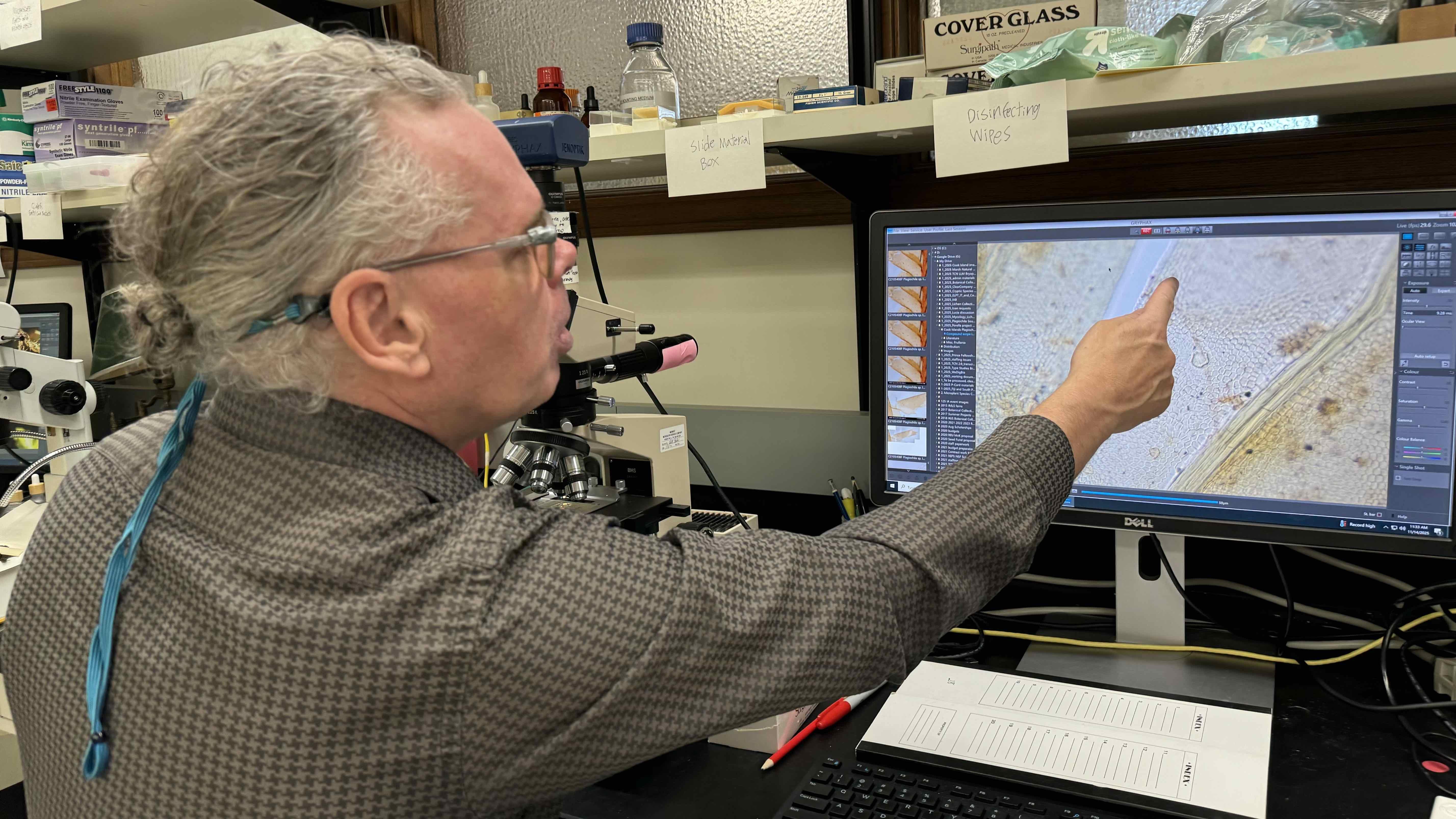 Field Museum research Matt von Konrat reveals the cellular-level detail of moss that can be viewed under magnification. (Patty Wetli / WTTW News)
Moss is an unlikely hero in its own 400-million-year-old story.
These non-flowering plants, which were among the first to make the transition from water to land, lack the showy blooms that typically attract attention. And because they don’t have vascular systems to deliver resources across the plant, they’re quite small.
“You know, it’s nothing exciting to look at with your naked eye,” said von Konrat.
For von Konrat, who grew up in Aotearoa New Zealand, moss was always just part of the background scenery, like so much green carpeting.
“Mosses love wet, damp environments. And parts of New Zealand are like the wettest areas in the world. We have an insane amount of rainfall in some areas, 30 to 40 feet of rain ever year. Can you imagine that? There are some places where it rains every day,” he said. “Well these mosses, they just love moisture, love the humidity. So they’re always around us.”
Von Konrat credits a mentor for encouraging him to take a closer look at the tiny plants.
“It was like opening a curtain to a whole microscopic world that I just didn’t know existed,” he said. “That’s what got me more curious.”
At university, von Konrat realized how little was known about mosses and how much there was still to discover, which is catnip to a scientist.
“They’re not a charismatic group of plants and so they’re often overlooked even in the science world,” he said. “That’s what drew me in.”
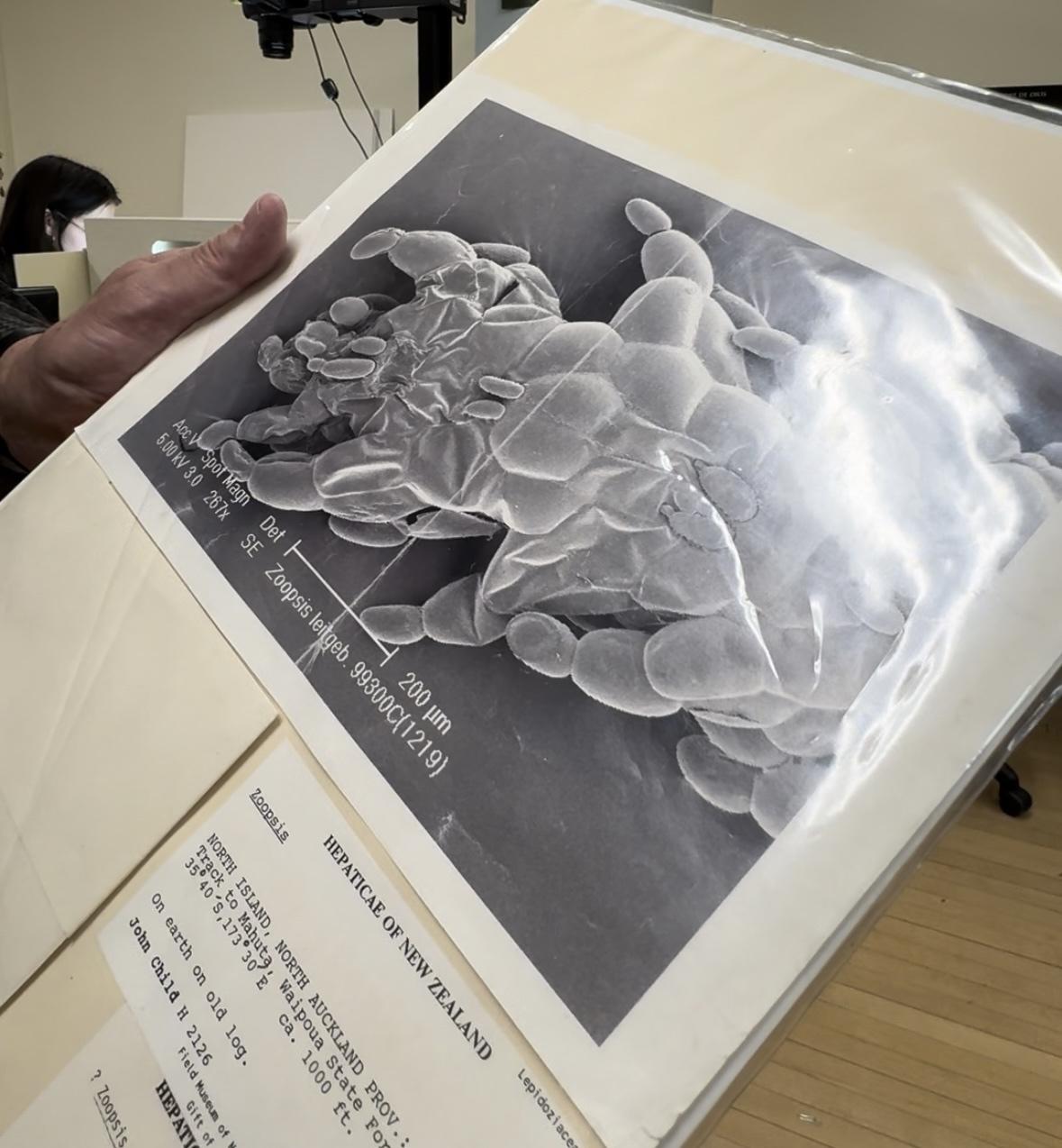 An eyelash-sized specimen of moss-like Zoopsis leitgebiana, under magnification, looks more like a bug than a plant. (Patty Wetli / WTTW News)
Take a small bit of moss and put it under a microscope and what once seemed like a uniform mass of velvet suddenly takes on defined characteristics.
“You see all sorts of anatomical detail,” said von Konrat. “It’s got little leaves, just like a little flowering plant.”
Under magnification, an eyelash-sized specimen of one of von Konrat’s favorite species of moss-like plants — Zoopsis leitgebiana (actually a liverwort) — could easily be mistaken for an insect itself.
“You’d look at this and you would think, Matt, that’s not a plant. I mean, it looks like it’s got limbs. It looks like it’s a bug or a mite or something,” he said. “Of course, it has to come from New Zealand.”
Accelerating Discovery
The Field Museum is in the process of digitizing its collection of moss and moss-like specimens, part of a global effort to create a centralized, searchable database that researchers around the world can explore. All together, the institutions involved in the project have a collective 1.2 million specimens of moss.
Access to such large data sets, which include information about where and when specimens were collected, would allow scientists to pinpoint, for example, when an invasive species first showed up and to track where it’s spread. Or researchers might notice migration patterns — species moving north or south over time.
“We can begin to investigate all sorts of questions … accelerating the whole process of discovery,” von Konrat said.
From an evolutionary perspective, moss holds keys to the ways plants adapted to life on land versus the sea. They’re also excellent indicators of environmental and ecological shifts.
“They can respond very rapidly to change, and we can see that earlier than with other organisms,” said von Konrat.
Where trees or humans might take decades to manifest the effects of exposure to a pollutant, for example, moss “can tell you in real time what’s happing in the atmosphere,” he said.
To gauge the usefulness of moss as the proverbial canary in a coal mine, von Konrat and his team at the Field are placing moss samples around the city and after a few weeks, bringing them back to the lab to test for the presence of heavy metals like iron, copper, zinc and others.
“It’s a standard tool that Europeans use and we’re wanting to see if this could be transferred to a Chicago urban setting,” he said.
Europeans are also experimenting with larger scale moss walls in cities like London and Berlin to remove pollutants and cleanse the air, something von Konrat would like to explore in Chicago as well.
Decades since he first arrived at the Field Museum, von Konrat has barely begun to scratch the surface of what we can learn from moss, the most basic of plants with infinite layers of complexity.
Which brings von Konrat back to forensics. He’s already working on second paper that will detail moss’ starring role in yet another local crime.
“I never imagined we could be using our research, our collections, our skills, our facilities to help law enforcement this way,” he said. “It’s a very different world.”
Contact Patty Wetli: [email protected]