Crime & Law
State’s Attorney Eileen O’Neill Burke Outlines Case to Uphold Cook County Assault Weapons Ban Ahead of SCOTUS Arguments
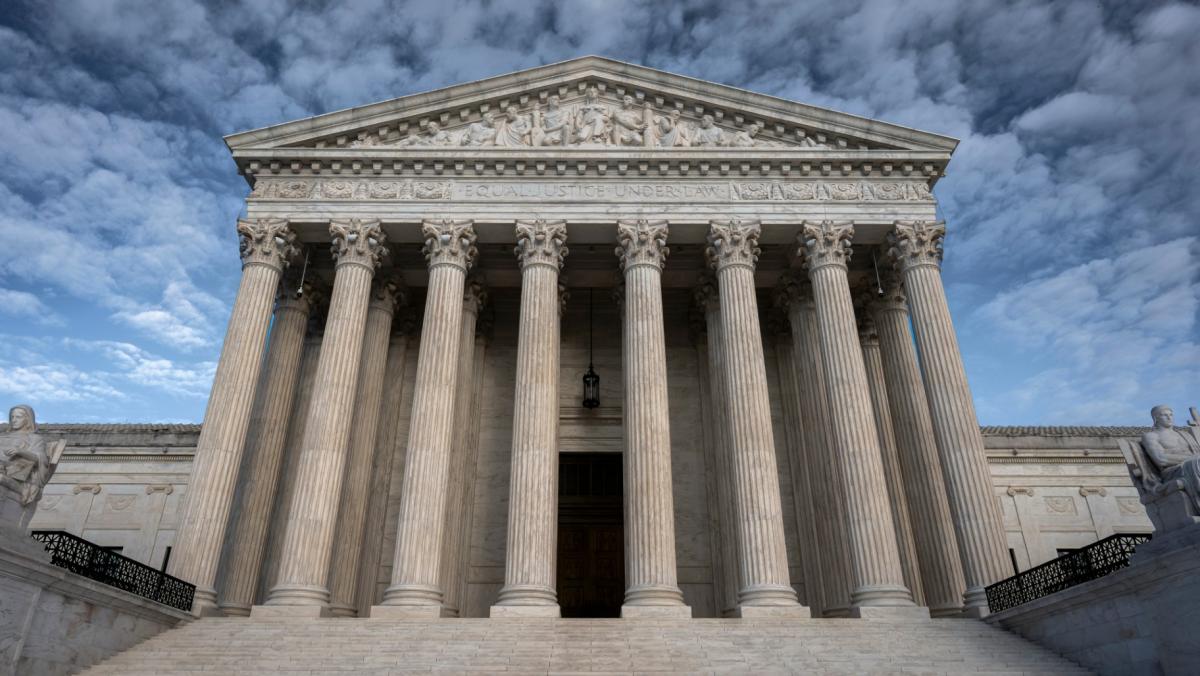 The Supreme Court is seen in Washington, Sept. 29, 2026. (AP Photo / J. Scott Applewhite)
State’s Attorney Eileen O’Neill Burke is defending Cook County’s ban on assault weapons, saying it “passes constitutional muster” as the U.S. Supreme Court is set to take up a challenge to that law later this year.
O’Neill Burke on Thursday filed a 78-page brief with the high court, detailing the legality of the ban, which she said is necessary to “(protect) Cook County from carnage wrought from military-style weapons.”
“Undoubtedly, some Americans may enjoy owning AR-15s for use in target practice and other recreational activities,” O’Neill Burke wrote. “But the Constitution generally leaves it to elected representatives to decide when enjoyable but dangerous products may be sold to the public. And the Second Amendment does not dictate otherwise for a militaristic weapon that is excessively dangerous and ill-suited for self-defense or hunting.”
The Supreme Court in June granted certiorari in a case brought by a pair of Cook County residents and gun rights activists who challenged the county’s existing law, which bars residents from owning, buying or transferring 125 types of rifles, such as the AR-15.
Cook County first adopted a local assault weapons ban in 1993, and it has been updated at least twice since then. It is now officially known as the Blair Holt Assault Weapons Ban, named after a Chicago teen who was killed in a 2007 shooting while protecting a high school classmate.
In 2018, a federal judge in Chicago upheld the law, citing a 7th Circuit decision from three years earlier upholding a nearly identical city ordinance in Highland Park. The case was appealed and in 2019, and the 7th Circuit reaffirmed its position that “bans on assault weapons and large-capacity magazines do not contravene the Second Amendment.”
Those challenging the law now have argued that AR-15 and similar rifles cannot be banned because they are in “common use,” adding in their own August brief that “tens of millions of Americans choose them for lawful purposes like self- and home-defense, hunting, and target shooting, and they are legal to own in a large majority of states across the country.”
That challenge was filed in 2021, when the two gun rights organizations went back to court seeking to have both the Highland Park and Cook County decisions reversed.
They argue that only firearms that are “both dangerous and unusual” may be banned.
According to O’Neill Burke, the velocity of a bullet fired from an AR-15 creates “maximum injury potential,” including broken bones, amputations and more casualties.
“Cook County enacted a ban on AR-15 platform weapons to meet its ‘most basic responsibility … to keep its people safe,’” O’Neill Burke wrote, citing a passage from Justice Samuel Alito in a 2016 case.
Seven of the eight deadliest attacks in the U.S. since Sept. 11, 2001, have involved AR-15 platform weapons, O’Neill Burke said, and from 1991 to 2022, 75% of shootings that resulted in 20 or more deaths involved an AR-15 platform weapon.
O’Neill Burke’s brief references the massacres at the Uvalde elementary school in Texas and the Pulse nightclub in Florida, in which law enforcement officers arriving at those scenes realized they were “outgunned” by the perpetrators.
The brief also mentions that the shooter who attempted to assassinate President Donald Trump during a 2024 campaign rally in Pennsylvania had used an “AR-15 style” rifle and fired from a rooftop around 150 yards away.
“When weapons are introduced into society that have the capability to perpetrate some of our most tragic and frightening crimes,” O’Neill Burke wrote, “from mass shootings to assassination attempts, democratically elected legislators are permitted to respond with appropriate regulation.”
She also argued that using an AR-15 for self-defense is “impractical” due to its heaviness and size, making it difficult to maneuver in a home and less readily accessible, and that numerous states and large cities have already banned AR-15 style weapons themselves.
“People are, of course, free to visit and live in communities that have more permissive approaches towards unusually dangerous firearms,” O’Neill Burke wrote. “But our Constitution and this Nation’s historic record do not support removing firearm regulation from democratic processes when the safety of communities hangs in the balance.”
The Supreme Court is set to hear oral arguments in this case Dec. 2.
Capitol News Illinois contributed to this report.