Politics
NITA Board Elects Leaders at First Meeting. Here’s What to Know About the New Transit Oversight Agency
Video: Nick Blumberg appears on “Chicago Tonight” on Sept. 9, 2026, to give an overview of upcoming changes to Chicago-area public transit ahead of the first meeting of the Northern Illinois Transit Authority, or NITA, board of directors.
The newly formed Northern Illinois Transit Authority’s board of directors met for the first time Thursday, electing longtime transit policy expert Tom Kotarac as chairman.
NITA, created last year to oversee CTA, Metra and Pace, officially replaced the Regional Transportation Authority on Sept. 1. The new governance model came along with an additional $1.5 billion in annual funding for transit to prevent the three operators from going over a fiscal cliff. A slew of elected and appointed officials spoke Thursday, celebrating the achievement and expressing excitement for the work ahead.
Kotarac, whose term as board chair will run for three years, said he’s “bullish” on Chicago-area transit, hailing the “enormous amount of experience and passion and firepower” among his fellow directors. He praised state lawmakers not only for plugging a budget gap as other regions had done with their transit systems but also for taking the opportunity to make “transformational” change.
Kotarac is a vice president of the Civic Committee of the Commercial Club of Chicago, former deputy executive director of CMAP and a former senior staffer for U.S. Sen. Dick Durbin (D-Illinois). Kotarac, who’s been heavily involved in negotiating the law that created NITA and the ongoing transition, acknowledged the enormity of the task facing NITA, CTA, Metra and Pace as they work to create a truly regional transit system.
“We’re going to need some patience from the public,” Kotarac said. “We’re going to need some patience and grace from each other as we work through some difficult issues. But patience can’t become an excuse for delay or inaction.”
At Thursday’s meeting, the board also appointed former Chicago Department of Aviation Commissioner Jamie Rhee as interim executive director of NITA by a 19-1 vote. Kotarac called Rhee, whose term is for six months with an option by the board to extend, “one of the region’s best public servants.”
The appointment came after more than 90 minutes of executive session. Director Oswaldo Alvarez — the lone “no” on the board — said he was not aware there were any candidates under consideration or a vetting process underway, calling instead for an emergency meeting to allow time to consider other potential interim leaders. Director Rosa Ortiz, who supported Rhee’s appointment, said she hopes to see a more open and transparent process for high-level positions going forward.
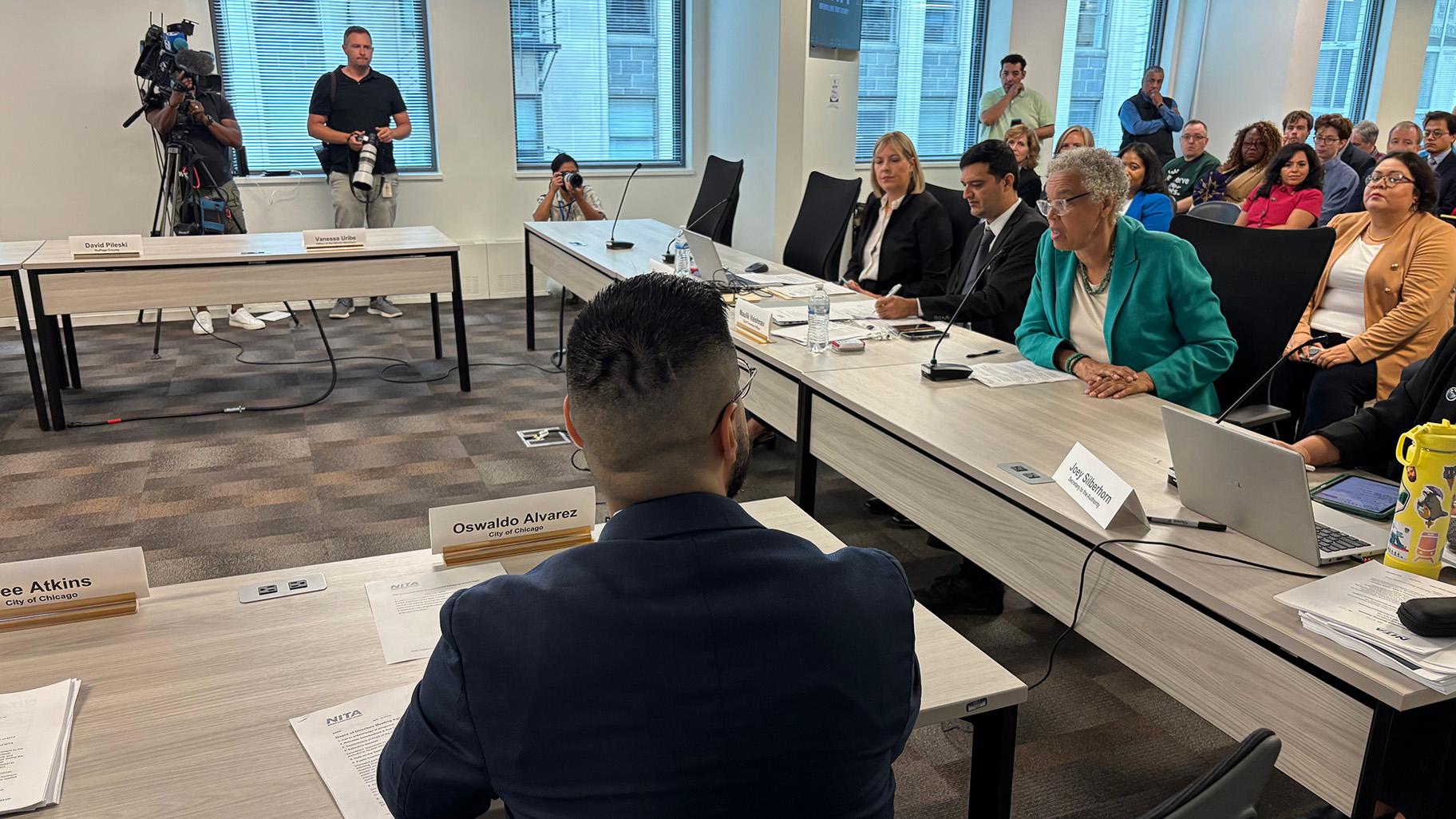 Cook County Board President Toni Preckwinkle addresses the Northern Illinois Transit Authority board of directors at its first meeting on Sept. 10, 2026, in Chicago. (Nick Blumberg / WTTW News)
Kotarac pledged that future major decisions would be handled much differently, but said the vacant executive director position presented an “immediate need,” adding that Rhee does not intend to vie for the permanent position unless the board calls on her to do so. The board approved a measure Thursday retaining the firm K&A to launch a national search for a permanent executive director. Rhee’s salary for the interim position is to be determined.
Asked how her experience leading O’Hare and Midway airports would translate to public transit, Rhee said whether it’s travel by air, bus or train, passengers have the same priorities: “clean, safe and efficient modes of transportation.”
“We have to focus on the transit workers, frontline workers, as well as taxpayers, and so showing those immediate improvements and hitting the ground running is going to be very critical,” Rhee said.
What is NITA?
The Northern Illinois Transit Authority was created after years of debate over the future of Chicago-area transit, a debate exacerbated by a drop in passenger revenue during and after the COVID-19 pandemic.
NITA replaced the Regional Transportation Authority, which critics charged did not do enough to meaningfully coordinate public transit systems and improve rider experience. But the law that created NITA, passed by the Illinois General Assembly in October 2025, stopped short of rolling CTA, Metra and Pace into a single transit agency as some advocates had called for. Instead, the measure grants NITA significantly increased oversight and coordination authority but leaves the three current systems in charge of day-to-day operations.
When will riders start seeing changes?
One of the driving forces behind NITA was creating a universal fare system across the three transit operators. The process for procuring that system is set to be in place by July 1, 2027, with the system fully up and running Feb. 1, 2030.
Another persistent issue facing Chicago-area transit is safety. Some efforts are already underway, including increased Chicago police and new Cook County sheriff’s police patrols on CTA. The law creating NITA established a Law Enforcement Task Force aimed at sussing out the best way to ensure public safety across the system. That task force’s report is due March 1, 2027. No later than June 1, 2029, the law calls for the task force to be disbanded with a transition to some form of crime prevention program using sworn law enforcement officers.
Advocates also called for non-law enforcement, customer-facing employees aimed at improving rider experience, known as transit ambassadors. That program is set to be implemented July 1, 2027.
Additionally, a key component is truly regional service planning and coordination — in essence, ensuring that a CTA train doesn’t pull into a station just as a Pace bus is pulling away, or a disembarking Metra passenger doesn’t face a lengthy wait to transfer to Pace or CTA. Under the law, IDOT was charged with hiring a consultant to come up with a sprawling transition plan that includes not just service planning, but everything from paratransit to procurement to capital planning. In August, the firm Boston Consulting Group began its work, with a final report due to the General Assembly by July 1, 2027. NITA is charged with implementing the transition plan by Sept. 30, 2027.
In a couple of years, service planning is set to be fully coordinated across the Chicago area. CTA, Metra and Pace are required to submit their service plans to NITA by April 30, 2028, and the board must approve a region-wide service plan by Dec. 31, 2028. That plan will go into effect in 2029.
Who’s in charge?
The NITA board is made up of five appointees each from the governor, the mayor of Chicago and the Cook County Board president, as well as one appointee each from the chief executives of Kane, Lake, McHenry, DuPage and Will counties. That structure was a bone of contention during negotiations, with collar county officials arguing the deck will be stacked in Chicago’s favor. NITA supporters said they’re committed to an equitable approach across the region — and Chicago transit advocates also point out the vast majority of trips in the area are on the CTA. Check out this link to see who’s on the board. Many of the appointees will also serve as directors for CTA, Metra and Pace, which will still have their own boards. The board terms for NITA and the three transit operators all began on Sept. 1, per law.
Contact Nick Blumberg: [email protected] | (773) 509-5434 | @ndblumberg