Science & Nature
From Saddles to Seed Nursery, This Former Barrington Horse Farm Is Being Restored to Native Habitat
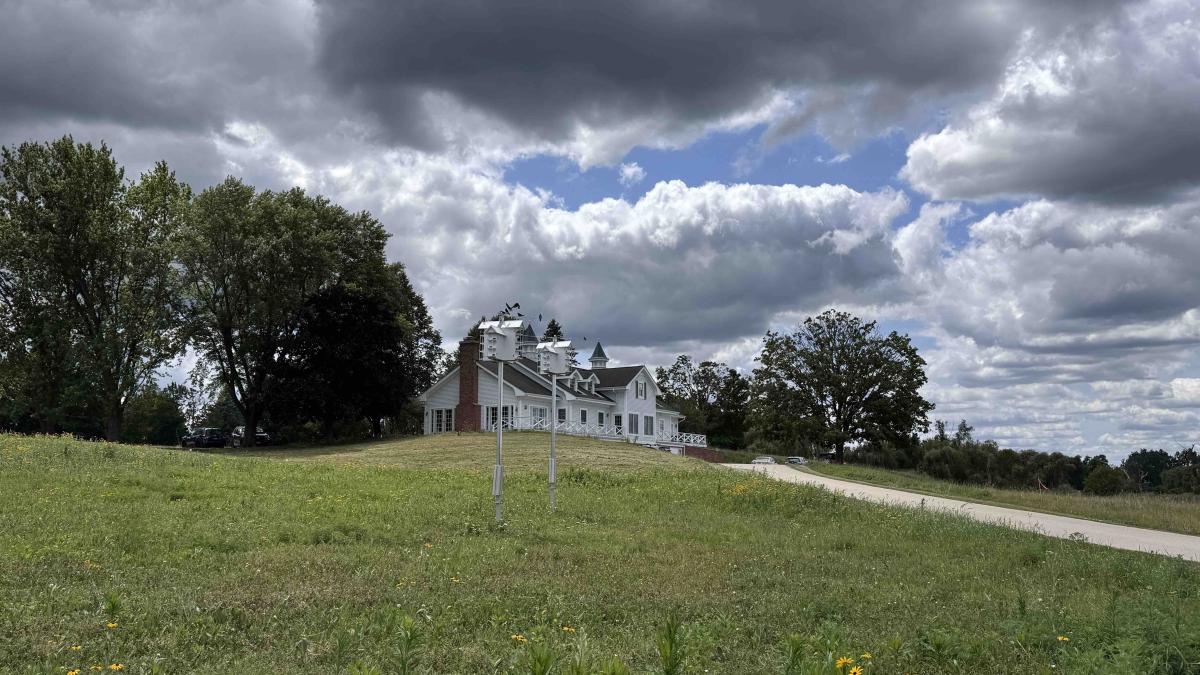 Citizens for Conservation moved its headquarters to Hill 'N Dale in 2025, taking advantage of an existing building on site. The views are spectacular and staff can witness changes to the landscape in real time, Abigail Derby Lewis said. (Patty Wetli / WTTW News)
First-time visitors to Barrington Hills must think they’ve taken a serious wrong turn somewhere. Between the horse-crossing signs and ubiquitous white rail fencing, this neck of Chicago’s north suburbs could easily be mistaken for Lexington, Kentucky.
It’s equestrian country here and Hill ‘N Dale horse farm was a long-established part of the area’s culture, but in 2022 the property was put out to pasture.
The Barrington-based nonprofit Citizens for Conservation (CFC) purchased the 232-acre parcel with the intent of returning the farm to its native wetland and prairie habitat. Last year, the organization moved its headquarters to what’s now Hill ‘N Dale Nature Preserve — repurposing an existing building — in order to gain an understanding of the land’s seasonal rhythms and to witness changes in real-time.
“This is the best office anyone could ever ask for,” said Abigail Derby Lewis, CFC’s executive director. “We’ll be in a meeting and suddenly you’ll hear the sandhill cranes and we’ll all just jump out of our chairs and go and take a look.”
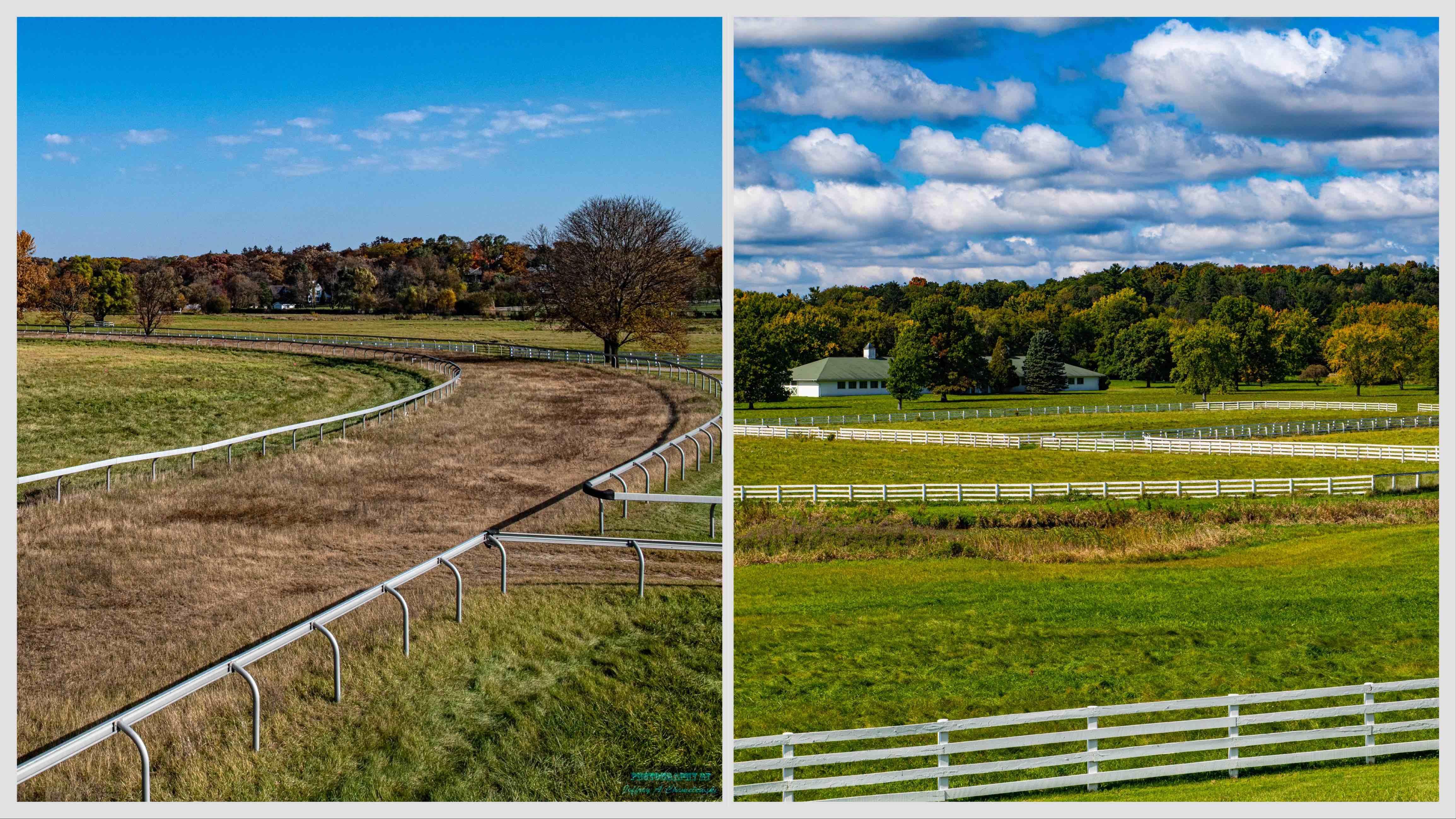 Some of the first restoration work at Hill 'N Dale involved removing a horse track and 20 miles of fencing. (Courtesy of Jeff Chemelewski)
After just a handful of years under CFC’s volunteer-led stewardship, the landscape already appears noticeably altered. A large viewing tower, horse track, paddocks and more than 20 miles of fencing were removed in short order to create a contiguous space. Over the past 18 months, efforts have picked up pace.
“When you’re listening, the land will tell you what it wants,” Derby Lewis said. “So, we’re beginning that slow roll.”
This year, burn crews conducted the first prescribed fires to see how plant communities responded. And this past spring, CFC dug out 10 acres of drainage tiles, the first phase in what will be the lengthy process of reviving natural wetlands along the section of Spring Creek (part of the Fox River watershed) that snakes through Hill ‘N Dale.
“Being able to see the amount of some of these native plants that are coming back as we remove that drain tile, having more of those wet areas and seeing what the seed bank is bringing up … it only spurs and energizes and inspires people to do more,” Derby Lewis said.
Additional plans include creating a community hub and increasing the nature preserve’s public visibility and accessibility. Currently the preserve is open Monday to Friday, 10 a.m. to 4 p.m.
But deliberate is the name of the game, especially in these relatively early days.
“This is a long game. This is a multi-decade restoration,” Derby Lewis said.
There are still surveys to conduct of existing wildlife — like the macro- and microinvertebrate populations in the creek, and amphibians and reptiles — before tackling larger projects.
“You need to know what’s already here because when you start changing — when you start putting fire to the ground, when you start seeding — you need to know whether you’re going in the right direction. And the animals will tell you that,” she explained. “So what kind of patterns or shifts that you see will help to inform the management moving forward.”
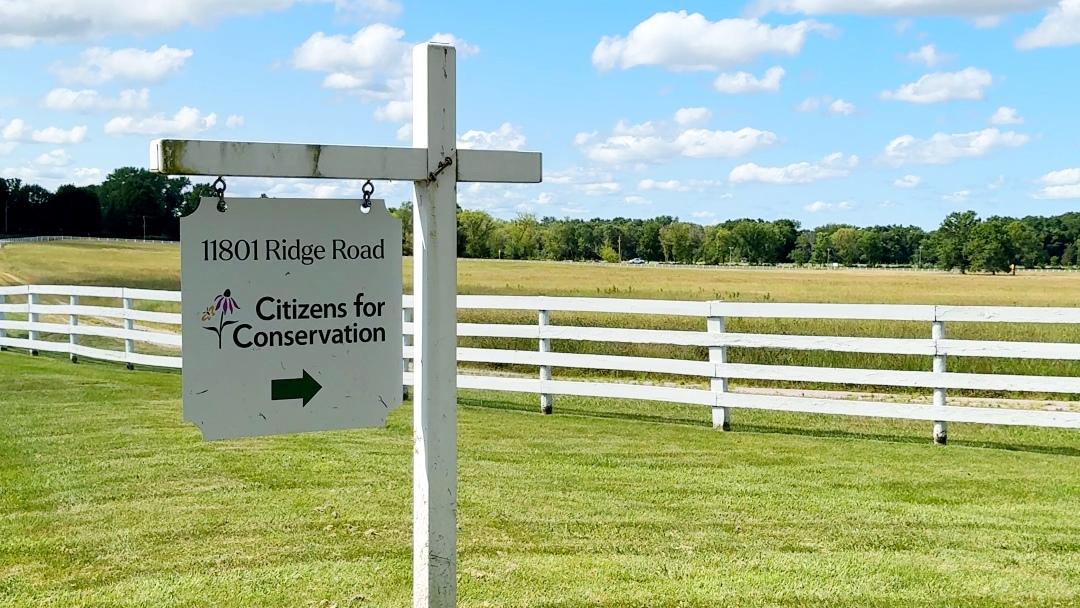 Citizens for Conservation is restoring grassland in the middle of Barrington's horse country. (Nicole Cardos / WTTW News)
Hill ‘N Dale was previously owned by the Duchossois family — a prominent name in Chicago’s business and philanthropic circles. (The family maintained ownership of the farm’s northern section.) The nature preserve is located less than 15 miles from another recently unloaded Duchossois property: the 326-acre Arlington Park, which the Chicago Bears bought in 2023 for $197 million, ostensibly as the future home of a new stadium.
By comparison, Hill ‘N Dale’s $10 million price tag sounds like a steal. For CFC, though, the purchase was a huge stretch, but one worth taking given how few properties of that size come on the market, Derby Lewis said.
Donors contributed half of the needed funds and the remaining $5 million came in the form of the largest grant ever awarded by the Illinois Clean Energy Foundation. And then CFC was off to the races.
While the Bears’ development has stalled, CFC came out of the gate with a clear plan for its new acquisition.
Twenty years from now, Derby Lewis envisions wetlands along the creek gradually giving way to drier prairie grassland as the topography becomes hillier.
“You’ll have all these different habitat types knit together in this space in 20 years,” she said. “Will it be completely whole again? No. But it will be on its journey to being what it once was, and also, importantly, what it can be in a different kind of future.”
Stepping Stones
CFC was founded in 1971 by Barrington residents as a response to rapid development happening at the time.
“It was about saving and protecting land before it could be paved over and a shopping mall put up,” Derby Lewis said.
Over the last couple of decades, the organization has adopted a more strategic approach toward acquisition, which becomes evident when Derby Lewis pulls out a map of the region.
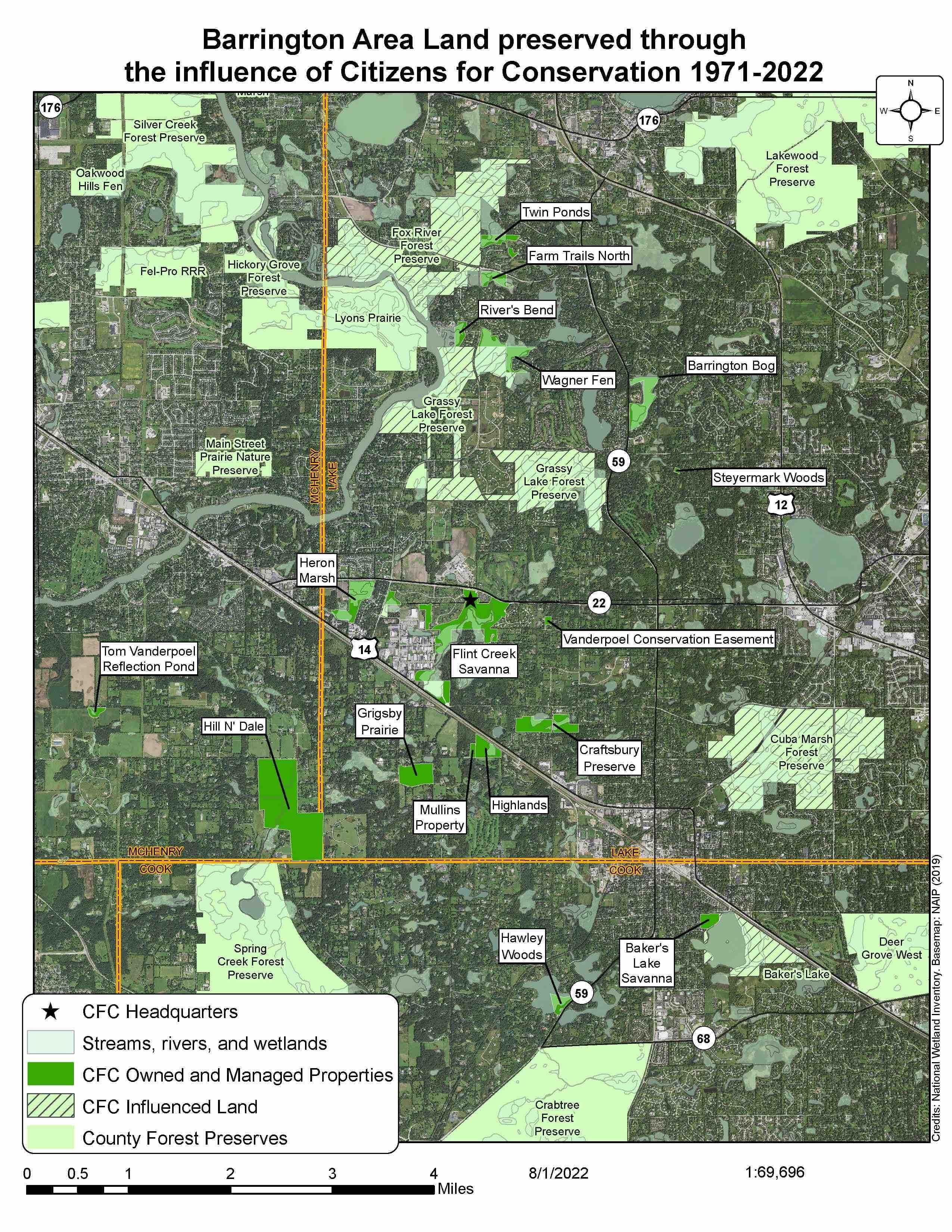 Citizens for Conservation's preserves, in dark green, can be viewed as stepping stones connecting public lands owned by surrounding forest preserve districts. (Citizens for Conservation)
CFC has staked out a territory, so to speak, in an area that straddles the confluence of Cook, Lake, McHenry and Kane counties, and their respective forest preserve districts.
“When you look at where the forest preserve public lands are, there are these big gaps,” she said.
CFC’s 14 natural areas help fill those gaps, serving as “stepping stones” between larger forest preserves. In this way, CFC helps connect and create a corridor for native plants and wildlife “across what is otherwise a pretty harsh landscape,” Derby Lewis said.
Hill ‘N Dale is far and away the largest preserve in CFC’s portfolio, accounting for nearly one-third of the 735 acres under the organization’s management. The size was a large part of the property’s appeal, in terms of the unique benefits it could offer to wildlife.
Its past equestrian use, and agricultural use before that, means there’s little in the way of trees at Hill ‘N Dale, with much of it managed as a hay meadow. In other words, it’s a grassland.
Northern Illinois was once dominated by prairie, but precious little remains today.
“Nobody talks about grasslands. They’re wildly under-studied, undervalued … and folks know vanishingly little about them,” Derby Lewis said.
As it matures, Hill ‘N Dale has the potential to educate neighbors and visitors about the ecosystem benefits of grasslands, while in the near term, its existing hay meadows are already providing a refuge for grassland birds, which require vast amounts of wide-open prairie for nesting and foraging.
“It’s really hard to support a grassland bird community in a prairie or hay meadow that’s less than 50 acres, because you have more trees and development, and that increases predation from raccoons, skunks, possums — animals that’ll eat bird eggs,” said Luke Dahlberg, CFC’s conservation seed program manager.
Though Dahlberg’s a horticulturist by training, he’s also a passionate birder, and he spends a lot of time thinking about the mix of plants that will best support the diverse needs of the various avian species he hopes to attract to Hill ‘N Dale.
There are birds that prefer cool season grasses, which grow in spring and early summer, while other species favor warm season grasses that grow in mid- to late summer. There are birds that fancy tall grasses topping 6 feet in height, birds that go for waist-high grasses, and birds that like grasses 1 foot tall or less.
Supplying that menu of options is no small order.
“Historically, you got that mosaic of grass height through grazing with bison and elk, when they were still in Illinois, and fire,” Dahlberg said. “When you’re trying to create an ecosystem … in a human lifetime … that took 12,000 years to form, it’s kind of challenging.”
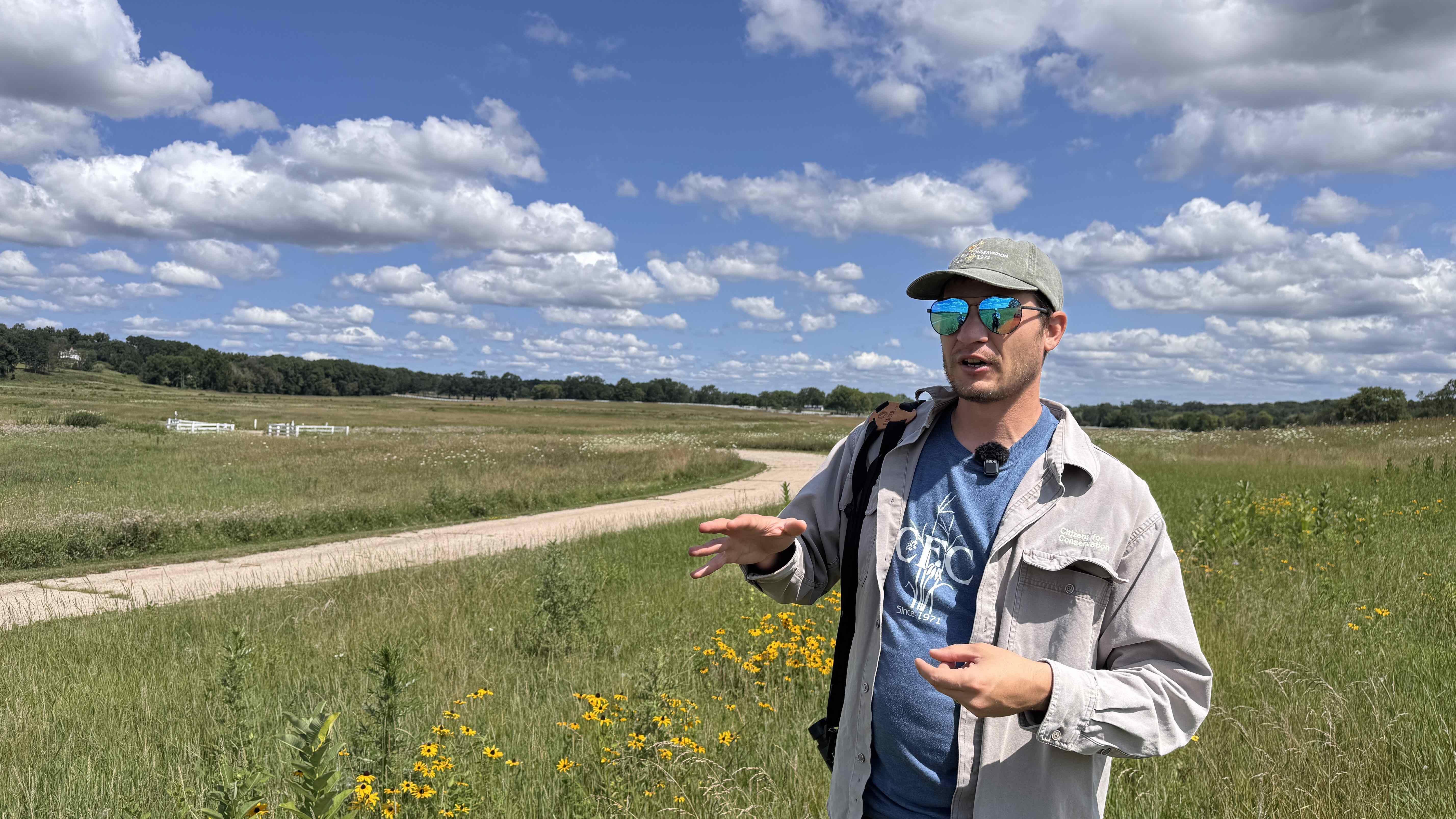 Luke Dahlberg describes the methodical approach he's taking to seeding native plants at Hill 'N Dale, beginning with a two-acre area. (Patty Wetli / WTTW News)
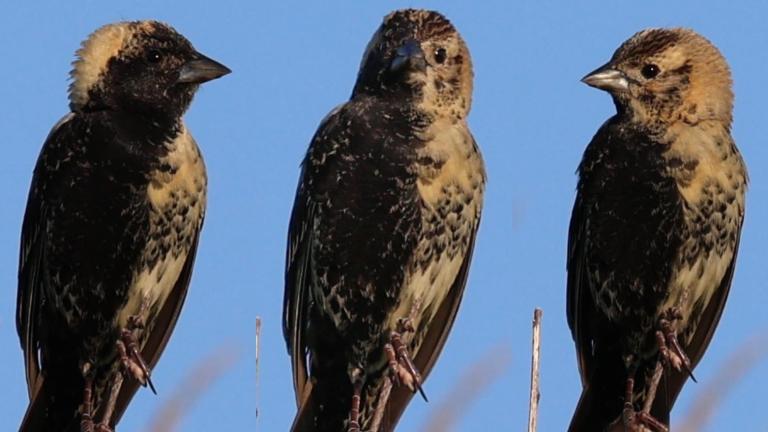
Dahlberg is taking a methodical approach, starting small with two acres of upland prairie at Hill ‘N Dale, taking care not to disturb too much hay meadow at once, knowing that grassland birds like bobolinks and Henslow’s sparrows have grown accustomed to using the habitat.
Initially, Dahlberg sowed what’s called a “pioneer” mix of seeds. These are plant species, like black-eyed Susan, that will bloom quickly — versus other natives that can take up to 10 years to flower — and compete with non-native weeds. Once Dahlberg senses invasives are under control, the next step will be to sow a higher diversity mix.
It sounds deceptively simple, but collecting and processing native seed is labor intensive, to say nothing of the complexity involved in getting some species to germinate. Dahlberg said he’s spent five years trying to crack the code of certain seeds.
“Some plants are just on their own different time schedule,” he said. “I’ve had to learn patience through plants.”
CFC relies on volunteers to collect seeds from its preserves — none of it is purchased. In the organization’s early years, before those properties were established, seed was gathered from nearby remnant prairies in pioneer cemeteries and along railroad right-of-ways.
“We’ve saved (those) local genetics at our preserves now,” Dahlberg said.
Grigsby Prairie, CFC’s oldest restoration, is located just a couple of miles from Hill ‘N Dale and contains some of the highest quality seed. Entire chunks of remnant prairie were dug up and transplanted here when CFC rescued plants about to be torn out when Northwest Highway was widened in the 1990s.
“We’re wondering if bringing the soil microbe community from that remnant ecosystem … could be why some of those rarer plants are doing well,” Dahlberg said.
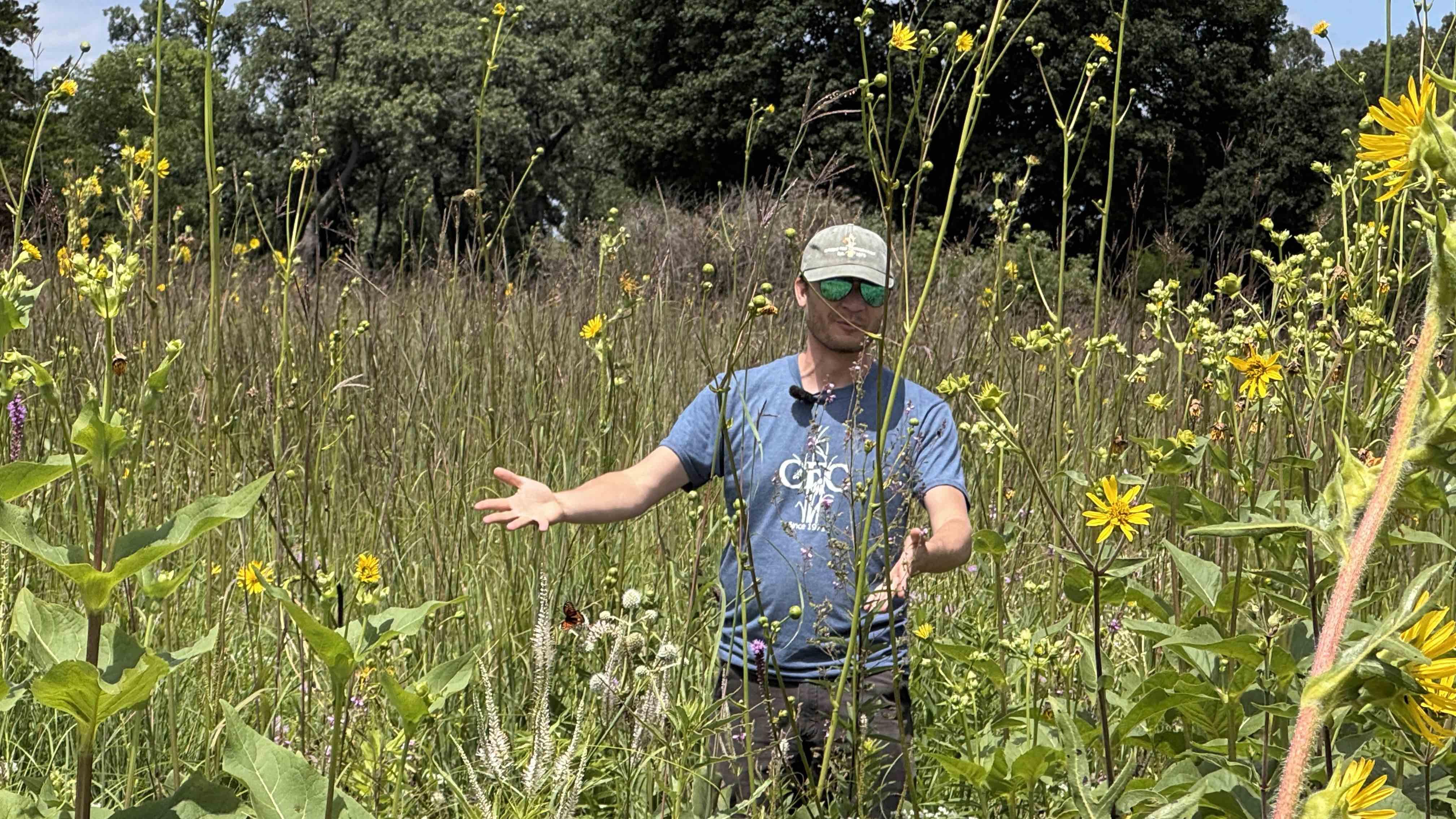 Grigsby Prairie, just miles from Hill 'N Dale, is Citizens for Conservation's oldest restoration project. Here, Luke Dahlberg is dwarfed by the tall prairie plants. While Grigsby can serve as a model for Hill 'N Dale, Dahlberg said every site has unique needs and characteristics, and some managements practices have changed as lessons have been learned over the years. (Patty Wetli / WTTW News)
In 2025, CFC volunteers gathered a total of 700 pounds of seed from more than 250 native plant species, many of which aren’t available commercially. Some of this haul is re-sown at CFC properties and some is shared with partners across the region, such as forest preserve districts.
A plant like dark green bulrush can have 500,000 seeds per ounce. “We collected a barrel full of that. Think about how many millions of seeds are in there,” Dahlberg said.
And still, it’s not enough.
As conservation organizations tackle larger-scale restoration projects, the need for native seed has only grown, which is why CFC is part of a regional “seed amplification” program, with participants that include the Chicago Botanic Garden.
“We’re going to build our own sustainable seed nursery with a greenhouse and a hoop house and a seed barn because we’re outgrowing where we’re at now,” Dahlberg said. “We’re filling our barn to the max with seed between us and our partner organizations and we just need a bigger barn. It’s like with ‘Jaws’ — you need a bigger boat. We need a bigger barn.”
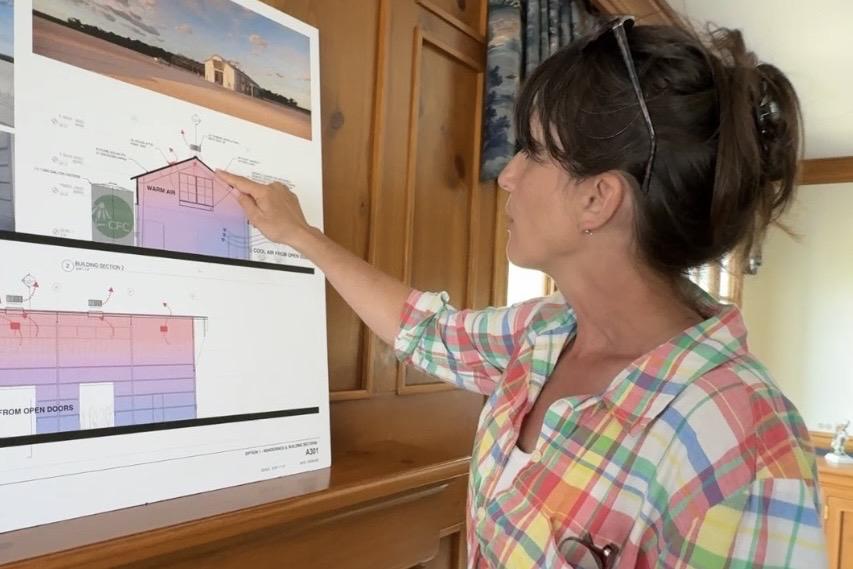 Talking through renderings of a planned seed nursery, Abigail Derby Lewis points out sustainable features including wind turbines, solar attic fans and a 7,000-gallon cistern. (Patty Wetli / WTTW News)
CFC hopes to break ground on the seed operation, which will be built at Hill 'N Dale, this fall, starting with construction of the greenhouse. The aim is to have it operational by February 2027, with the rest of the nursery up and running by spring 2027.
It’s an ambitious timeline, but “that’s how I roll,” Derby Lewis said.
Dahlberg is already anticipating what the seed nursery will mean for restoration efforts — propagating thousands of plants and growing bagfuls of rare seed instead of collecting handfuls — while Derby Lewis is excited about the opportunity for community engagement.
The plans include a flex space for presentations, trainings, workshops and gatherings, looking right out onto the same creek she can see from her office.
“A lot of folks in conservation talk about the work we do as being in the forever business, because what we’re doing now isn’t just for today or tomorrow,” she said. “This is about caretaking and everyone being a part of that caretaking and feeling that responsibility we have to the land, to the water, and passing that on generation to generation.”
Contact Patty Wetli: [email protected]
Related Stories