Science & Nature
Voyager 1 Is Almost a Light-Day Away From Earth. NASA Wants Everyone to Flash an Interstellar Greeting
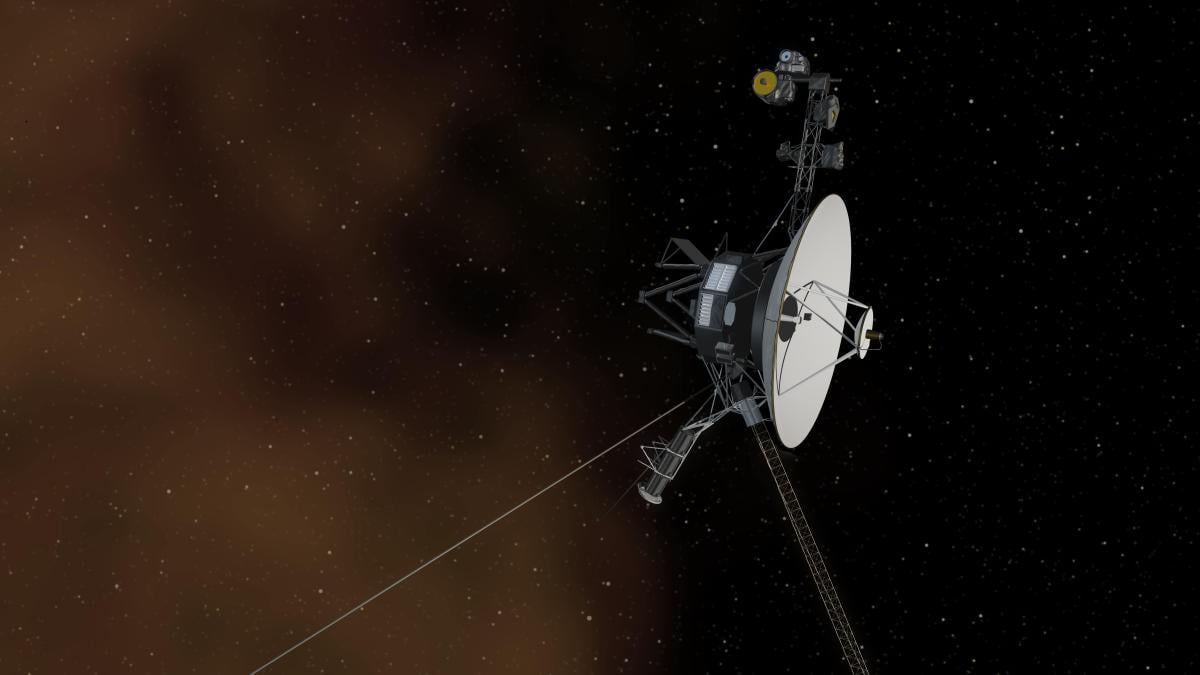 A rendering of Voyager 1 in deep space. (NASA / JPL-Caltech)
NASA is recruiting all of planet Earth to send a celebratory message to Voyager 1 as the spacecraft nears a milestone that’s been half a century in the making: It’s about to reach the incredible distance of one light-day away from Earth.
No other human-made object has ever ventured so far — roughly 16 billion miles, or the distance a particle of light can travel in a single day.
For context on how far out there Voyager 1 really is, sunlight takes 8.3 light-minutes to cover the 93 million miles from the sun to Earth. That’s a fraction of a light-hour, which is a fraction of a light-day.
To mark the historic moment, NASA is inviting everyone to “shine bright for Voyager’s light-day” by sending a light signal, spelling V-G-R in Morse code, to the spacecraft after sunset on Tuesday. It will then take a light-day for the message to reach the spacecraft on Wednesday, when it actually crosses the light-day threshold.
“A simple act. A shared moment. A celebration of humanity’s farthest reach,” NASA said.
NASA has created an automated flasher, available online.
Or people can grab any sort of light of their choosing — headlamp, flashlight, phone, lantern, etc. — and blink the code on their own. If switching on and off is clunky, NASA suggests covering the light with your hand or a piece of cardboard.
Here’s the series of dots and dashes that spells out V-G-R:
— V: dot-dot-dot-dash
— G: dash-dash-dot
— R: dot-dash-dot
Dots are quick bursts, dashes are slightly longer. Wait one second between letters. NASA is encouraging people to repeat the code for up to one minute, and to share videos online by tagging @NASA.
Voyager 1 launched in 1977, 16 days after its twin, Voyager 2, but its trajectory has taken it further, faster. Voyager 2 won’t reach light-day distance until November 2035.
Voyager 1’s initial planetary mission included fly-bys of Jupiter and Saturn, where it documented new moons and rings.
As the spacecraft prepared to leave the solar system in 1990, mission commanders told it to take one look back. The resulting photo, Pale Blue Dot, shows Earth from Voyager 1’s vantage point, a single tiny pixel, some 3.8 billion miles away.
The craft went interstellar in 2012 and is now headed toward a star known as Gliese 445 in the Ursa Minor, or Little Dipper, constellation. It should get there in 40,000 years.
Contact Patty Wetli: [email protected]