Crime & Law
Judge Set to Rule Thursday in Case Centering on Federal Immigration Agents’ Use of Force: ‘I Could See Inside the Barrel’
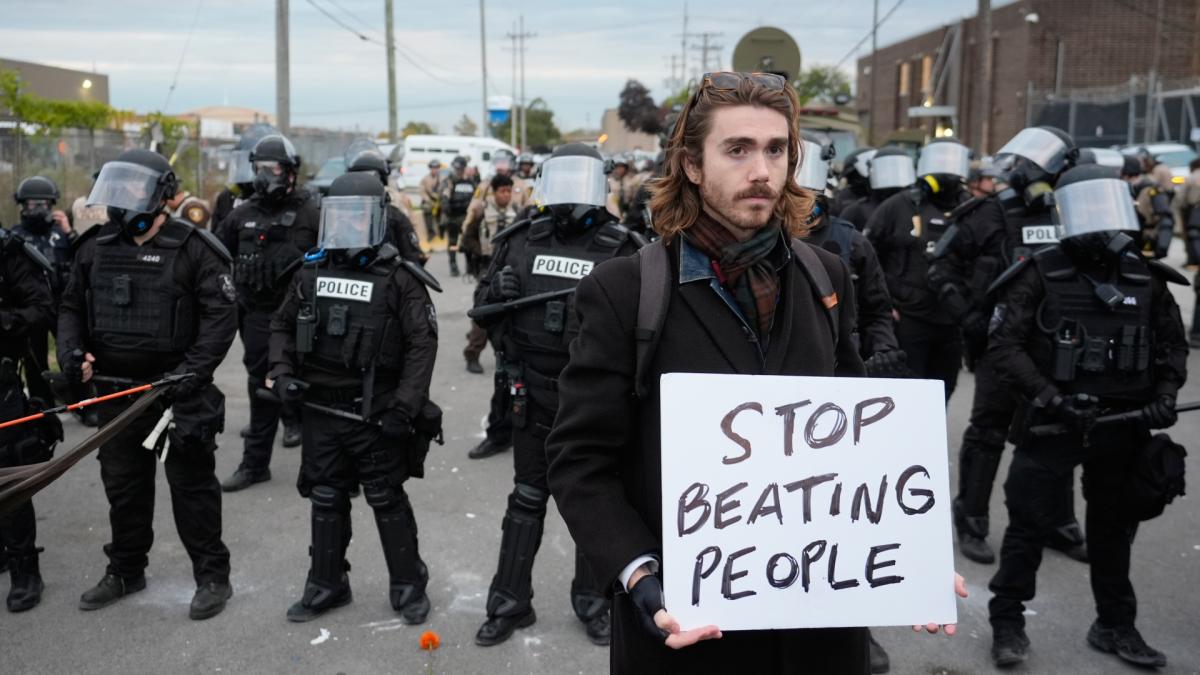 Law enforcement standoff with protesters outside an ICE processing facility in the Chicago suburb of Broadview, Ill., Saturday, Nov. 1, 2025. (AP Photo / Alex Brandon)
Protesters, clergy members and others who say they’ve been directly impacted by a series of increasingly aggressive raids across Chicago and the suburbs testified before a federal judge weighing whether to impose a lengthier ban on immigration agents’ use of chemical weapons like tear gas and pepper balls.
U.S. District Judge Sara Ellis oversaw a daylong hearing Wednesday amid claims that federal immigration agents have repeatedly flouted her temporary order banning the use of “riot control” weapons against people who aren’t posing any threat to law enforcement officers.
The hearing came as part of a lawsuit brought by the Chicago Headline Club, Chicago Newspaper Guild Local 34071, Block Club Chicago and other media organizations who’ve alleged immigration agents have engaged in a “pattern of extreme brutality” that’s part of a “concerted and ongoing effort to silence the press and civilians.”
Ellis did not rule on the request Wednesday, but is set to decide on the preliminary injunction early Thursday before the TRO expires at 11:30 a.m.
The daylong, oftentimes contentious hearing included several hours of eyewitness testimony, footage of immigration agents deploying pepper balls and tear gas, and portions of a recorded deposition with Border Patrol chief Gregory Bovino.
Attorneys repeatedly grew upset with each other over timing and the scope of questioning to the point that Ellis eventually pulled lawyers on each side into a hallway outside of court to scold them.
“If someone strays into a pepper ball, that’s on them — don’t protest,” plaintiffs’ attorney Craig Futterman said Wednesday, describing the sentiments of Bovino and other federal immigration officials. “If you don’t want to get tear gassed, don’t protest.”
As part of that lawsuit, Ellis last month entered a temporary restraining order banning federal agents from using tear gas or other “riot control” weapons against journalists, protesters and any others who do not pose an immediate threat to law enforcement.
With that TRO set to expire Thursday, the plaintiffs have now sought a preliminary injunction to continue that ban indefinitely.
Futterman argued that without that injunction, immigration officials “will continue to trample on plaintiffs’ rights” after agents have deployed tear gas in and around Chicago more than a half dozen times since Oct. 3.
“We have children, parents and grandparents who will forever be afraid to exercise the very freedoms that make this country great,” Futterman said, “assaulted by the very people assigned to protect those freedoms.”
Plaintiff attorney Steven Art said regardless of the TRO, federal agents have not stopped attacking children, families and protesters who pose no threat to them. He argued those “brutal tactics continue to this day,” pointing to an incident in Evanston over the weekend when agents “bashed” a young man’s face into the pavement after he was already pinned down.
“They are inciting violence,” Art said, “and then they are using the violence they created to justify even more violence.”
Sarmad Khojasteh, an attorney for the Department of Justice, countered that while vocal, peaceful protest is absolutely allowed, throwing rocks and bottles, “wielding” weapons or threatening to kill immigration agents is not.
“What these people are doing,” he said, “is not speech.”
Khojasteh argued the plaintiffs are presenting an “incomplete snapshot” of incidents between protesters and immigration agents. He claimed that even if journalists and peaceful protesters did not attack agents themselves, those who allegedly did jeopardized the safety of everyone at those scenes.
Ald. Julia Ramirez (12th Ward) testified Wednesday about an Oct. 4 incident in which federal agents launched pepper balls and tear gas at residents in the Brighton Park neighborhood.
Protesters gathered at the sight following reports of a vehicle crash, Ramirez said, before agents detained a man on scene.
She told the court that it appeared as if federal agents were trying to rile up the crowd and “create more chaos” by firing pepper balls and deploying tear gas without warning. Eventually, an armored vehicle arrived on scene and an agent inside pointed a weapon at protesters on the streets, Ramirez testified.
“That was the most distressing part,” she said, “I couldn’t even believe I was living that.”
Several witnesses on Wednesday detailed for the court their experiences facing immigration agents’ use of force in recent weeks.
Youth organizer Leslie Cortez told the court an immigration agent pointed a firearm at her head on Oct. 1 when she began recording them as they detained day laborers in a Home Depot parking lot on Cicero Avenue.
“I could see inside the barrel,” she testified, recounting the incident. “It was a traumatizing experience because I never had a weapon drew at me … it made me really reconsider if this was something safe to do, even though I wasn’t doing anything to obstruct.”
Cortez said she continues to document immigration enforcement activity in her community, but now questions her own safety when she does so.
“I do worry that something will happen to me,” she said. “I’m worried that they’ll fire their weapon.”
Juan Munoz, a trustee on the Oak Park Village Board, said he was arrested during a protest at the Broadview immigration processing facility in early October.
He told the court that he believed he was following orders from agents to back away before he was pushed to the ground by Bovino, who informed him he was being arrested.
Munoz and a handful of others were then detained inside the Broadview facility for eight hours before being released at a gas station without explanation. He testified Wednesday that he was not told then — and has not been told since — what he had been arrested for.
After their testimony, Khojasteh lauded witnesses for their “courage” to continue protesting after the incidents they dealt with. But Ellis cut him off, saying that it doesn’t matter if they went back out, what matters is if there was a chilling effect caused by those interactions.
“If they are making changes to what they do,” she said, “because they have been tear gassed, because they have been hit in the head with a pepper ball — twice — because they’ve been staring down the barrel of a gun, then that is what matters.”
‘Everybody F--king Gets It’
The court also heard from Bovino himself as portions of his sworn deposition taken in recent days were also shown Wednesday in lieu of Bovino testifying live in court.
Bovino was repeatedly asked about the ongoing “Midway Blitz” operation and his goals in the city of Chicago and said he backed DHS Secretary Kristi Noem’s call to “go hard” against people advocating for violence.
“I agree with the secretary that we are going to hammer people who advocate for violence,” he said.
Attorneys also played a video of Bovino addressing federal agents during a separate operation in Los Angeles in June, telling them “everybody f--king gets it if they touch you.” When asked during the deposition if he meant that agents had free reign to arrest anyone who touched them, he claimed he did not.
He said instead that when someone “impedes, delays, obstructs or assaults” a federal agent, then that agent does have the authority to arrest them.
Bovino was also asked about a Sept. 19 incident outside the suburban Broadview immigration processing facility in which the Rev. David Black, one of the plaintiffs in the case, was shot with pepper balls at least seven times.
Black himself testified Wednesday along with video, which appeared to be security footage taken from the Broadview facility itself, showing Black walking from a crowd of protesters toward the building and looking up, apparently speaking to agents on the roof.
There is no audio in the footage, but Black could be seen speaking to agents off-screen with his arms outstretched at his sides as white puffs could be seen hitting the ground around his feet.
As other protesters walked around him, Black turned and then stumbled to the ground after, he testified, he was struck in the head by a pepper ball. He said he was then surrounded and led a few feet away by those protesters before he grabbed a megaphone and was then struck a second time in the head.
Black testified no protesters were engaged in violent activity at this time and agents provided no warnings before opening fire.
Bovino in his deposition denied that agents have deployed less lethal or chemical weapons against protesters in Broadview, but said those had instead been deployed against “violent rioters and assaultive subjects.”
He declined to comment on the use of force seen in that video, saying it was an incident he wasn’t involved in and had no direct knowledge of.
In a previous media interview, Bovino described his agents’ use of force in Chicago as “exemplary,” saying it marked “the least amount of force necessary to accomplish the mission.”
Asked in the deposition if that was still true, Bovino said “No.”
“No, all uses have been more than exemplary,” he replied.
While Bovino did not testify Wednesday, Supervisory Border Patrol agent Kristopher Hewson — who has been in Chicago since September as part of “Operation Midway Blitz” — did take the witness stand where he denied that tear gas is a “serious weapon.”
“Is it dangerous?” asked Jon Loevy, an attorney for the plaintiffs.
“No,” Hewson replied, adding that he does not believe it harms people and was not aware that its use has been banned in warfare.
“It should be used as a last resort, would you agree?” Loevy asked.
“No,” Hewson said.
Hewson added that Ellis’ temporary restraining order has had no impact on their operations because he claimed agents were already in compliance with it.
“It protects people from unjustified uses of force,” he said, “however, we haven’t been using unjustified uses of force.”
The escalation in immigration enforcement comes as part of the Department of Homeland Security’s ongoing “Midway Blitz” operation, which has resulted in more than 3,200 arrests in Chicago and Illinois since September as the Trump administration continues to target cities with “sanctuary” immigration policies.
Last month, Bovino himself threw a canister of gas toward a crowd of residents in the Little Village neighborhood. The Department of Homeland Security said Bovino was hit with a rock. Bystanders rejected that claim, saying agents deployed gas without warning.
Plaintiffs attorneys this week also claimed that Bovino’s justification “was a fabrication.”
“Defendant DHS and Defendant Bovino have made up a false story to justify misconduct committed in violation of this Court’s TRO,” the plaintiffs wrote. “Defendant Bovino has lied under oath about the issue.”
Bovino this week told the Associated Press in an interview that using chemical agents is “far less lethal” than what agents face.
“We use the least amount of force necessary to effect the arrest, we do that,” he told the AP. “If I had more CS gas, I would have deployed it.”
Heather Cherone and the Associated Press contributed to this report.
Note: Loevy and Loevy, the firm that filed the suit, has done legal work for WTTW News.