Politics
While National Guard Deployment Remains Blocked, ICE Strike Teams Escalate North Side Raids
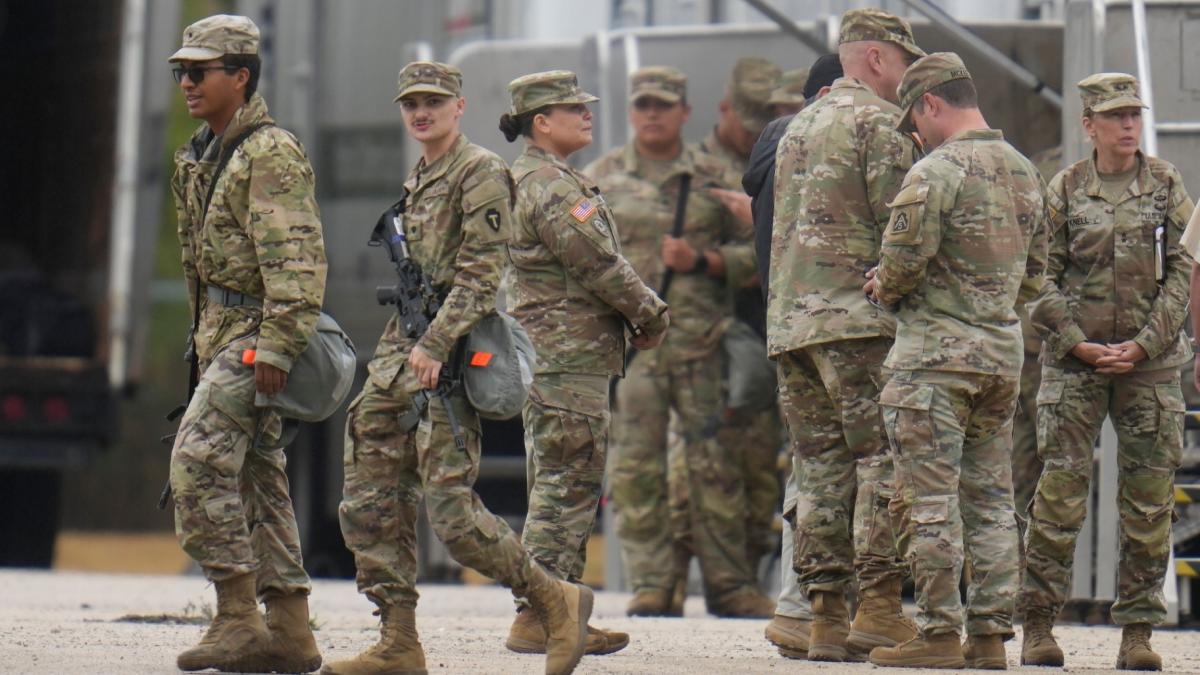 Military personnel in uniform, with the Texas National Guard patch on, are seen at the U.S. Army Reserve Center, Wednesday, Oct. 8, 2025, in Elwood, Ill., a suburb of Chicago. (AP Photo / Laura Bargfeld)
Even as an appeals court allowed a federal judge to temporarily block the Trump administration from sending 500 National Guard troops into Chicago, teams of masked immigration enforcement agents staged a series of increasingly aggressive raids across the city’s North Side.
U.S. District Court Judge April Perry issued an order on Thursday blocking “the federalization and deployment” of 300 members of the Illinois National Guard, 200 members of the Texas National Guard and 14 members of the California National Guard into Illinois.
The Trump administration immediately appealed that order to the 7th U.S. Circuit Court of Appeals, which allowed Perry’s ruling blocking the deployment of National Guard troops in Illinois to stand, while halting her order stopping President Donald Trump from federalizing those troops.
That decision means that the hundreds of National Guard troops remain at a military facility near Joliet, where they arrived last week, but are blocked by Perry’s order from doing anything other than training on land controlled by the federal government.
But the outcome of what promises to be just the first skirmish in a lengthy legal battle that could reach all the way to the U.S. Supreme Court did nothing to stop immigration agents from carrying out the Trump administration’s combative immigration enforcement operation dubbed “Operation Midway Blitz.”
The operations carried out by U.S. Department of Homeland Security agents, including members of Immigration and Customs Enforcement and Customs and Border Patrol, appeared to be concentrated in neighborhoods away from the course of the 47th annual Chicago Marathon, which went off without disruption despite widespread concerns.
A WGN-TV employee was detained by Border Patrol officials on Friday near Lincoln Square on the city’s North Side before being released without charges several hours later. Tricia McLaughlin, a spokeswoman for the Department of Homeland Security, said on X, the social media site formerly known as Twitter, that the employee “was arrested for throwing objects at law enforcement.”
As agents left that scene, they struck a vehicle and did not stop.
“Several violent agitators used vehicles to block in agents to impede & assault federal officers. In fear of public & law enforcement safety, officers used their service vehicle to strike a suspect’s vehicle and create an opening,” McLaughlin posted.
After several people were detained Thursday and Friday in the Far North Side neighborhood of Rogers Park, hundreds of people rallied Saturday near Clark Street and Lunt Avenue, the location of at least one of the raids, Block Club Chicago reported.
After immigration enforcement agents were reported outside nearby St. Jerome Catholic Church, video of a priest warning parishioners about leaving Mass unaccompanied early Sunday went viral. After word of that warning spread, a human chain formed to protect attendees, witnesses told NBC Chicago.
Community organizations have been working to identify the location of federal agents in Chicago neighborhoods to warn undocumented immigrants of their presence. Groups have distributed whistles and created text and phone networks to sound the alarm.
During a separate incident Sunday morning, federal agents appeared to point a gun at a man who was objecting to their activities in a Rogers Park alley, according to several videos of the incident posted on social media.
But perhaps the most violent encounter between Chicagoans angry about immigration enforcement operations occurred Sunday afternoon in Albany Park, on the city’s Northwest Side, when a group of Chicagoans confronted four vehicles of agents, as reported by the Chicago Sun-Times.
After agents shoved people to the ground, the agents dispersed tear gas — without any warning — to the dozens of people nearby, according to witnesses and videos posted on social media.
A federal judge ordered agents to issue two warnings before using tear gas.
‘Unreliable’ Assertions by the Trump Administration
Although lawyers for the state of Illinois and city of Chicago had asked Perry to block President Donald Trump from deploying the military into Illinois, she found that there had not been sufficient evidence presented that the president planned to take that step.
The Posse Comitatus Act, which dates to 1878, is a criminal law that bars the use of the military for domestic policing.
Trump has said he would consider enacting the Insurrection Act, which allows presidents to deploy the U.S. military within the country in response to what is determined to be an insurrection against the government, if judges block his deployment of National Guard troops to Illinois and Portland, Oregon.
“So far it hasn’t been necessary, but we have an Insurrection Act for a reason. If I had to enact it, I’d do that,” Trump said. “If people were being killed and courts were holding us up, or governors, or mayors were holding us up, sure I’d do that.”
Perry said she found federal officials’ assertions that federal agents had been subjected to serious and coordinated violence by protestors “unreliable.”
Perry wrote that she took note of “a troubling trend of Defendants’ declarants equating protests with riots and a lack of appreciation for the wide spectrum that exists between citizens who are observing, questioning, and criticizing their government, and those who are obstructing, assaulting, or doing violence.”
“This indicates to the Court both bias and lack of objectivity,” Perry wrote.
Perry also concluded that she could not “find reasonable support for a conclusion that there exists in Illinois a danger of rebellion satisfying the demands” of the federal law allowing the president to federalize the National Guard.
“The unrest Defendants complain of has consisted entirely of opposition (indeed, sometimes violent) to a particular federal agency and the laws it is charged with enforcing. That is not opposition to the authority of the federal government as a whole,” Perry wrote. “Defendants have offered no explanation supporting the notion that widespread opposition to immigration enforcement constitutes the makings of a broader opposition to the authority of the federal government.”
Perry, who was appointed by former President Joe Biden, was first tapped to serve as the U.S. attorney for the Northern District of Illinois. Her confirmation to that post was blocked by former U.S. Sen. JD Vance, who is now vice president.
‘Countermanding the President’s Military Judgment’: Feds
During Thursday’s historic hearing, Deputy Assistant Attorney General Eric Hamilton repeatedly asserted that Perry must give the president’s determination that the deployment of the National Guard is necessary “great deference.”
“The president’s judgement is unreviewable,” Hamilton said.
In its appeal, the Trump administration said Perry had misapplied the law.
“In countermanding the president’s military judgment, the district court largely ignored the facts on the ground, relied on an improper … factual investigation, and rested on an adverse ‘credibility’ finding that had no basis in the record,” according to lawyers for the Trump administration.
The appeals court panel could decide at any time whether to take up the Trump administration’s appeal and whether to allow the deployment of federalized National Guard troops while it resolves the case.
Perry scheduled the next hearing in the case for 9 a.m. Oct. 22, when she said she will consider extending the temporary restraining order she issued for an additional 14 days before the initial order expires at 11:59 p.m. Oct. 23.
Nearly 2,500 federalized National Guard troops from several states led by Republicans have been in Washington, D.C., since August.
While the president has credited those troops with lowering crime in the nation’s capital, crime data shows no significant drop in violent crime, records show. National Guard members have picked up trash and helped package meals for unhoused residents, according to the Associated Press.
A lawsuit brought by D.C.'s attorney general is challenging the deployment, with a hearing scheduled for Oct. 24.
Of the more than 4,000 National Guard troops and 700 U.S. Marines sent to Los Angeles, approximately 100 California National Guard members remain under federal authority, officials said, including the 14 soldiers sent to Illinois to provide “training and subject matter expertise.”
Los Angeles and California officials challenged that deployment in federal court. A judge found not only was it illegal, but the activities of the military violated the Posse Comitatus Act. That order has been halted by an appeals court, but the litigation remains ongoing.
Trump has also ordered National Guard troops to Portland, Oregon, despite Gov. Tina Kotek’s objections.
U.S. District Court Judge Karin Immergut, a Trump appointee, said the president’s claims of daily unrest in Portland were “untethered to facts” and risked violating the U.S. Constitution by imposing military rule. Immergut has temporarily blocked the deployment of National Guard troops into Portland.
A three-judge panel of the 9th U.S. Circuit Court of Appeals could decide at any time whether to overturn Immergut’s ruling.
Contact Heather Cherone: @HeatherCherone | (773) 569-1863 | [email protected]