Politics
Pritzker Expects Trump to ‘Keep the Militarization Going’ Despite Government Shutdown
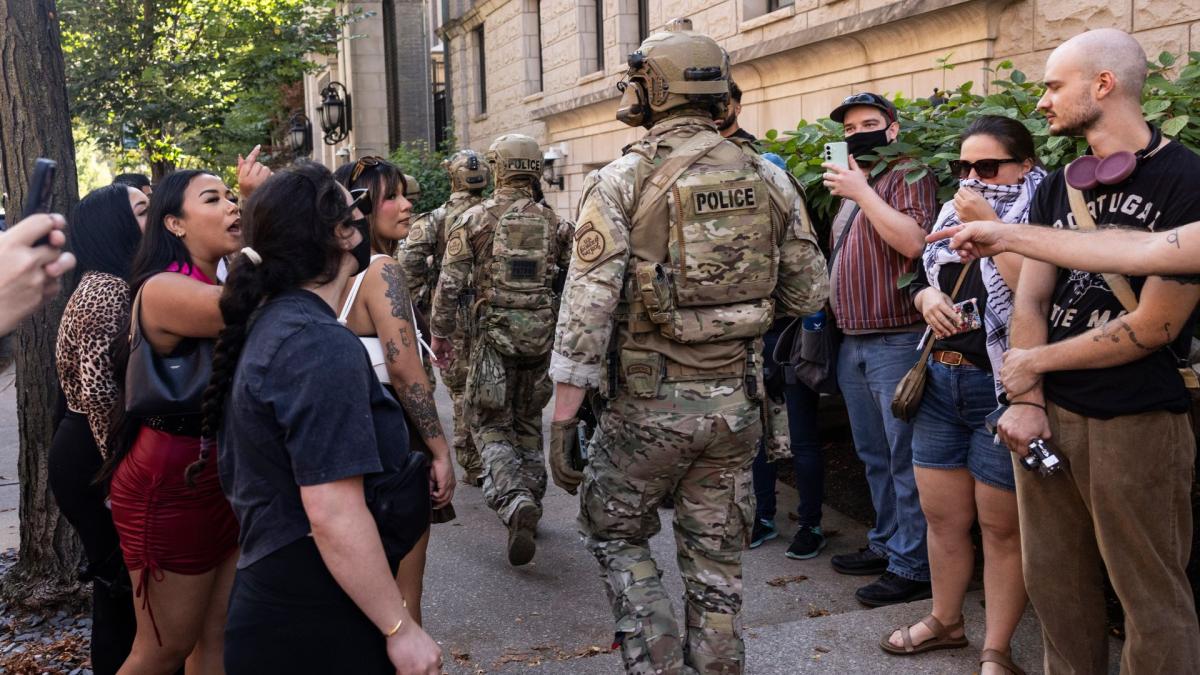 Pedestrians yell at federal agents from U.S. Immigration and Customs Enforcement and U.S. Customs and Border Protection as they walk along North Clark Street near West Oak Street in the River North neighborhood, Sunday, Sept. 28, 2025, in Chicago. (Ashlee Rezin / Chicago Sun-Times via AP)
It’s not yet clear when military troops could be deployed into Illinois, but Gov. JB Pritzker expects President Donald Trump to “keep the militarization going” even after the federal government shut down overnight.
Pritzker on Wednesday said he’s received no new information about the Trump administration’s possible deployment of 100 military troops into Illinois since he first learned of those plans earlier this week.
But on Day 1 of the federal government shutdown, Pritzker said he doesn’t expect Trump to back off his efforts.
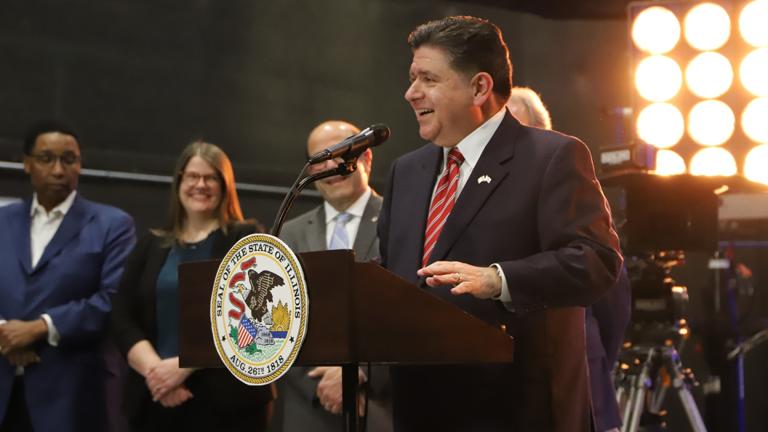
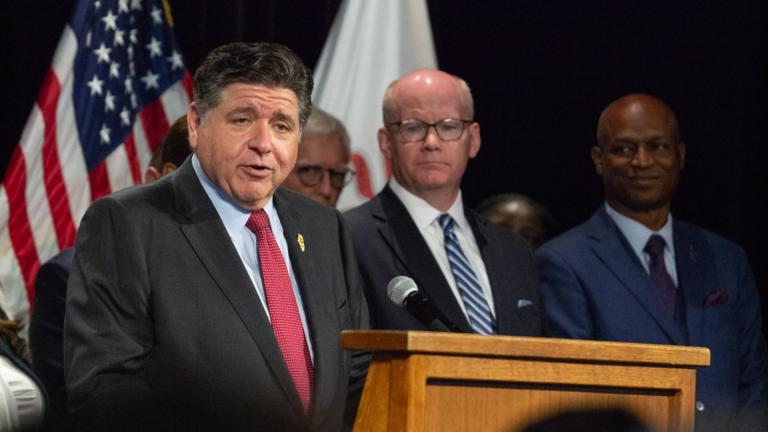
“Unfortunately the president is likely to keep the militarization going,” Pritzker said during a press event Wednesday at the University of Illinois Chicago. “He can do that because there are emergency personnel and military personnel that he can keep on the job. He is likely to do that.”
Washington, D.C., is bracing for what could be a prolonged federal shutdown after lawmakers deadlocked and missed the deadline for funding the government.
On Monday, Pritzker said the Illinois National Guard had informed him that the Department of Homeland Security sent a memo to the Department of Defense seeking the deployment of 100 military troops into Illinois to protect Immigration and Customs Enforcement officials.
That announcement came after ICE agents utilized chemical munitions and less lethal ammo on protesters outside the agency’s suburban Broadview facility.
But since then, Pritzker said he hasn’t heard more about any deployment plans.
“They are not communicating, this is the problem,” he said. “If they would simply discuss things with local law enforcement, with state law enforcement, with the governor of the state, we would be able to inform the public about what’s happening.”
Trump has repeatedly threatened to send the military into Chicago and Illinois in recent months, pointing to shootings and homicide data in claiming a deployment is necessary, even as violent crime levels have dropped significantly since last year.
As of Wednesday, homicides are down 28% and shootings are down more than 35% in Chicago compared to the same time last year, according to city data.
Over the weekend, dozens of armed federal agents, in full tactical gear, walked the streets of some of Chicago’s most prominent tourist and shopping areas, marking an escalation of the Trump administration’s ongoing immigration enforcement crackdown.
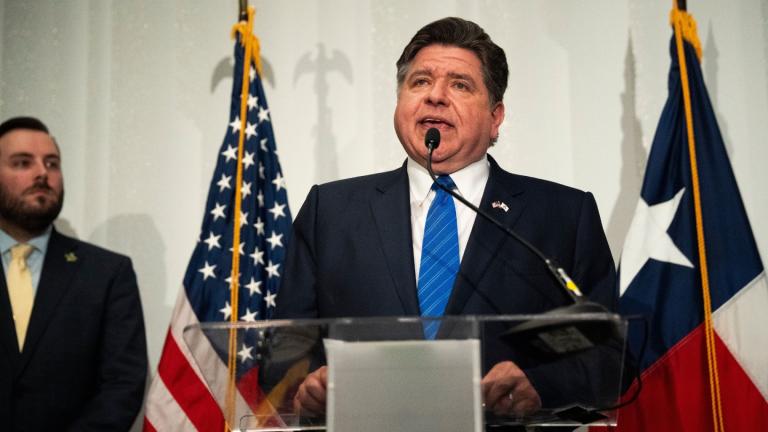
Pritzker on Wednesday repeated that Chicago is not “crime-ridden” and that he believes Trump “clearly doesn’t know anything” about the city.
“If he visited Chicago, what he would see is what many of us see — a vibrant big city,” Pritzker said. “We have challenges, but we are always working and actually always doing better now at overcoming those challenges.”
Pritzker’s remarks came at a panel discussion with local health care professionals responding to recent “medical misinformation” spread by Trump and Department of Health and Human Services Secretary Robert F. Kennedy Jr.
Trump recently warned pregnant women not to take Tylenol, known by the generic name acetaminophen, and he fueled discredited claims about autism and vaccines. Some studies have raised the possibility that taking acetaminophen in pregnancy might be associated with a risk of autism. Many others, however, have not found a connection and no causal link has been proven.
The current scientific evidence does not support a causal link between acetaminophen use during pregnancy and neurodevelopmental disorders such as autism, said Lynn Yee, a doctor and professor at Northwestern University.
“Acetaminophen remains the safest first-line medication for pain and fever during pregnancy,” she said. “Toughing it out and leaving these symptoms untreated can expose women and their fetuses to harm.”
Earlier this month, Kennedy’s new vaccine advisers also declined to recommend COVID-19 vaccinations for anyone, instead leaving the choice up to those who want a shot. Though anti-vaccine activists, including Kennedy, have long suggested a link between vaccines and autism, widespread scientific consensus and decades of studies have firmly concluded there isn’t one.
“The federal government’s inaccurate information regarding vaccines, autism and acetaminophen is causing unnecessary confusion, stigma and stress for Illinois residents,” Illinois Department of Public Health Director Dr. Sameer Vohra said. “We will continue to work with the state’s health care practitioners to provide credible, science-based information to help Illinois’ individuals and families grow and thrive.”
The Associated Press contributed to this report.