Politics
Amid Push for Nuclear Reactor Construction, Illinois Is One Step Closer to Selecting a Site
Illinois is one step closer to building its first new nuclear reactors in nearly 40 years.
Though the state leads the nation in nuclear energy generation, a recently lifted moratorium on new nuclear power plant construction means the race is on to bring new plants online — a task that can take years.
As Illinois looks for the right sites to build, several communities have already said “yes” to new plants.
Planning for these new reactors is happening in a different context from the last time they were built in the state in the 1970s and ‘80s. Reactor technology has advanced, but so has wind and solar power. And with energy demands rising quickly, construction time and costs are sure to play a big part in the trajectory of nuclear power.
A Winding Path to New Plants
This is just the latest step in the state’s long history with nuclear technology.
University of Chicago scientists built the world’s first nuclear reactor under the stands of the school’s football field in 1942. After World War II, the federal government opened Argonne National Laboratory to continue research into civilian uses for nuclear power.
Today, Illinois leads the nation in generating nuclear energy, with 11 plants pumping out half of the state’s total electricity. But of these existing plants, the last one came online in 1988.
A statewide moratorium on new construction lasted from the late 1980s until this January, when it was lifted as part of an energy omnibus bill. Gov. JB Pritzker wasted little time getting the ball rolling on new projects.
“The economic opportunity of building new, clean power is enormous,” Pritzker said in his February budget address, announcing an executive order intended to speed up the construction of new nuclear facilities.
“We can take years off of the development and launch of new base load energy production,” Pritzker said.
Read More:
- These 9 Illinois Communities Say They’re Interested in New Nuclear Facilities
- What Does Pritzker’s Nuclear Energy Executive Order Do in Illinois?
- Pritzker Signs Major Energy Reform Bill Amid Projected Shortages
The order directed state agencies to create a framework for the evaluation, financing and safety regulation of new nuclear power plants. Importantly, the order also directed those agencies to request information from communities interested in hosting a new facility.
Now, the responses are in. Nine communities, plus the University of Illinois Urbana-Champaign, submitted initial comments.
Many came from communities that host existing nuclear plants, like Grundy County. In addition to the Dresden Generating Station within the county lines, the LaSalle Generating Station is a 40-minute drive to the west, and the Braidwood Generating Station is about 25 minutes south.
“We have a comfort with nuclear, we have the workforce for nuclear, we have the safety mechanisms in place,” said Nancy Norton, president of the Grundy County Economic Development Council.
“And frankly, (we have) the infrastructure and transmission to get power out to the customers,” Grundy said.
Then there are places like Peoria County, which is navigating a new energy landscape after the closure of a coal-fired power plant in 2022.
“Where we separate ourselves is we’ve been very supportive and agnostic of all the alternative energy sources,” said Scott Sorrel, the Peoria County administrator.
Peoria County is one of the state leaders in approving utility-scale solar power projects and is planning two utility-scale wind power projects, according to Sorrel.
“At this point in time, we’re not closing a door to nuclear, but making sure that door stays open,” Sorrel said. “And if the opportunity presents itself, to walk through that door.”
Time and Money Shape the Clean Energy Transition
Nuclear power is considered “clean” energy, since it does not emit the greenhouse gases that cause climate change. It can also output energy around the clock. But the role it can play in the transition away from fossil fuels is still a matter of debate.
The two most recent nuclear plants to come online in the United States, at the Vogtle Generating Plant in Georgia, opened seven years behind schedule and $17 billion over budget.
With energy demand rapidly rising, environmental advocates point to the relatively cheap and fast deployment of renewable sources like solar and wind projects.
While nuclear power still provides Illinois with about half of its electricity, the share provided by renewables has tripled in the past decade — growing to 16% in 2025, according to the Illinois Power Agency.
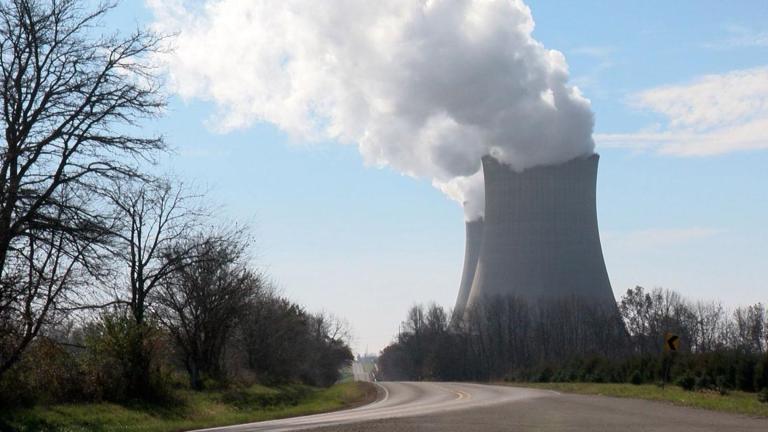
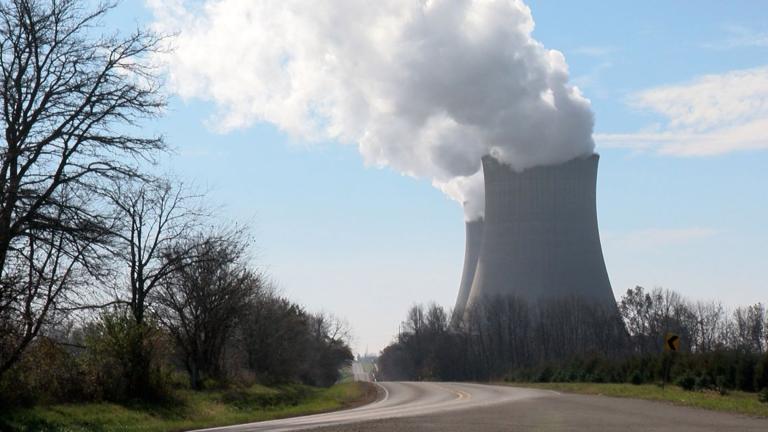
That’s at least the current status of nuclear power in Illinois, generated at large facilities with the familiar hourglass-shaped cooling towers. But Norton and Sorrel both acknowledged that the technology is changing, and the next generation of reactors could look and operate differently.
Advancing Reactor Designs
One place to look for what modern nuclear reactors might accomplish is the University of Illinois Urbana-Champaign. There, the university is working in partnership with the company NANO Nuclear Energy to build a prototype of a “microreactor” on campus.
While this would produce around 1% of the energy made by traditional large reactors, James Walker, the NANO Nuclear Energy CEO, said the advantage is in how it can be built and operated.
“All the components will be shipped to site as a modular system, assembled there, and begin to immediately output power,” Walker said.
So far, no commercial small modular reactors (SMRs) have been completed in the United States, and the industry is split between dozens of different designs. The NANO Nuclear reactor, which would fit on a 2-acre plot of land adjacent to an existing power plant, is the first of its size to be submitted for federal approval from the Nuclear Regulatory Commission.
But even though the designs are new, Walker said the technology isn’t the main bottleneck for quickly deploying reactors like the University of Illinois project.
“It’s having all of the components to be able to mass manufacture the reactors, that’s going to be the challenge,” Walker said.
And since new reactors of any size haven’t been built in decades, one remaining question is where the workforce and expertise might come from.
For Norton, the answer is right down the street.
“We have the construction workers that have been maintaining these nuclear plants,” Norton said.
“In our region, we probably have a couple thousand employees who understand how nuclear reactions and nuclear reactors work,” Norton said. “So I don’t know that to scale up would be that difficult for us.”
Capitol News Illinois contributed to this report.