Politics
Pritzker Signs Bills Allowing State to Review Homeowner, Auto Insurance Rate Hikes
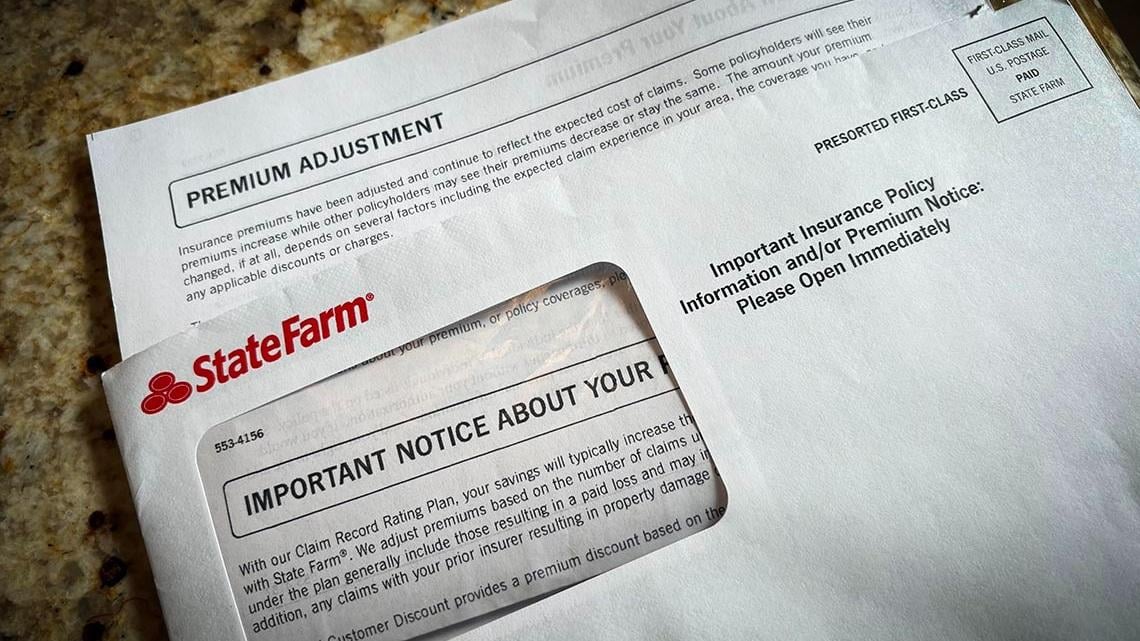 Mail from State Farm insurance. (Capitol News Illinois file photo)
SPRINGFIELD – Gov. JB Pritzker signed legislation Tuesday that will give the Illinois Department of Insurance authority to review and approve rate changes for homeowners and automobile policies.
“It’s not asking too much to say to insurance companies, if you’re telling your customers that rate hikes are necessary, you should be able to prove why,” Pritzker said at a bill signing ceremony in Chicago.
Prior to the bill signings, Illinois was one of only two states, with Wyoming, that did not exercise regulatory control over insurance rates.
The new laws, which take effect July 1, 2027, prohibit companies from charging “excessive, inadequate, or unfairly discriminatory” rates and prohibit them from shifting the cost of losses in other states onto Illinois consumers.
The new laws come a little more than a year after Illinois-based State Farm announced it was raising homeowners insurance rates an average 27.2% statewide. They also come two years after Illinois motorists saw an average 18% hike in their auto rates, according to Secretary of State Alexi Giannoulias.
In both cases, insurance industry officials said the rate increases were necessary due to inflation, the rising cost of repairs and, in the case of homeowners insurance, the increasing frequency of extreme weather.
In addition, State Farm recently noted that auto insurance rates have been falling in Illinois and that it lowered its premiums by an average 15% in 2025.
Insurance Department Director Ann Gillespie agreed there often are legitimate reasons for rate increases. But she said the new laws will help make sure that rate increases in the future are justified by reliable data.
“While no state legislation can fully eliminate these impacts to insurance premiums, these bills today hold insurance companies accountable for addressing their cost increases by requiring rates to reflect Illinois-specific losses and considerations,” she said.
House Bill 4273, the homeowners insurance bill, requires companies to give their customers 60 days’ notice before raising premiums more than 10%.
It also requires them to use credible state-specific claims data to develop their rates when it is available, but companies will be able to supplement that data with national, regional or out-of-state data if needed to meet actuarial standards of credibility.
Companies will still be able to charge new rates once they are filed with the Insurance Department. But the new law gives the department authority to review those rates and order rebates of any excess premiums collected if the rates are found to be excessive or unfairly discriminatory.
Senate Bill 714, the auto insurance bill, requires companies to give customers 30 days’ notice before raising premiums more than 10%. It also gives the department authority to review rates and order rebates if the rates are found to be excessive or unfairly discriminatory.
Giannoulias pushed for that bill, criticizing companies for basing rates on factors unrelated to a person’s driving record, such as their credit score or ZIP code. But while those practices are not specifically prohibited in the final legislation, the new law does ban rates that are “unfairly discriminatory.”
“For far too many Illinois families, the cost of mandatory auto insurance has become absolutely unsustainable, forcing impossible choices between paying for coverage and paying for life’s basic necessities,” Giannoulias said at the bill signing ceremony. “That’s not just a financial burden. It puts more uninsured drivers on the road and makes our roads and communities less safe.”
Insurance industry organizations, however, remain opposed to the new laws.
In a joint statement issued after the bill signing, the Illinois Insurance Association, the American Property Casualty Insurance Association and the National Association of Mutual Insurance Companies warned the new laws will lead to higher costs and fewer choices in the insurance market because they do not address the economic realities behind premium increases.
“Instead, the laws impose a fundamental shift in Illinois’ regulatory environment, moving the state toward a more rigid rate approval system similar to struggling insurance markets like California,” the organizations said. “This shift will make it harder for insurers to respond in real time to market conditions and adjust rates up or down based on actual claims experience.”
Pritzker, however, dismissed the industry’s criticism.
“It’s silly to suggest that this is going to raise rates across the board,” he said. “What’s raising rates are when insurance companies are simply putting out their bills that people can’t afford and that don’t have any relationship to what’s actually happening on the ground.”
Capitol News Illinois is a nonprofit, nonpartisan news service that distributes state government coverage to hundreds of news outlets statewide. It is funded primarily by the Illinois Press Foundation and the Robert R. McCormick Foundation.