Politics
‘I Think He’s Losing It’: Pritzker Brushes Aside Latest National Guard Threat From Trump
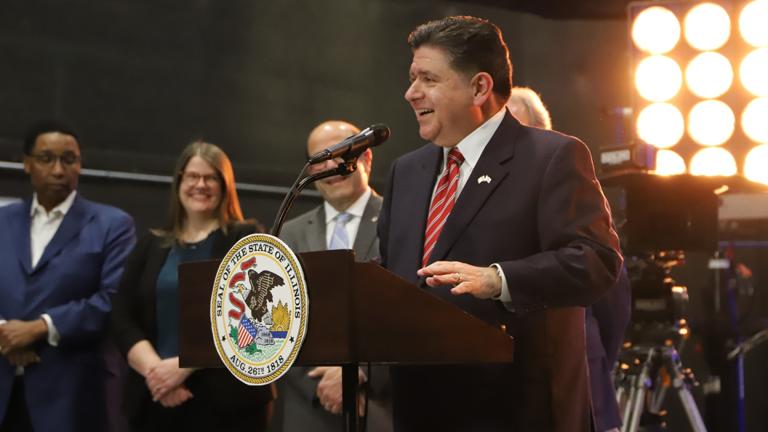
As federal immigration agents and officials continue expanded operations in Illinois, Gov. JB Pritzker brushed aside President Donald Trump’s latest threat to deploy National Guard troops into Chicago, suggesting the president may be suffering from dementia.
Pritzker — a Democrat and potential 2028 presidential candidate — said Tuesday he can’t take “anything that (Trump) says seriously” and said he thinks Trump is “losing it” following another threat of a military deployment.
“I think he might be suffering from some dementia,” Pritzker said during a press availability in Oak Park. “The next day he’ll wake up on the other side of the bed and stop talking about Chicago. So I’ve never really counted on anything that he said as real.”
Trump has promised for weeks that Chicago would see a surge in deportations and National Guard troops over the fierce objections of local leaders and residents.
Mayor Brandon Johnson said Trump’s threats to send armed military personnel to Chicago had “placed our democracy at incredible risk.”
“There are no circumstances under which the deployment of American soldiers should be sent to cities across America,” Johnson said.
Immigration advocates in Chicago said they had noticed an uptick in immigration enforcement agents in recent days as Trump targets Democratic strongholds. However, Trump has seesawed on sending a military deployment to Chicago.
After appearing to back off his threat and opting instead to send National Guard troops to Memphis, Trump on Tuesday said “I’m going to go to Chicago,” over the objections of Pritzker and other elected officials.
“Pritzker’s nothing,” the president told reporters outside the White House. “If Pritzker was smart, he’d say, ‘Please come in.’”
Trump called Chicago a “death trap” and has repeatedly highlighted violent crime in the city as a reason to send in troops, even as the city has reported drops of 29% in homicides and 34% in shootings this year compared to last.
Even if the National Guard isn’t deployed, federal immigration officials have ramped up arrests and deportation efforts in Illinois.
Gregory Bovino, the Border Patrol agent who spearheaded the immigration crackdown that sparked widespread protests in Los Angeles, announced Tuesday that he was in Chicago.
“Well, Chicago, we’ve arrived!” Bovino said in a social media post that included footage of U.S. Immigration and Customs Enforcement vehicles and agents under Chicago street signs and views of downtown. “Operation At Large is here to continue the mission we started in Los Angeles.”
Department of Homeland Security Secretary Kristi Noem on Tuesday said she too was “on the ground in Chicago,” days after an ICE agent fatally shot a man during a traffic stop in suburban Franklin Park.
The arrival of Bovino and Noem in Chicago on Mexican Independence Day, as dozens of federal agents fanned out across the Chicago area, was designed to frighten Chicagoans, Johnson said.
“I understand that the fear and anxiety is real,” Johnson said, again pledging Chicago police officers will not help immigration agents detain those they suspect of being undocumented.
Johnson signed an executive order Tuesday designed to allow Chicagoans to protest the immigration enforcement actions without interference from federal agents. The order directs the Chicago Police Department to help groups find a new location to exercise their First Amendment rights to free speech and freedom of assembly.
It was not clear how that order could be implemented in the midst of sometimes chaotic protests and concerns that federal officials would seek to ratchet up confrontations.
Johnson said he was moved to act after federal agents fired balls filled with OC, or pepper spray, at protestors outside an Immigration and Customs Enforcement facility in south suburban Broadview who attempted to block its entrance.
“The First Amendment clearly states that we have the right to peacefully assemble, petition our government and speak freely without intervention or fear of retaliation,” Johnson said in his prepared remarks. “If the federal government will not uphold this right, then the city of Chicago will.”
Pritzker on Monday said ICE had thus far been unwilling to share any additional details of Friday’s shooting in Franklin Park, which left 38-year-old Silverio Villegas-Gonzalez dead. The agency has claimed Villegas-Gonzalez attempted to flee a traffic stop.
Noem in a social media post Tuesday claimed an ICE agent suffered “serious injuries” after being “dragged many yards” by Villegas-Gonzalez’s vehicle when he allegedly drove toward the agents.
Pritzker has said he hasn’t received any updates on the agent’s condition and on Tuesday criticized Noem, whom he said was in Illinois for only a “few hours” and refused to take any questions.
The governor also claimed Bovino has a “history of acting in ways that are quite violent against people, many of whom are not criminals.”
“They are grabbing people who have brown skin or who speak with an accent or who speak another language,” Pritzker said, “and not people who are guilty of or are accused of perpetrating a violent crime.”
ICE and DHS have also refused to communicate with local authorities about their operations in Illinois, according to Pritzker, which he said could cause significant challenges for local law enforcement doing their job.
But he said those agencies have been “gathering their troops” and are relying on immigration agents, rather than the National Guard, to operate in a “more militarized fashion” statewide.
“It’s dangerous,” Pritzker said. “This is wrong, it’s unconstitutional, it’s un-American.”
WTTW News’ Heather Cherone and The Associated Press contributed to this report.