Science & Nature
Armadillos Are Coming. Is Chicago Ready?
Ever since they crossed the Rio Grande into Texas in the mid-1800s, armadillos have been making a slow but steady push north.
At this point, it’s a matter of when, not if, they’ll turn up in Chicago, according to one expert.
“I believe we’ll be seeing them very soon,” said Anderson Feijó, assistant curator of mammals at the Field Museum. “I would say five to 10 years."
And they might already be closer than we think, giving scientists a short window of opportunity to understand the implications of introducing a new mammal into the local ecosystem.
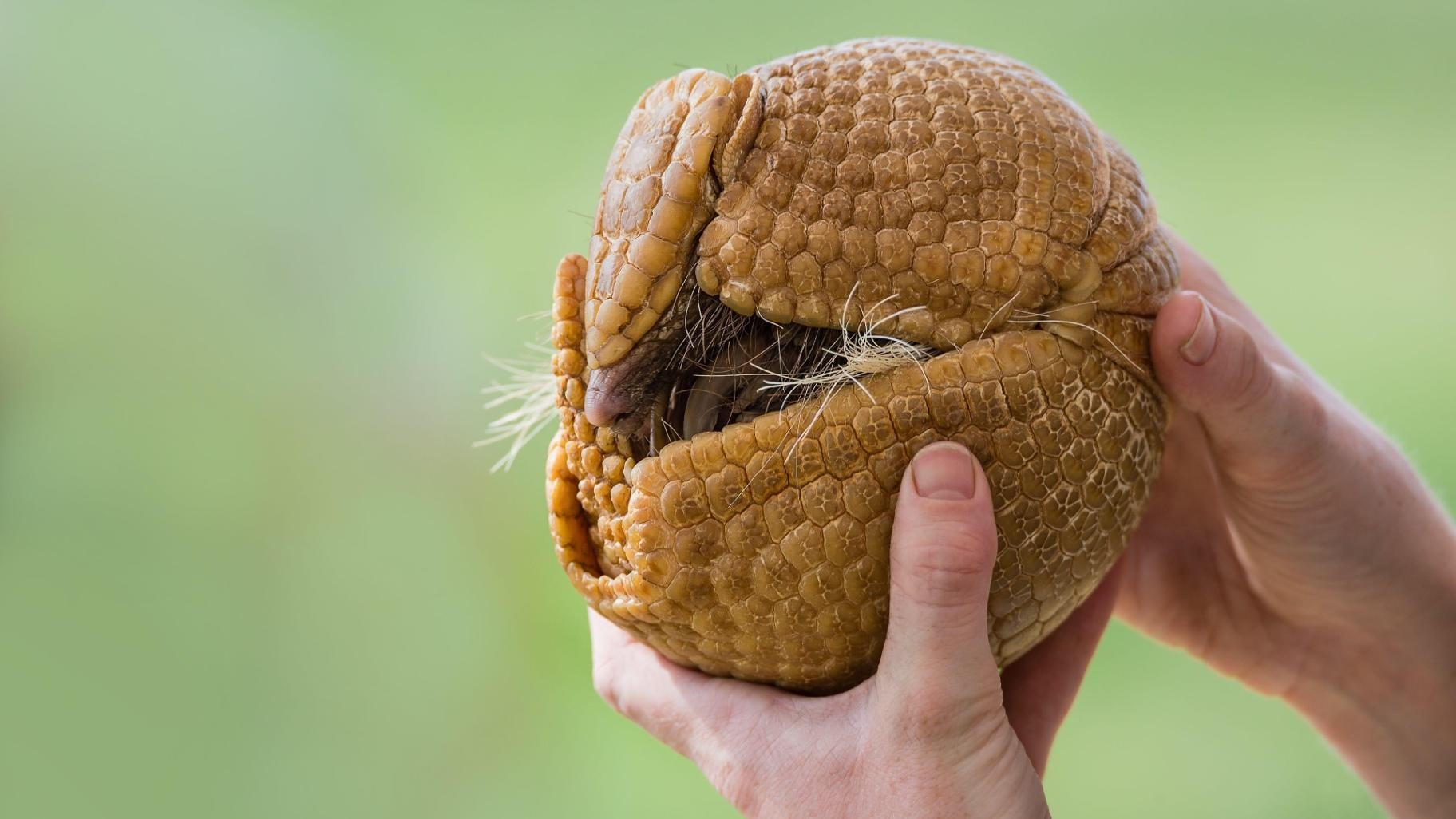 Fun fact: Only three-banded armadillos can completely roll up into a ball. It’s a great tactic for avoiding predators like wild dogs but not as successful against human hunters. (Lee Kris / iStock)
The armadillo is a New World critter, related to the sloth and anteater, found almost exclusively in South and Central America.
“It’s a group that originates about the time of when the dinosaur went extinct about 66 million years ago," Feijó said. "And then they diversify in South America and then only later they moved to Central America and then North America.”
There are more than 20 different armadillo species, some more common than others. Though they all share a body seemingly designed by Mad Libs — stumpy legs, long snouts and those signature bony plates — there’s significant variation even between members of this already quirky animal family.
Among the most elusive armadillo species are a pair occupying opposite ends of the size spectrum: the giant armadillo — weighing as much as 100 pounds and measuring nearly five feet long from the tip of its tail to the tip of its snout — and the pink fairy armadillo, just six inches long. (The “size of a cat” is a more typical frame of reference for armadillos.)
It’s this diversity that caught the attention of Feijó, a native of Brazil, who made armadillos the topic of his Ph.D. research.
“I would visit different collections and say, ‘Ah, this species doesn’t seem to be the same as the one I know from Brazil,’” he said. “So that’s why I started to look into more details. … I realized there’s a lot to learn from them.”
Feijó focused on the nine-banded armadillo, named for the nine flexible bands on the creature’s midsection that allow the shell to bend and twist. (There are three-banded and six-banded armadillo species, among others.)
The nine-banded armadillo — specifically the Mexican long-nosed armadillo — is the only species found in the U.S. having migrated from northern Mexico. (The nine-banded was recently reclassified as four separate species, the Mexican long-nosed among them, after members of a research team that included Feijó conducted extensive DNA tests.)
Defying Expectations
For millennia, natural barriers like the Rio Grande and the vegetation along the river stymied the creature’s northward progress. But as areas of what’s now known as Texas were colonized, people brought armadillos along for the ride.
Armadillos remained a southern curiosity for decades, and assumptions were made regarding their ability to survive harsh northern winters. Cold temperatures below freezing are thought to be one obstacle — armadillos don’t hibernate, and they don’t have much in the way of hair or fat stores.
Snow cover is another presumed impediment, perhaps even more so than cold, because it keeps armadillos from getting to their food source, primarily ants, termites and other insects they dig up from the ground.
But armadillos are nothing if not adaptable.
“There has been a lot of expectations of how north they could go and every time, the armadillos are able to move up and up,” Feijó said. “This is probably related to climate change as the winter is getting warmer, so they’re able to colonize and survive through the winter. And then in the spring they can reproduce and increase the population.”
There already are species that live in higher elevations in the Andes Mountains, “so actually they can survive in cold areas as long as they can find food during the winter,” he noted.
And those food sources might not be as limited as previously thought.
In his research, Feijó found that armadillos in North America seem to have a broader diet than those in South America, encompassing edibles like roots and fruits.
“This might help explain why there were able to so successfully colonize areas that were not common to them,” he said. “So here, the armadillos in the U.S., they eat not just insects but a variety of food they can find in their environment.”
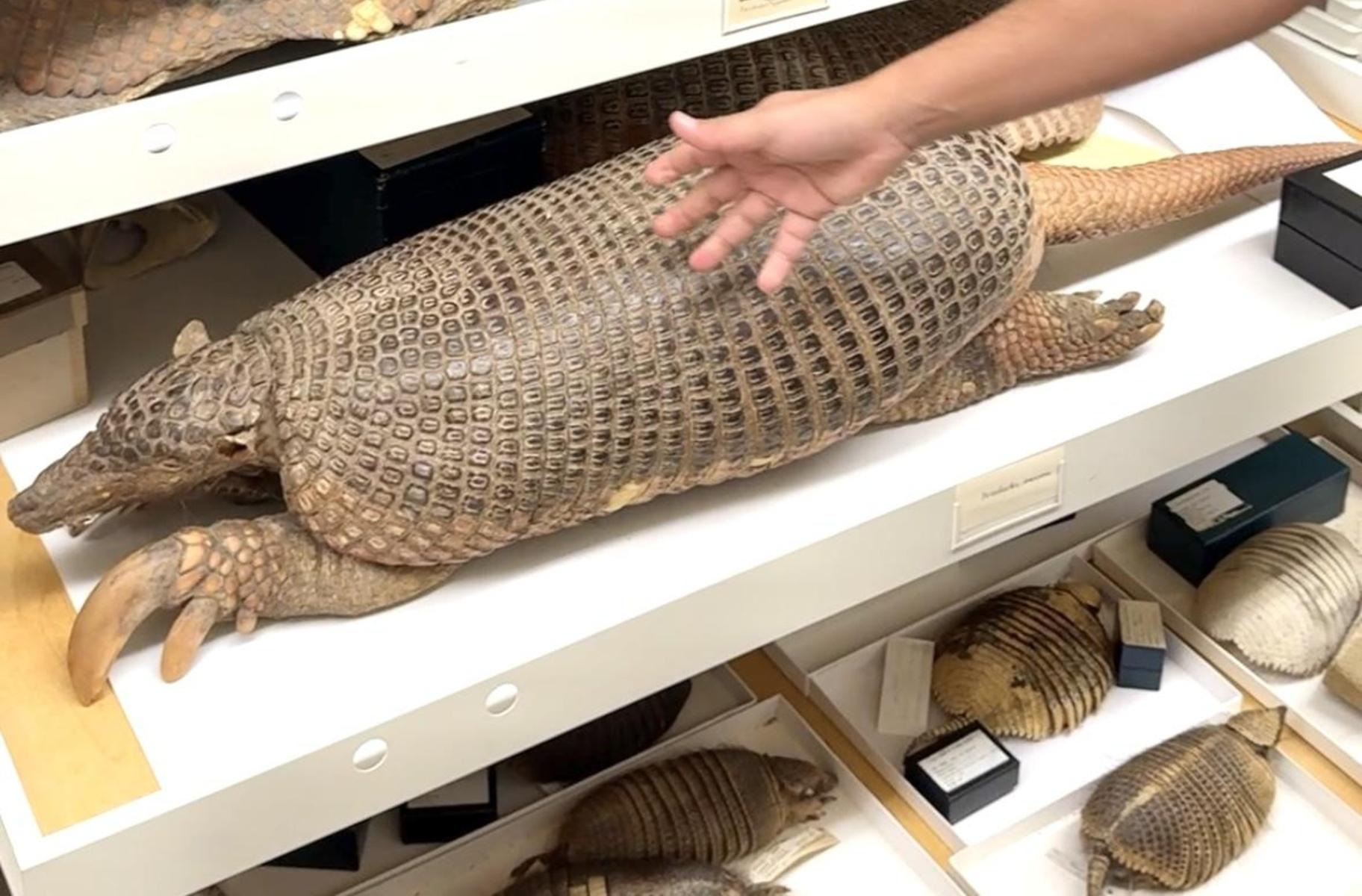 The Field Museum’s collection of specimens includes this giant armadillo. It might look fierce, but it’s actually quite docile — and elusive. Those massive claws are for busting insect mounds and digging burrows. In fact, dozens of other species use giant armadillo burrows for shelter, protection and warmth. (Nicole Cardos / WTTW News)
Armadillos have already made their way to southern Illinois, where sightings and encounters are no longer a rarity.
What wildlife experts want to know is how quickly the creatures are advancing into the central and northern parts of the state.
The Illinois Department of Natural Resources is asking the public to report any sightings online, in order to get a sense of the animal’s movement.
“We’re actually in the perfect moment to study before they arrived in Chicago and after they arrived in Chicago … to understand a little more the environment before they arrive so we can have the comparison of before and after,” Feijó said.
Some evidence suggests the situation may have already moved past “before.”
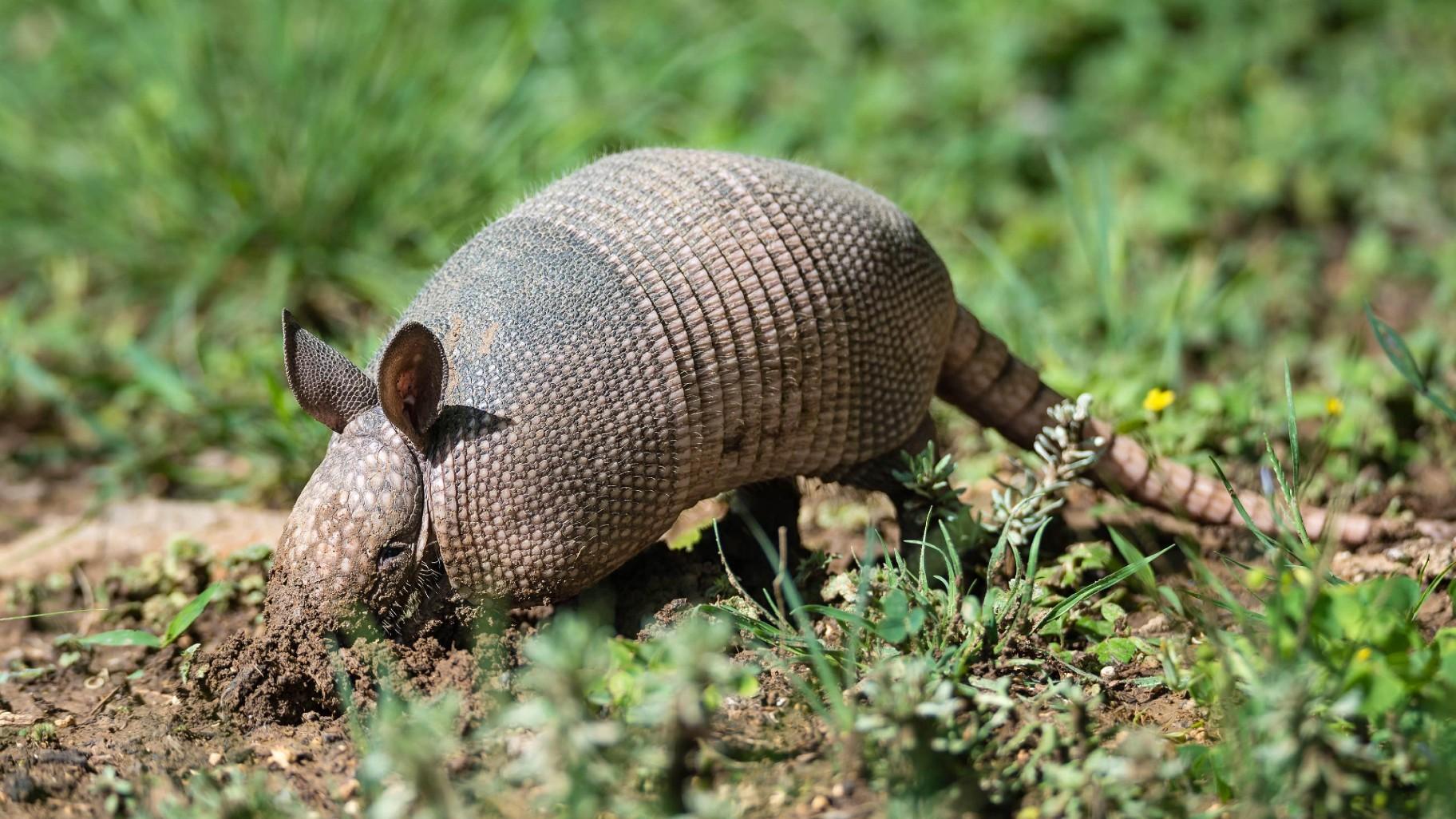 Armadillos’ diet consists mostly of ants and insects. But the nine-banded armadillo, the only species found in the U.S., has expanded its palate to include roots and fruits. (Lee Kris / iStock)
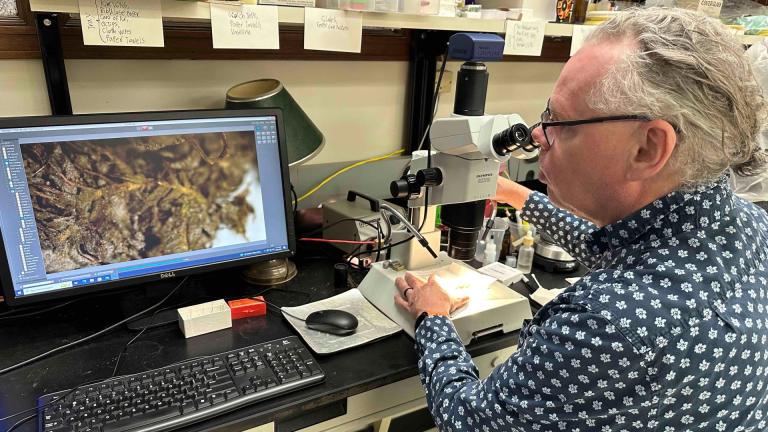
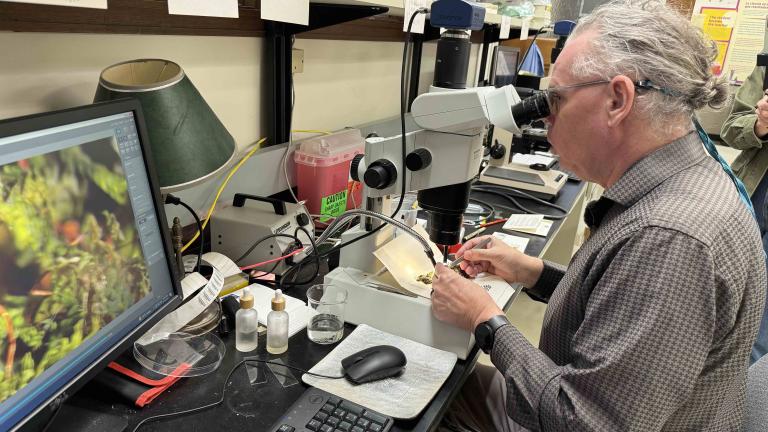
Sophie Picq is a scientist at the Field Museum who specializes in environmental DNA (eDNA), a relatively new discipline that’s boomed in the last 10 years.
Picture, for example, any stretch along the Amazon River where scientists might be attempting a species count. It’s an all but impossible task, even using multiple techniques such as direct observation, wildlife cameras and traps.
A team might have the bad luck of setting up netting during full moon conditions, when bats aren’t flying around, Picq explained. It doesn’t mean bats aren’t present, but if they don’t show up during a specific timeframe, they don’t get counted.
But with eDNA, researchers can collect, say, soil or water specimens, and conduct an analysis of all of the genetic material shed by all of the organisms — including bacteria — in that environment.
“It’s really helpful for habitats that are super hard to sample,” Picq said. “It’s not necessarily for finding species that have never been identified before. It’s more like if we’re trying to see ‘who lives here’ and we can’t eyeball them, it’s a tool that helps us try to get an idea of what lives where.”
While she’s seen eDNA deliver exciting results in the Amazon, Picq is also working in the Chicago region. She’s currently analyzing data from the Chicago River to compare the presence of vertebrates and mussels in restored habitat versus more degraded areas.
But it was a during a project in the Kankakee River, back in November 2021, that Picq found something she wasn’t looking for: armadillo DNA.
“It was a really, really low abundance — there were a couple of sequences of armadillo DNA,” Picq recalled. “I was amazed. I had no idea they could come all the way up to Kankakee County. It’s not really that far south in Illinois.”
The amount of armadillo DNA was just under the threshold of the standard Picq uses to declare 100% confidence in a detection, “but I remember getting really excited about it and thinking we should go and try to put camera traps or do more eDNA samples there to see if we can catch more sequences. … If I was to try again, I think it’d be really interesting to try again in the summer.”
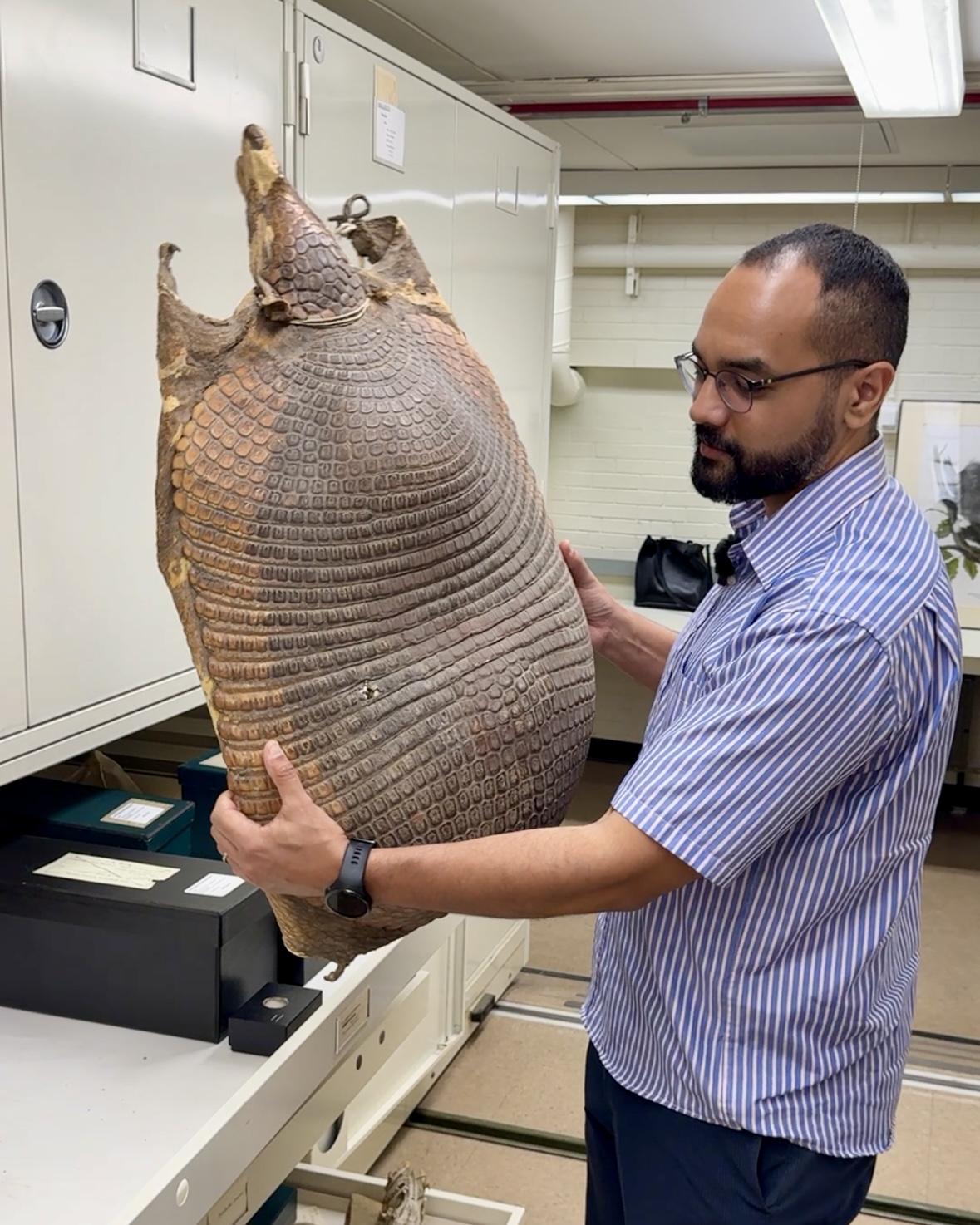 The giant armadillo’s carapace (or shell), held by Anderson Feijó, was historically used as a baby cradle when turned upside-down. (Nicole Cardos / WTTW News)
Even though armadillos are native to the Americas, they’re not native to Illinois. They didn’t evolve with the native ecosystem and vice versa.
“It’s a perfect example to talk about how climate change is allowing animals to change their distribution,” Feijó said. "Our actions have allowed these animals to go to areas they’re not supposed to be. … Here, they are probably going to cause some disturbance.”
For humans, that disturbance could range from the spread of infectious diseases including leprosy to the annoyance of having armadillos dig up lawns and gardens as they root around for grubs or other munchies. Currently Illinois Wildlife Code doesn’t protect armadillos, so if they do get a reputation as a nuisance, they could find themselves on the wrong side of a pest control agent.
Armadillos are also something of a hazard on roadways: They have a tendency to jump straight up when frightened, rather than skedaddling, putting them directly in the path of oncoming cars. Indeed, some folks have never seen a live armadillo, only roadkill.
The greatest consequences are likely to be felt by other wildlife. In their home range, armadillos are kept in check by predators including jaguars, cougars, foxes and wild dogs — basically any carnivore, according to Feijó.
“So there is a balance in their ecosystem,” he said. “Here they have very few predators, so they’re able to expand and colonize areas and become very abundant.”
That abundance could put armadillos in direct competition for resources with native mammals like raccoons.
On the flip side, armadillos could pose a threat, for example, to birds that nest in the ground and haven’t developed a natural defense against a big-snouted, hard-shelled interloper.
“It’s definitely not a good thing for the ecosystem because (armadillos) aren’t part of the native habitat,” Feijó said.
Contact Patty Wetli: [email protected]