Politics
Deal Reached to Sell Chicago Parking Meters to Investment Firm, Alderpeople Say
 A Chicago parking meter is pictured in a file photo. (400tmax / iStock)
Stay updated on Chicago news. Subscribe to the free Daily Chicagoan newsletter.
A deal has been reached that will allow Chicago’s parking meters to be sold to a New York-based investment firm that in turn will sell an airline that has been carrying out deportations for the Trump administration, five alderpeople announced Tuesday.
Stonepeak Partners first asked the City Council to approve the $2.53 billion sale of the meters from Chicago Parking Meters LLC in July, only to run into a brick wall of opposition. Chicago Parking Meters LLC leased the meters for 75 years in 2008.
The new deal requires Stonepeak to sell Omni Air International, which has a contract with the Department of Homeland Security to provide long-haul deportation flights, according to the City Council members. More than a dozen progressive members of the City Council said they would not allow the sale of the city’s meters unless the firm sold Omni Air.
In addition, Stonepeak has agreed to pay the city $75 million once the sale closes, according to the City Council members. Those funds will be earmarked for the city’s pension funds, according to the City Council members.
In addition, Stonepeak will pay 5% of its net operating income annually to the city, which is expected to yield $376.2 million for the city over the next 57 years, according to the agreement. Those funds will also be earmarked for the city’s pension funds, according to the alderpeople.
Representatives of Stonepeak did not immediately respond to a request for comment from WTTW News.
James Wyper, Stonepeak’s senior managing director, told a City Council committee that the firm believed the Trump administration’s ongoing mass deportation effort was “abhorrent” and was actively trying to sell Omni Air.
The sale of Omni Air must be “confirmed via a certified document, following federal approvals,” according to the deal.
The agreement must be approved by the Chicago City Council. A final vote on the deal by the City Council’s Finance Committee could come as soon as Sept. 21, with a final vote by the City Council as soon as Sept. 23.
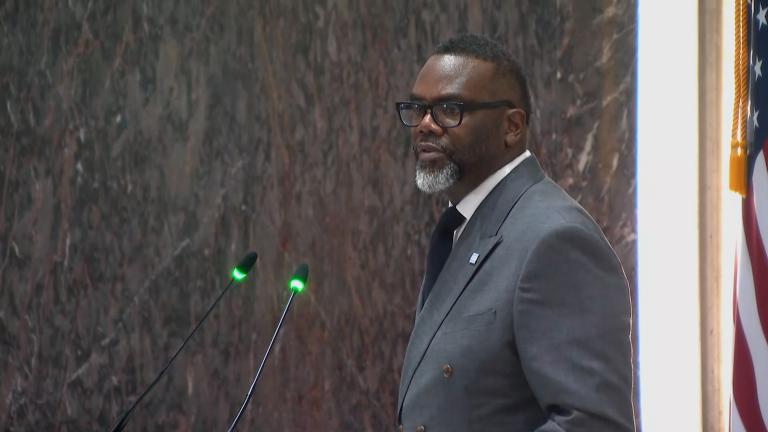
Mayor Brandon Johnson told reporters during a City Hall news conference that he was hopeful the City Council will approve the agreement, calling it a better deal for taxpayers, but stopping short of calling for its approval.
Johnson once again called the parking meter deal the worst ever approved by a local government in United States history.
In 2008, the firm leased the city’s meters for 75 years in return for $1.15 billion — a much-loathed deal crafted by former Mayor Richard M. Daley and rubber-stamped by the City Council that continues to roil Chicago politics nearly two decades later.
The parking meter lease generated $1.97 billion in revenue for the firm between 2009 and 2024, records show. That is approximately $500 million more than was paid to the city nearly 18 years ago, records show.
“This is a good deal for the city and for all Chicagoans,” said Ald. Pat Dowell (3rd Ward), the chair of the City Council’s Finance Committee. “The completion of this agreement will be a departure from the old deal, which did not think about the people of the city of Chicago, and which yielded little benefit for the city. This proposed agreement, on the other hand, offers long-term benefits for city government and for the taxpayers.”
Dowell praised the Johnson administration for helping to negotiate the agreement.
Ald. Scott Waguespack (32nd Ward), who was one of just five alderpeople who voted against the original sale of the parking meters and the only one still on the City Council, said the agreement represented a breakthrough.
“This deal always seemed ironclad and impossible to change — but through these negotiations, we were able to break it open and make significant changes,” Waguespack said. “I am certain that is absolutely the best pathway we could get, and I’m proud to support it. I urge my colleagues to do the same.”
The agreement announced by the City Council members also calls for the city to get an additional payment of 2% of the sale price if Stonepeak sells the meters. The deal also gives the city’s chief financial officer 30 days to review that proposed sale and make a recommendation to the City Council, which will have 90 days to approve or reject the sale.
Critics of Johnson blasted his handling of the parking meter sale, and accused him of withholding crucial information from the City Council that members could have used to force changes to the deal, which has become shorthand at Chicago City Hall for disastrous policy proposals.
Johnson announced in January that Chicago would not buy back the city’s meters, telling reporters “the final purchase price was far too high.” In a memo sent to alderpeople, Johnson said the city bid $3.2 billion for the meters — by far the highest offer — before reversing course.
The city would have had to borrow billions to finance the purchase, pledging to repay that debt with motor vehicle parking fine receipts as well as off-street parking and garage tax receipts, in addition to all parking meter revenue, according to the Johnson administration. Officials would also have been required to use the city’s other tax revenues to make up a shortfall, which could threaten the city’s ability to provide other services, according to the Johnson administration.
“Our team was focused on how to get the best deal for the residents — and we knew that had to include long-term benefits, not just a one-time transfer fee,” Ald. Nicole Lee (11th Ward) said. “I’m proud of the work that we did, especially to ensure that any future transfer of this asset includes a transfer fee, and that there will be a sharing of the profits on an ongoing basis. It’s wonderful news that our children won’t have to pay for more debt for this asset in the future. Instead, we’re getting an actual cash benefit over the rest of the life of this contract.”
In addition, the agreement will change the way the city is required to compensate the firm for lost revenue when meters are temporarily taken out of commission for seven special events to reduce the cost to Chicago taxpayers.
City officials and representatives of Stonepeak will also “examine establishing certain non-metered blocks as potential electric-vehicle charging stations,” and any revenue from those charging stations would be split between the firm and the city, according to the agreement.
Stonepeak also agreed to ensure that at least 50% of its Chicago Parking Meters workforce will live in Chicago, and disclose to the city how many employees live on the South and West sides, where some of Chicago’s poorest residents live, according to the agreement.
The agreement also prohibits Stonepeak from sharing any information about Chicago drivers who use the system with the federal government.
Contact Heather Cherone: @HeatherCherone | (773) 569-1863 | [email protected]