Science & Nature
This Cook County Pond Had a Water Quality Problem. Now a Floating Wetland Acts as a Kidney
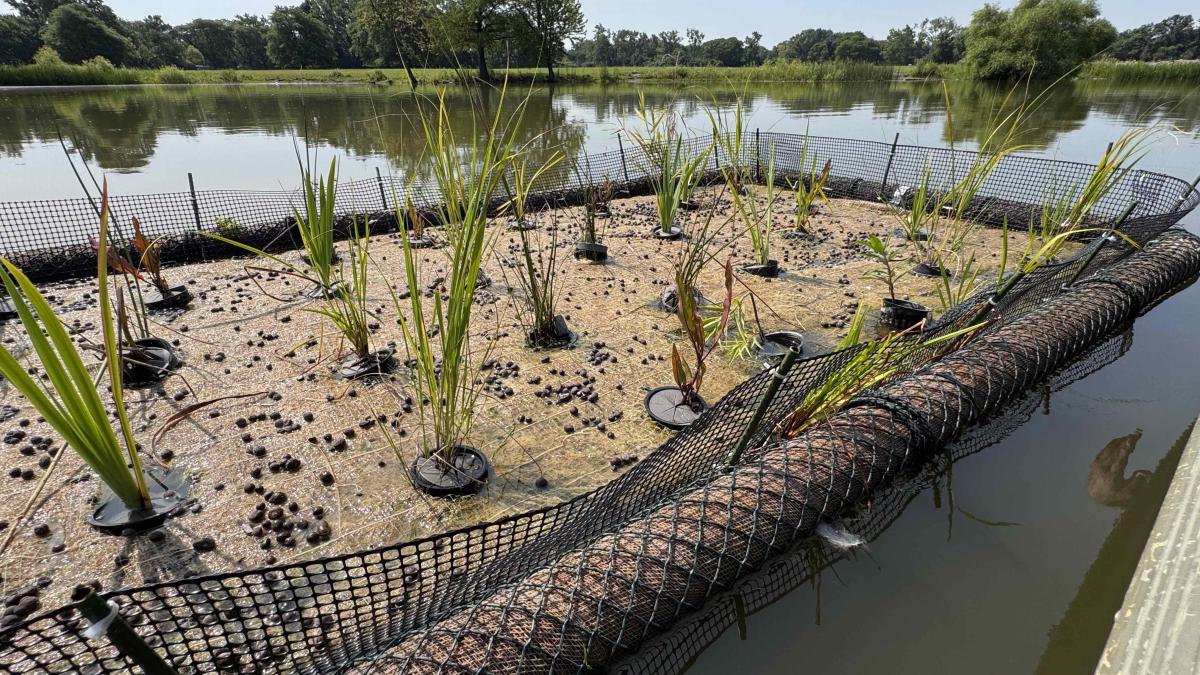 The Forest Preserve District of Cook County has installed its first-ever floating wetland at Schiller Pond. (Patty Wetli / WTTW News)
Compared with the Great Lakes, the six-acre Schiller Pond is a puddle. But this tiny body of water in Schiller Woods could wind up making an outsized contribution to conservation practices at the Forest Preserve District of Cook County, thanks to a first-of-its-kind pilot project for the district.
A floating wetland, roughly the size of a quartet of pool rafts tethered together, is anchored near the southern end of the boomerang-shaped pond. The 5-foot by 10-foot assemblage of PVC pipe, foam insulation board, coconut roll, clay pellets and plants supplied by the Chicago Botanic Garden is an experimental solution to a water quality issue at the pond.
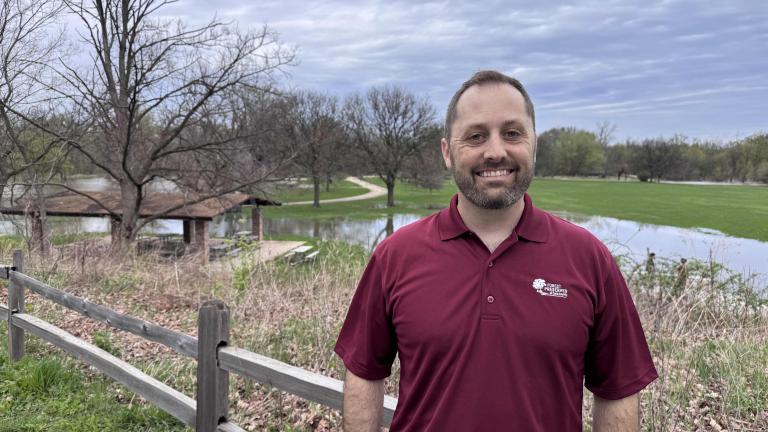
“It’s so small,” Mike Feldmann, a fisheries technician with the forest preserve district, said of the wetland. “But building it, it felt really big.”
After visiting floating wetlands installed by Urban Rivers in the Chicago River and consulting with their experts, Feldmann and his colleagues in the district’s three-man fisheries division — Steve Silic and Jim Phillips are the other two — crafted their own $600 DIY version out of materials from Home Depot.
The fisheries team has already dreamed up an even more pared-down cost-effective configuration that can be turned over to Eagle Scouts for construction assistance.
The goal is to add another 100 or so of the plant-filled rafts over the next five years in order to achieve the 1.5% surface area coverage research suggests is necessary for such wetlands to be effective, Feldmann said.
If the wetlands work as hoped, they’ll serve as a giant natural filter, removing the excess of phosphates and nitrates choking the pond and contributing to algae growth, a lack of oxygen and an impenetrable murk.
“You can’t see down to the bottom,” Feldmann said. “It looks like dirty green bathwater.”
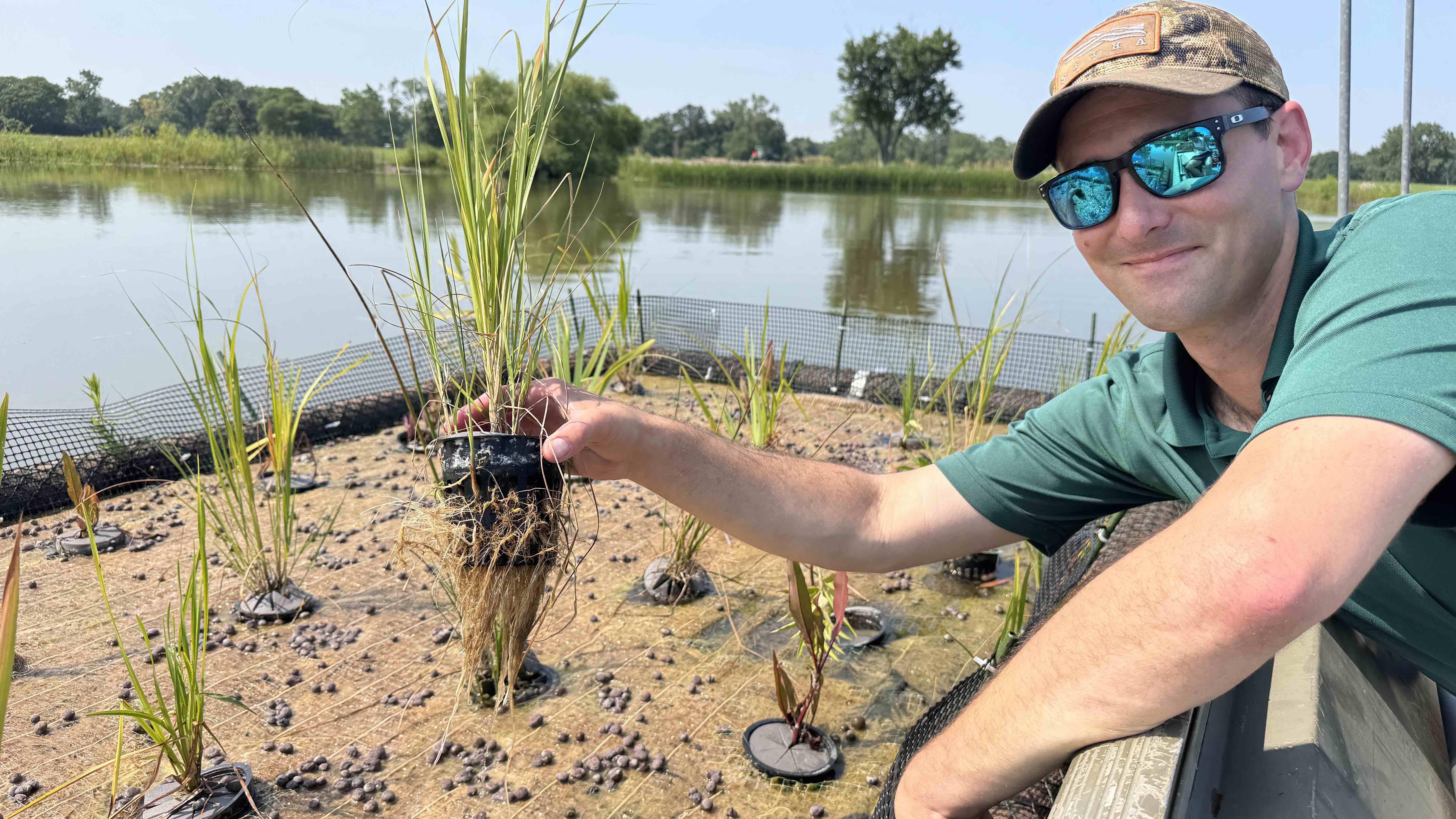 Mike Feldmann is proud of his roots. After just one month, the floating wetland’s plants have undergone underwater growth. The roots will remove pollutants from the water and provide habitat for fish and aquatic insects. (Patty Wetli / WTTW News)
The point of improving water quality is two-fold, as is the mission of the fisheries team, which is responsible for the district’s 44 lakes and ponds, all human-made.
On the one hand, the team’s goal is to maintain ecological sustainability in the aquatic environment. On the other hand, they cater to the public in terms of creating angling opportunities. Healthy fish habitat leads to healthy fish, which makes for happy anglers.
That equation got out of whack at Schiller Pond.
Over the past few years, surveys of the pond’s fish population showed an overabundance of common carp — 60% to 70% — versus the more desirable bluegill and largemouth bass.
“Common carp are very prolific breeders,” Feldmann said. “They’re essentially the rabbits of the lake. And they grow very fast.”
As the carp feed on the pond’s bottom muck layer, they slurp up eggs of other fish, along with crayfish, mussels and worms. They also consume phosphates and nitrates that have settled in the muck, which the carp then release back into the water column, muddying things up, Feldmann explained.
“We don’t want that,” he said. “So we come out and remove carp.”
Staff have reeled in more than 185 carp over nine trips, totaling 374 pounds. But carp aren’t the only problem.
Geese are also adding nutrients in the form of poop, and to address that, a “no mow” buffer has been established around the pond’s perimeter to discourage the birds from lounging on the water’s edge.
Still, there’s one source of nutrients the forest preserves can’t control: Humans, and their use of fertilizer.
Schiller Pond is a collection basin for the surrounding watershed, sandwiched between Chicago to the east and suburbs and O’Hare Airport to the west. Runoff from nearby roads and lawns will eventually trickle down to the pond.
“The message is, even though it doesn’t seem like such a big action just to put some fertilizers on your lawn, or on your flowers, your vegetable garden, it has larger consequences — it gets amplified downstream. Maybe you don’t always need a green lawn,” Feldmann said.
“I can’t go door to door” telling people not to use fertilizer, he said. “That’s just unrealistic.”
Instead he built the pond a life raft.
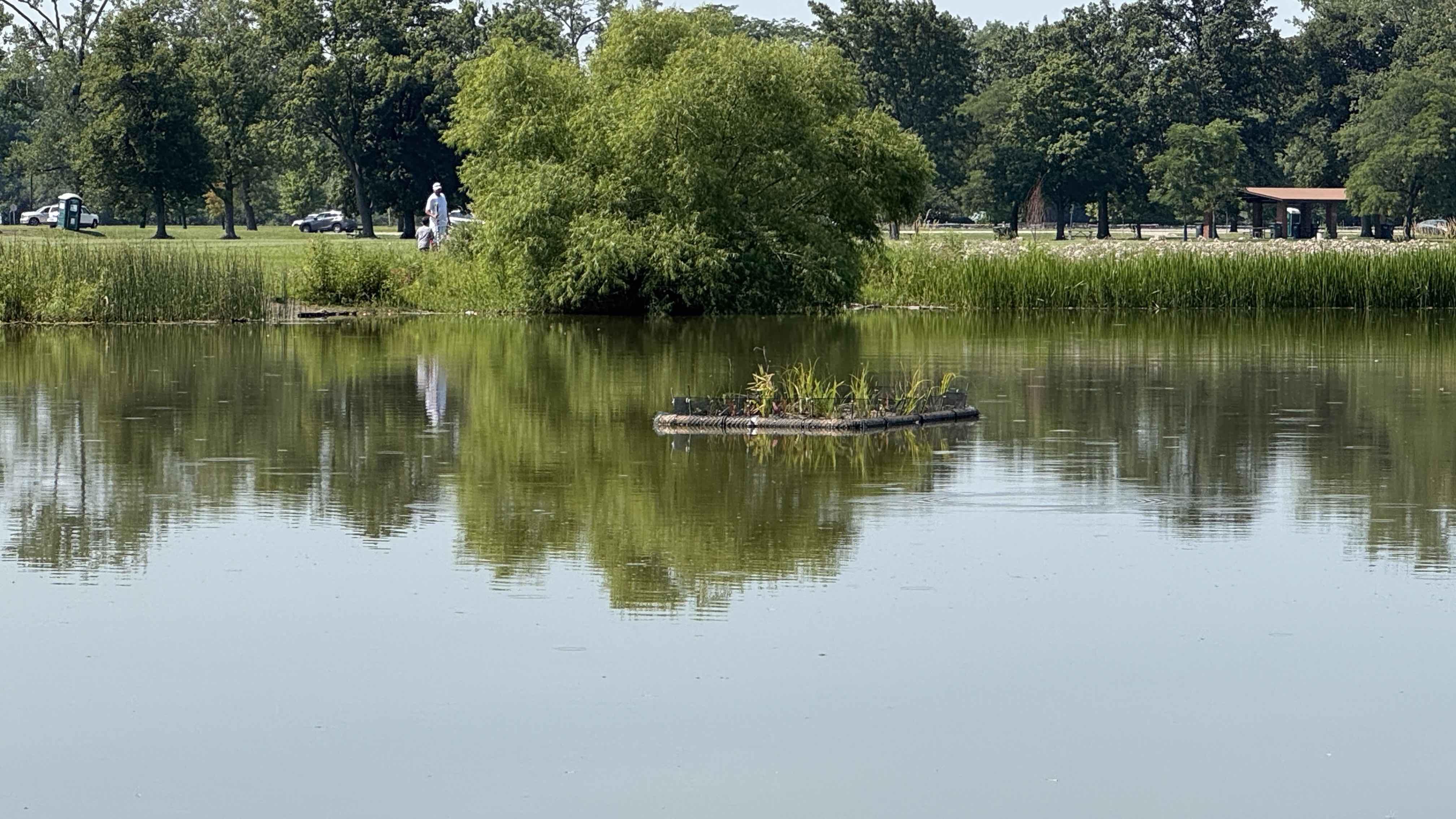 Plans are in the works to add roughly 100 more of the wetland rafts to Schiller Pond. For now, this float stands alone. (Patty Wetli / WTTW News)
The plants installed in the floating wetland —hardstem bulrush, blue flag iris, prairie cordgrass, swamp dock, giant bur-reed and swamp milkweed — will uptake the phosphates and nitrates through their roots and store them in their stem and leaves, Feldmann explained.
That’s what wetlands do, floating or otherwise. They’re nature’s kidneys.
Barely a month after the raft was placed in the pond, Feldmann steered a small motorboat out to the tiny wetland, which is nearly invisible from the bank. He pulled one of the potted plants from what resembled a cup holder, and excitedly pointed to several inches of dangling roots.
“It’s starting to work, these roots are starting to grow through,” Feldmann said.
Eventually, he said, microbes will gather on the roots, creating a biofilm that will attract heavy metals, muck and algae, binding them like glue to the root system and further clearing up the water. In all, mature floating wetlands, at the recommended scale, should remove 5% of nutrients.
In addition to functioning as a filter, the floating wetland provides habitat above and below the water. Pollinators benefit from the plants, turtles can bask on the raft, and small fish can use the roots as a hideout from predators or a safe place to lay their eggs.
“It adds aesthetic value, too,” Feldmann said. “It’s going to look like a green island and it’ll add some beauty to the lake.”
And if the experiment fails?
Feldmann has a nothing ventured, nothing gained attitude. If the wetland pilot educates even one person about the issue of fertilizer runoff, it will be worth it, he said.
“My main goal, too, is to get that thought in people’s brains, … to get people thinking about conservation of water quality,” Feldmann said. “Because it affects us all.”
Contact Patty Wetli: [email protected]