Crime & Law
No Evidence of White House Influence in ‘Broadview Six’ Charges, Court Finds
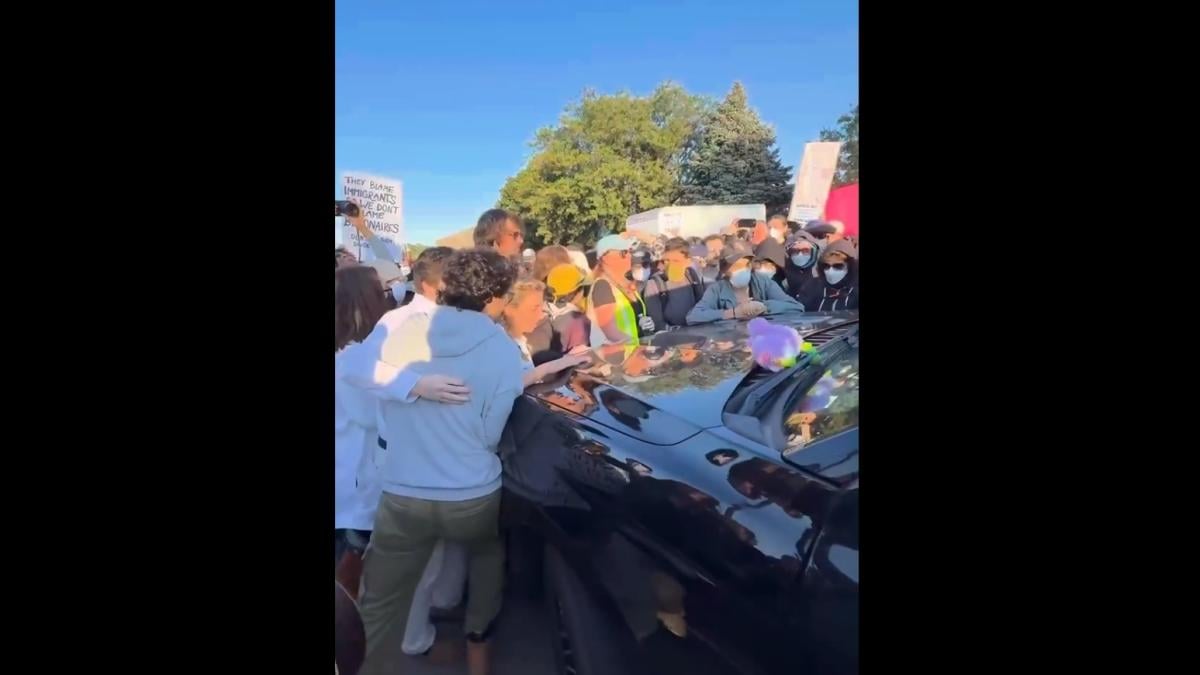 Congressional candidate Kat Abughazaleh, left, is seen along with a crowd around a vehicle on Sept. 26, 2025, outside the Broadview ICE facility. (Credit: Kat Abughazaleh)
A federal judge has tossed out the rest of a motion brought by the remaining “Broadview Six” conspiracy defendants after she found there was no evidence showing the Trump administration had improperly influenced the politically charged case.
U.S. District Judge April Perry on Tuesday found much of the defense motion to be moot after federal prosecutors said they found no evidence of outside communications coming from the White House or Trump officials pushing for them to file charges specifically against the defendants in this case.
Perry also rejected accusations by the remaining four defendants — Kat Abughazaleh, Michael Rabbitt, Andre Martin and Brian Straw — of a selective prosecution based on their status as political candidates or public officials.
“Being a politician is not a protected class,” Perry said, noting that prosecuting public officials is the “bread and butter” of the U.S. Attorney’s Office in Chicago. “I don’t see anything in the communications that indicates one particular political class was targeted here.”
The case stems from a confrontation on Sept. 26, 2025, between protesters and federal agents outside the Immigration and Customs Enforcement processing facility in west suburban Broadview.
The indictment against the group alleges they surrounded a government vehicle, “with the intent to hinder and impede” a federal agent from proceeding to the Broadview facility and “discharging the duties of his office.”
Last month, federal prosecutors dropped charges against two other defendants in the case — Catherine Sharp and Joselyn Walsh — saying that decision came after they continued to evaluate “new facts, evidence, and information to ensure that the interests of justice are served.”
Defense attorneys had sought any potential evidence showing the charges were politically motivated and driven by the defendants’ vocal criticisms of President Donald Trump and his administration.
“Put simply,” defense attorneys wrote in their discovery motion, “the defendants, the Court, and the public deserve an answer as to whether this prosecution was brought for unconstitutional retaliatory and/or selective reasons.”
Abughazaleh, a political candidate and former journalist, finished in second place in the March Democratic primary race for Illinois’ 9th Congressional District seat.
Sharp, who had been running to represent the 12th District on the Cook County Board of Commissioners, suspended her own campaign in January, citing the criminal case against her. Rabbitt serves as a 45th Ward Democratic committeeperson, while Straw is an Oak Park Village Board trustee.
Prosecutors blasted the defendants’ accusations as a “nonsensical hypothesis” that alleges Trump administration officials identified the defendants — whom Assistant U.S. Attorney William Hogan referred to in a recent court filing as “politically obscure figures” — and ordered their “selective and vindictive prosecution.”
“Such assumptions are the product of fevered paranoia and delusional speculation,” Hogan wrote in a March 30 filing, “not to mention grossly disingenuous and thoroughly irresponsible.”
While the group that allegedly surrounded and interfered with the ICE vehicle consisted of far more people than just the defendants, prosecutors said many of them were masked and could not be identified. Those who were ID’d and not charged were “not similarly situated from an evidentiary and proof perspective,” prosecutors said.
Perry on Tuesday said she saw no evidence of the defendants’ political affiliation being considered when prosecutors opted to bring charges in this case.
The four remaining defendants have also filed a motion to dismiss the case against them, which Perry has not yet ruled on. Pending Perry’s ruling on that motion, those four remain set to go on trial beginning May 26.
Perry noted the heated arguments from both the prosecution and defense, despite the fact they were in what she called “violent and aggressive agreement” on the vast majority of discovery issues resolved during Tuesday’s hearing.
“Save your drama for the jury,” she told attorneys.