Science & Nature
Rescuers Spring Into Action To Save Snowy Owl Injured Along Illinois Tollway
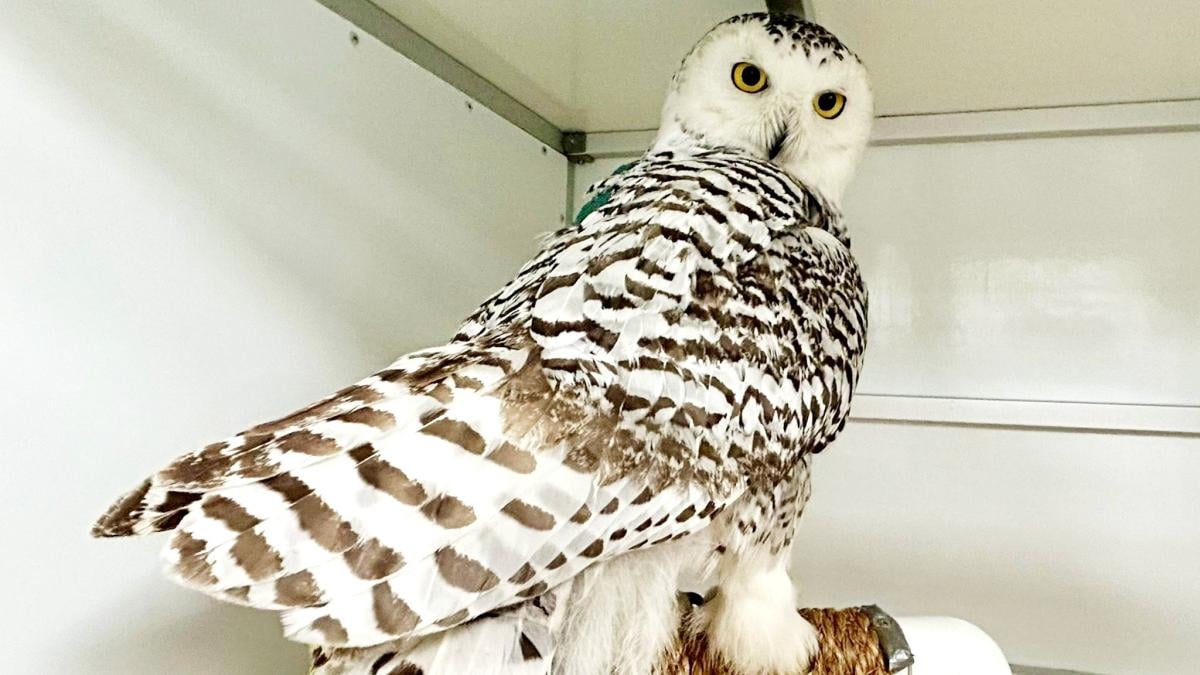 A juvenile snowy owl is recovering from a broken wing at DuPage Wildlife Conservation Center. (Courtesy DuPage Wildlife Conservation Center)
Holding a snowy owl in his hands was a once-in-a-lifetime opportunity that Ken Reinert said he’ll never forget.
It’s also an experience he’d rather not repeat.
“You don’t want to see the bird injured,” Reinert said.
But an injured bird is precisely why, early on the morning of Feb. 7, Reinert received an SOS from Oaken Acres, a wildlife rehab center in Sycamore, Illinois, west of Chicago.
A snowplow driver on I-88 had spotted a snowy owl in distress along his route, near DeKalb, and called Chicago Bird Collision Monitors, which in turn contacted Oaken Acres. The game of telephone ended with Reinert: Could he nab the bird and bring it in?
“I’ll help any time I can,” said Reinert, a long-time self-described “bird nerd” who’s become Oaken Acres’ go-to guy for owls — especially owlets — hawks and other raptors.
He sprang into action, grabbed his net and carrier case, and headed to the scene.
In a stroke of luck, the owl was struggling along a fence line when Reinert arrived, which helped contain the bird. The snowplow driver had not only remained on site, he’d been joined by a supervisor, and the two distracted the owl while Reinert crept up from behind with his net.
“The adrenaline was going,” Reinert said, but his experience served him well. The entire operation took all of three minutes, he estimated.
Reinert transported the owl to Oaken Acres and from there the bird was taken to DuPage Wildlife Conservation Center, where it was quickly diagnosed with an open fracture to its left wing (humerus), likely due to a collision with a car, according to Dr. Sarah Reich, the center’s lead veterinarian.
“These birds are born up in the arctic tundra. There’s a 2,000-mile flight to get down here, to get hit by a car,” Reinert said.
By comparison, a pair of snowy owls that landed on Chicago’s Montrose Beach in late 2025 were lucky to have only encountered a horde of camera-wielding admirers. Though the optics weren’t great — “That was a carnival out there,” Reinert said of Montrose — those owls seemed far safer to him than a snowy perched atop a utility pole along a highway.
In an update shared on social media, Reich said she opted to perform surgery on the injured owl immediately, a choice that’s “always risky as we generally want to make sure an animal is stable enough for prolonged anesthesia first. However, the longer a bone is exposed, the more likely it is to become infected or necrotic.”
At one week post-op, Reich said the bird was doing as well as could be expected — eating and demonstrating “spunk” — but it was too soon to tell if interventions had been successful.
“If this bird survives, I’ll buy (Reich) and her entire staff lunch," Reinert said.
In the decade or so that he’s been volunteering with Oaken Acres, Reinert has learned the hard way that not every rescue has a happy ending.
“I had a long-eared owl a few years ago that I rescued off of a snowbank and held him in my hands all the way to Oaken Acres. He looked like he was going to pull through and a couple days later he didn’t,” Reinert said.
“It’s a shame but the one out of four times that one actually survives and I get to participate in their release, gosh what a reward. What a reward,” Reinert said.
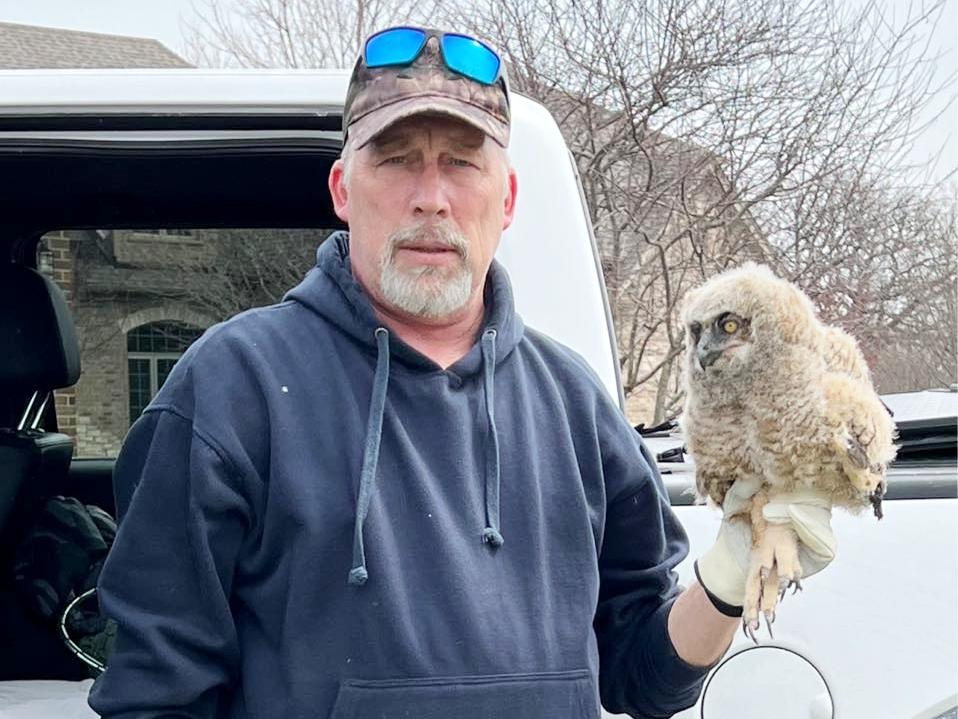 Ken Reinert, pictured, has rescued enough owlets to know protective gloves are always a must. Look at those talons. (Courtesy of Ken Reinert)
While he waits on the outcome of the snowy owl tale, Reinert is gearing up for what’s typically his busiest time of the year, in terms of rescues.
Every spring, he usually gets three or four calls to check on a report of a great horned owlet that’s fallen out of its nest.
“Great horned owls are more than capable of taking care of their owlets when they’re on the ground, but if they’re in an area where there are predators or people, I’ll go and get it,” Reinert said.
He’ll strap a milk crate to the same tree as the nest, fill it with sticks and leaves, and place the owlet in its new home.
“Mom will come down and she’ll feed the bird. … It’s good to go,” said Reinert. “Out here in Sycamore, there’s a number of milk crates in different trees around the area that have my name on them.”
Contact Patty Wetli: [email protected]