Science & Nature
Chicago Park District Limits Access to Snowy Owls, Citing Safety Concerns. Here’s What to Know About the Arctic Visitors
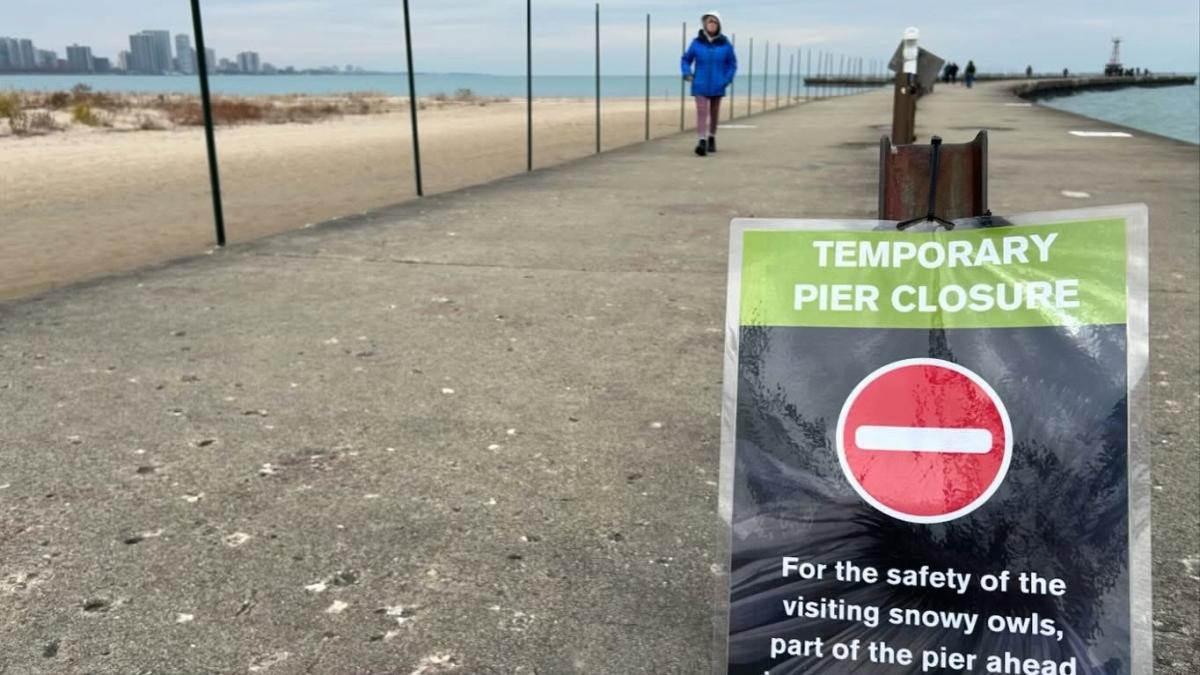 The Chicago Park District has placed signage at Montrose pier, announcing a temporary closure to protect visiting snowy owls. (Courtesy Chicago Park District)
Chicagoans have been going gaga over a pair of snowy owls that have settled in at Montrose Beach. Maybe a little too gaga.
Over the weekend, the number of visitors ballooned as people flocked to the lakefront to catch a glimpse of the Arctic birds. Some estimated the crowd as between 75 and 100 people at a time, while others said the experience had turned into a “circus.”
In response, the Chicago Park District on Monday announced the temporary closure of access to Montrose pier.
“These birds have traveled all the way from the Arctic and are considered vulnerable due to their population decreasing. Help give the owls a warm welcome to Chicago by being respectful and giving them space,” the Park District said on social media.
A spokesperson for the district told WTTW News that while this isn’t the first time snowy owls have taken up residence at a city park, in previous years, they’ve landed at the less accessible Northerly Island.
Montrose, on the other hand, is a hot spot for birders, as well joggers, cyclists and the general public, with plenty of available parking.
Scott Weidensaul, co-founder of Project Snowstorm, which has spent a decade researching the movement of snowy owls, was watching developments in Chicago from his home in New Hampshire.
“I was a little concerned,” Weidensaul told WTTW News. “From what I could tell looking at the eBird reports, there were a lot of people out there watching those birds.”
While he said he was relieved to learn of the Park District’s actions, he also wanted to acknowledge and encourage excitement over their presence.
“This is a part of the Arctic that’s shown up in your back yard,” he said. “One of the first things I thought of was Chicago needs this right now. This is a piece of natural beauty and vivid wilderness come to the Windy City in a year when you guys have had a pretty rough go of it.”
There are ways to safely appreciate snowy owls, Weidensaul said, beginning with respecting their space and admiring from a distance, minimally 300 yards, which means they’re best viewed through binoculars or a scope.
“If the snowy is watching you, you’re too close,” he said.
The enthusiasm over the owls has also led to a lot of information and misinformation being shared online. Here’s what Weidensaul and other wildlife experts had to say about Chicago’s guests.
Where did they come from?
Snowy owls breed in the high Arctic, so, parts of Alaska, Canada, Greenland, Scandinavia and Russia. Unlike a lot of other birds Chicagoans may be familiar with, snowys don’t return to the same nesting site year after year.
“They’re highly nomadic,” Weidensaul said. “They move tremendous distances.”
Why?
They’re looking for booms in the population of their preferred food source, namely lemmings and other small mammals like voles. And they seem to have an uncanny sense for zeroing in on those spikes in prey.
“Sometimes, they really hit the jackpot,” said Weidensaul.
In 2013, in northern Quebec, there was a historically high number of lemmings. Snowy owls descended in force and in turn had their own owlet boom. That winter of 2013-14 was the biggest appearance of snowy owls in places south of their normal range in nearly 100 years.
“There were thousands and thousands of them flooding into southern Canada and the eastern United States,” he said. “That was the year we started Project Snowstorm. A friend of mine said, ‘None of us are going to live long enough to see this again. Let’s try to get as much information as we can.’”
Weidensaul said it’s likely snowy owls enjoyed a good breeding season in the Canadian Arctic and juveniles are dipping south in search of territory.
A sizable number of snowys have shown up in Great Lakes states already this year, he said, which is within their normal range, but they are showing up unusually early. It’s more typical to see them in December, and some arrived in late October.
To bust one prevalent myth, Weidensaul said snowy owls’ appearance does not mean they’re starving up north.
“You do not migrate thousands of miles if you’re starving,” he said. “Most of these birds are in good shape.”
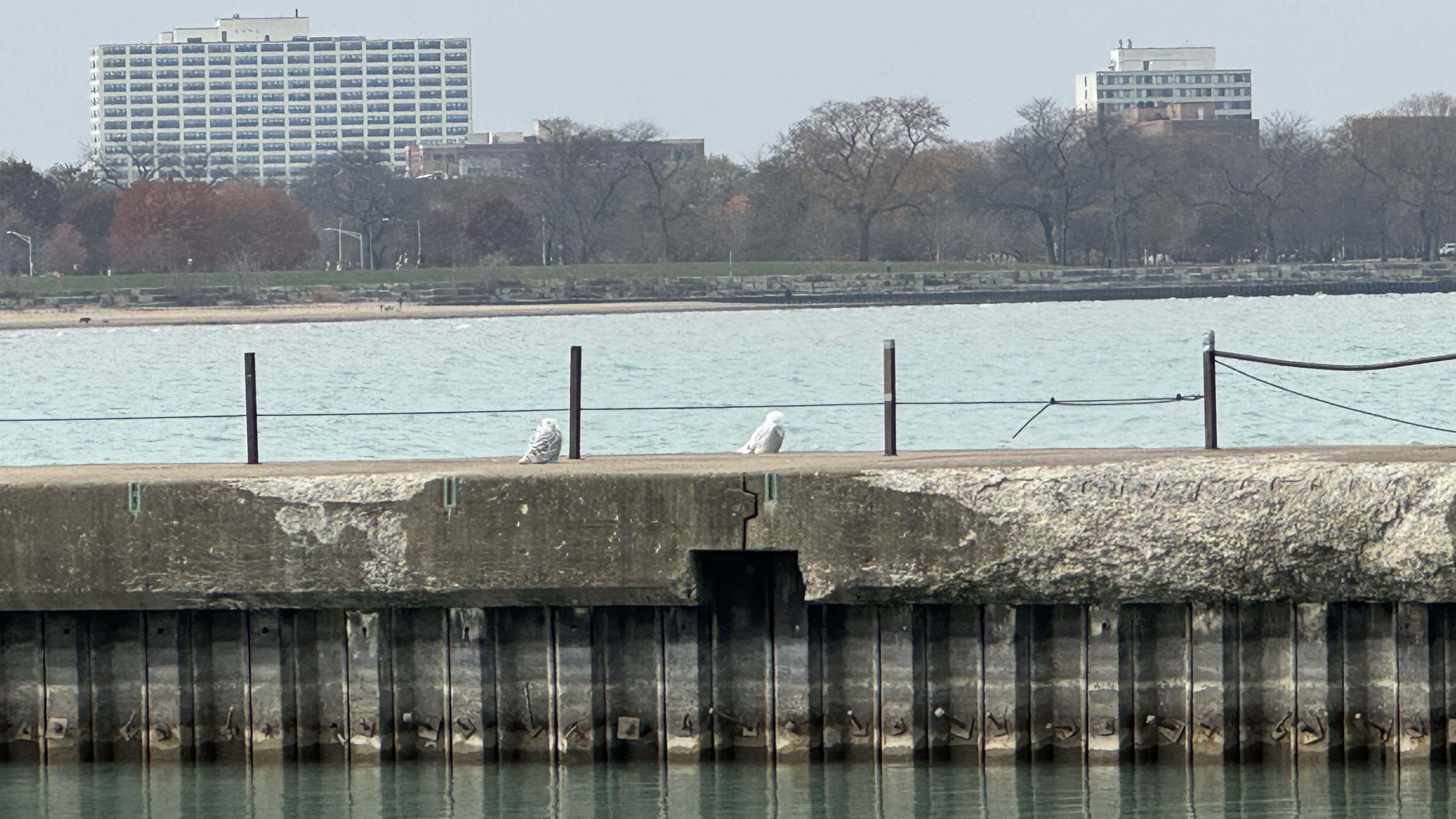 Chicago's snowy owl duo at Montrose pier, Nov. 21, 2025. (Patty Wetli / WTTW News)
Is the twosome at Montrose likely to become the next Monty and Rose, Chicago’s piping plover lovebirds?
In short, nope.
Based on images he’s seen of Chicago’s snowys, Weidensaul is certain that both are juveniles. (To get deep in the weeds, all their flight feathers are the same age, he said, which is only seen in juveniles.) One’s a male and one’s a female, but they are not a pair, he emphasized.
“This is not a romantic coupling,” he said. “They don’t care about each other.”
One, it’s not breeding season and two, even if it was, these two aren’t mature enough, Weidensaul explained.
If push comes to shove and there’s an argument over territory or food, don’t be surprised to see the female chase off the male. In the snowy hierarchy, rankings are: female adult, male adult, female juvenile and male juvenile at the bottom of the ladder.
What threats do they face in Chicago?
Young snowys are extremely inexperienced in the ways of the world, which lands them in trouble.
People often wonder why snowys hang out at airports. Aren’t they frightened by the airplanes?
Actually, Weidensaul said, they don’t know what an airplane is, anymore than a tree.
Most of them have never seen a human, which is why they can be easy to approach — they don’t have an instinctive fear of people. Alarmingly, if they become habituated to people as, say, a source of food, they might head back north and wind up winging their way toward a hunter, without understanding the danger, Weidensaul said.
Every year, a number of snowy owls die in collisions with cars and increasingly they’re being killed by rodenticides — they eat the rodents that have ingested anticoagulant rat poison.
In 2013, none of the snowys studied by Project Snowstorm had rodenticide in their system. In 2022, more than half did. It’s a problem for every raptor, not just snowys, Weidensaul said, and he was pleased to hear that Chicagoans are pushing to ban rodenticide use.
Did someone try to trap the snowys at Montrose?!
Yes. But for good reason.
Wildlife biologists with the Forest Preserve District of Cook County were attempting to band the birds and conduct a health assessment. According to Chris Anchor, the district’s senior wildlife biologist, the forest preserve has been banding snowys for decades, in conjunction with state and federal partners.
This work has become more and more critical due to the spread of avian influenza. Snowys congregate near shorebirds — that’s a big part of their diet in places like Chicago — and shorebirds are the primary carriers of avian influenza.
“We’ve seen a really alarming number of snowy owls over the last three or four winters that have been turning up dead from avian influenza. It has worried many of us … we’re actually concerned about population level decreases in snowy owls,” Weidensaul said.
Performing health workups, like the ones attempted at Montrose, provide a crucial look at the health of bird populations and track the movement of zoonotic disease.
For witnesses at Montrose who may have been disturbed to see people approach the owls, a spokesperson for Cook County forest preserves said: “It is important the public know that when biologists conduct this work, it’s done as quickly as possible and in a way that limits any stress to the animal — and ultimately provides insights into ecosystem health and zoonotic disease trends.”
Snowy vs. peregrine, a battle for the ages?
A number of photographers captured the Montrose duo repelling an assault over the weekend by a peregrine falcon.
The images had all the drama of an epic Hollywood battle scene, but Weidensaul said the peregrine’s threat had more bark than bite, to mix animal metaphors.
Peregrines are more of a pest to snowys. It’s bald eagles that strike real fear in the owls, he said. Notably, an eagle has been seen hanging out on the lakefront a little north of Montrose recently.
Day owl or night owl?
Here’s another myth Weidensaul wants to bust.
Snowys are not diurnal, he said, at least not this time of the year, when they’re mostly active after dark.
So why do they have the reputation of being daytime hunters?
Because it’s light in the Arctic all summer long, he said.
Will the Montrose snowys spend the entire winter in Chicago?
Hard to say, according to Weidensaul. “They may very well move on.”
Or others could join them — it’s early in the season.
How rare are snowy owls?
Scientists used to think the snowy population was close to 300,000. But once researchers realized the owls were nomadic, and that birds counted one year in Russia were the owls counted the next year in Greenland, numbers were adjusted downward by an order of magnitude.
Today the population is estimated at somewhere between 14,000 and 28,000 breeding adults. In a first-ever global conservation assessment, scientist Rebecca McCable placed the snowys’ decline at 30% in the last 25 years.
“We’re not sure why,” Weidensaul said.
But one thing scientists are sure of: Because snowy owls breed at the very highest latitudes, they are among the species at greatest and most immediate risk of climate change.
“I would put the snowy with polar bears,” said Weidensaul.
So yes, Chicagoans should absolutely revel in the opportunity to host these rare and beautiful creatures. Just admire them from afar.
Contact Patty Wetli: [email protected]