Crime & Law
No Evidence CPD Provided Required Update on System That Would Flag Officers With Multiple Complaints
 (WTTW News)
There is no evidence that Chicago police brass updated Mayor Brandon Johnson and three City Council committee chairs about their progress in crafting a system designed to alert officials about which officers have been the subject of repeated police misconduct allegations, as required by city law.
The ordinance that implemented the city’s 2026 budget included a provision requiring monthly updates on long-delayed efforts to craft and implement that system, which is required under the terms of the consent decree, the federal court order designed to compel the department to change the way it trains, supervises and disciplines officers.
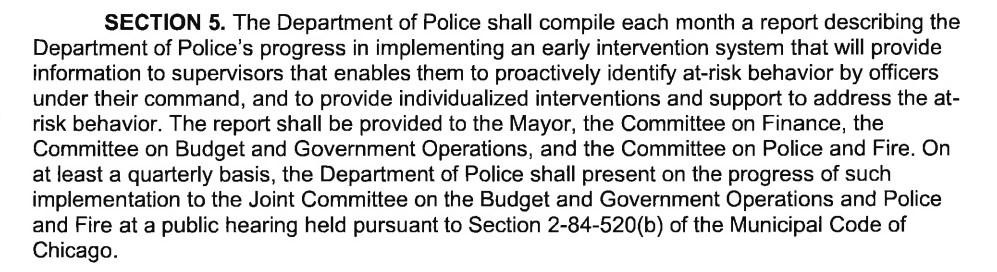 Text of the 2026 Budget Management Ordinance. (City Clerk’s Office)
A letter was supposed to be sent to Johnson; Ald. Pat Dowell (3rd Ward), the chair of the Finance Committee; Ald. Jason Ervin (28th Ward), the chair of the Budget Committee; and Ald. Chris Taliaferro (29th Ward), the chair of the Police and Fire Committee.
In response to a Freedom of Information Act request filed by WTTW News for the letter that was due to be sent Feb. 1, a CPD spokesperson responded that the department had no record of that letter.
The mayor’s office did not respond to two requests for comment from WTTW News.
A CPD spokesperson did not respond to a request for comment from WTTW News about why the department did not comply with the ordinance.
Ervin and Taliaferro did not respond to a request for comment from WTTW News, while Dowell referred questions to Ervin and Taliaferro, saying she was focused on “the revenue side of things.”
When he announced the requirement for monthly updates about the system, Johnson said it would make it possible for police leaders to offer officers “early, individualized interventions that improve performance, accountability and wellness — reducing misconduct, building community trust, and lowering litigation costs,” according to the mayor’s office.
CPD had fully complied with 22% of the consent decree’s requirements, according to the most recent report from the court-appointed monitoring team charged with keeping track of efforts to comply with the federal court order. That order was prompted by a 2017 probe that found officers routinely violated the constitutional rights of Black and Latino Chicagoans.
Creating a system that flags officers with multiple complaints and lawsuits to prevent incidents is central to the consent decree, which is designed to restore the public’s trust in CPD, which has faced decades of scandals, misconduct and brutality.
Chicago taxpayers paid $295 million between 2019 and 2024 to resolve lawsuits naming officers whose alleged misconduct led more than once to payouts, according to an analysis of city data by WTTW News.
That issue returned to the City Hall spotlight last week after the City Council’s Finance Committee rejected a recommendation to pay $8.25 million to the family of a woman who was struck and killed by a driver being chased by Chicago police.
That September 2022 pursuit lasted for 11 miles and reached speeds of up to 95 mph. The officer who led that pursuit “ran 20 red lights and several stop signs,” according to an attorney for the city.
That officer has been suspended three times for a total of six days for engaging in several pursuits that violated CPD policy, officials said.
One of those pursuits occurred just 10 days before Dominga Flores Gomez, a 55-year-old mother of five and a grandmother of eight, was killed.
WTTW News reported in September 2023 that officials could have rolled out an early warning system citywide in May 2021, but police brass transferred the department members assigned to run the system to patrol amid a surge in crime that has since abated.
Johnson is the fourth mayor of Chicago to attempt to implement an early warning system.
New Requirements for CPD Included in Budget
One of the last changes made to the 2026 spending plan before it was passed by the City Council over Johnson’s objections was to remove a requirement that CPD brass publicly ask the City Council for more money if the department exhausts its $200 million budget for overtime.
The City Council did not, however, amend or strike the section of the ordinance implementing the budget requiring monthly updates on the early-warning system, records show.
Johnson attempted to restore those controls on CPD overtime by signing an executive order.
The city of Chicago spent approximately $256 million on overtime for members of the Chicago Police Department during 2025 — 156% more than the City Council set aside for police overtime as part of the city’s annual budget, according to updated records published by the city’s watchdog.
CPD not only exceeded its annual budget as set by the 2025 city budget, but it also spent 28% more than the amount set aside for police overtime in the 2026 city budget, records show.
In January, CPD spent $16.5 million on police officer overtime, 18% less than what CPD spent on officer overtime in January 2025, according to the inspector general’s website.
Contact Heather Cherone: @HeatherCherone | (773) 569-1863 | [email protected]
WTTW News coverage of policing and police reform is supported by The Joyce Foundation.