Politics
Rival Budget Proposal Advances Calling for $473M in New Taxes, $35M From Advertising on Light Poles and City Vehicles
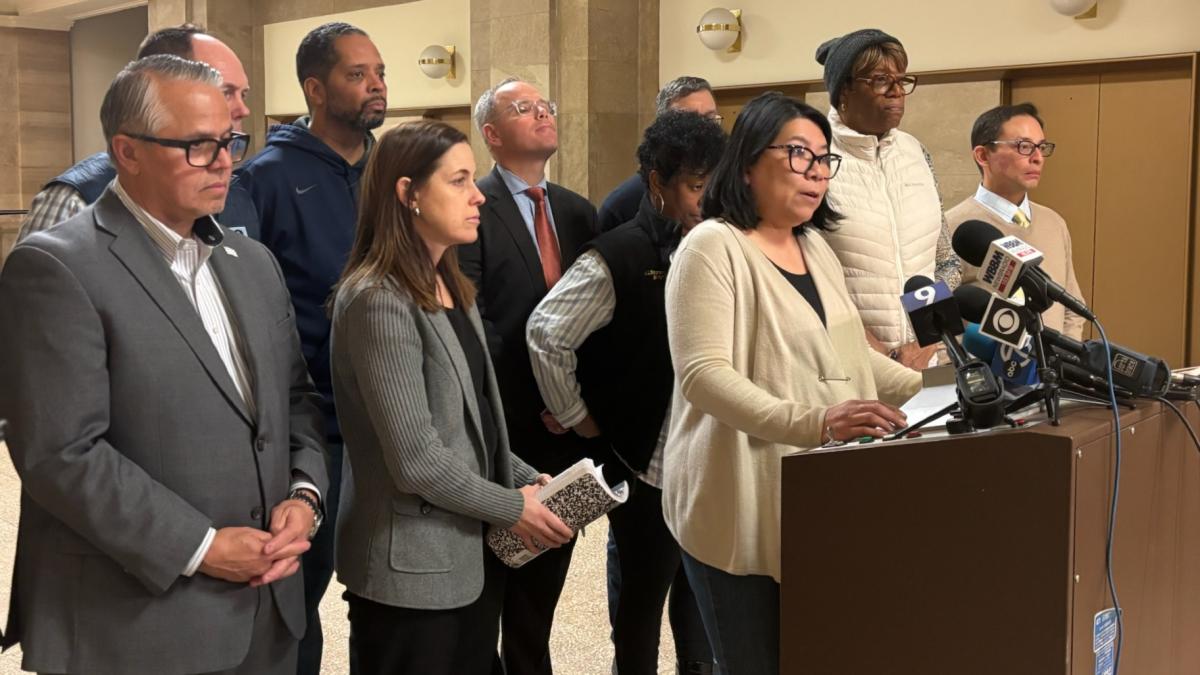 Ald. Nicole Lee (11th Ward) addresses the news media at City Hall, alongside a group of alderpeople who proposed an alternative budget proposal on Monday, Dec. 15, 2025. (Heather Cherone / WTTW News)
The Chicago City Council’s Finance Committee voted 22-13 Tuesday to advance a plan to bridge Chicago’s $1.19 billion budget gap without hiking taxes on large firms, handing Mayor Brandon Johnson another stinging defeat.
The rival budget plan unveiled just hours before the vote, which sends it to the full City Council, calls for more than $473 million in new taxes and relies on $35 million in revenue from advertising on city light poles and in other public spaces.
The plan also calls for the city to collect an additional $89 million from Chicagoans who owe to the city ambulance payments, utility bills, red-light camera tickets and other debt while eliminating Johnson’s proposal to levy a $33 per month per employee tax on companies with 500 or more employees in order to generate $82 million to fund violence prevention and youth employment programs.
Mayor Brandon Johnson immediately rejected the proposal to increase the city’s debt collection efforts as a tax “on everyday Chicagoans” that would target “poor and working” people.
“Not only is this proposal immoral, it is simply not feasible,” Johnson said. “There is no way to sell off Chicagoans' debts that would yield that amount of revenue. If passed as is, this proposal would likely result in a significant midyear budget shortfall and leave Chicagoans vulnerable to deep cuts to city services.”
It would take 34 votes to override a mayoral veto.
Ald. Nicole Lee (11th Ward), who helped Ald. Scott Waguespack (32nd Ward) present the rival budget plan to the City Council’s Finance Committee, said those stepped-up debt collection efforts, which could be outsourced to private firms, would not target low-income residents.
“Our budget is balanced,” Waguespack said, adding that it offers a path out of “this time of crisis.”
While Johnson and his allies have defended the so-called head tax as the best way to continue funding the programs they credit with reducing Chicago’s homicide rate by approximately 29% and the city’s overall violent crime rate by more than 22%, opponents contend the tax will kill jobs and stifle economic growth.
There are just 14 days left before the deadline to avoid an unprecedented shutdown of city government. Officials cannot pass a short-term ordinance to keep City Hall functioning while negotiations continue, officials said. That means without a budget agreement, more than 30,000 workers will not be paid and city services will stop.
The City Council’s Budget Committee is set to take up the other half of the budget plan at a meeting set for 2 p.m. Wednesday. The plan advanced Tuesday by the Finance Committee raises the necessary revenue for the city’s 2026 spending plan, while the measure set to be considered by the Budget Committee would spend it.
Ald. Pat Dowell (3rd Ward), the mayor’s hand-picked Finance Committee chair, presided over the hours-long debate, even as she has emerged as one of the leading opponents of the mayor’s plan and helped craft the rival proposal without the assistance of the city’s finance team.
The proposal also relies on $6 million from an “augmented reality” advertising licensing program that would allow companies to impose videos and other content on city properties like Millennium Park or the Riverwalk that can be seen through a smartphone, virtual reality glasses or tablet, according to the proposal.
“Who has kids who play Pokemon Go?” Lee asked, adding that her children play the virtual reality game whose popularity peaked in 2016. “This is a really cool new revenue option.”
That proposal had already been dismissed by Budget Director Annette Guzman, Chief Financial Officer Jill Jaworski and Comptroller Michael Belsky, who said those projections lack “a clear evidentiary basis” and cannot be relied on.
An additional $29.3 million would come from new advertising on 3,000 city light poles, city vehicles and iconic bridge houses, according to the proposal.
Chicago’s movable bridges are designated by the federal government as landmarks, and regulations prohibit advertising on them.
Ald. Anthony Quezada (35th Ward) blasted that plan, calling it an unwise “privatization of public spaces” and “commodification” of public spaces.
Another $8.7 million would come from charging shoppers 15 cents for each single-use paper and plastic bag at stores and allowing retailers to keep 1 cent to cover costs. The current tax is 10 cents, with store owners keeping 1 cent. That fee was also hiked by 3 cents in last year’s budget.
The rival spending plan would not rely on revenue from new video slots and video poker machines at O’Hare and Midway airports, but would legalize video poker and slot machines in every Chicago bar or restaurant with a liquor license.
That would ring up $6.8 million in revenue, Ald. Anthony Beale (9th Ward) said. That assumes Bally’s will stop paying the city $4 million annually, as called for in the agreement it reached with Chicago officials in 2022 for the city’s first, and only, casino license, Beale said.
An economic impact study ordered by the mayor could cost nearly 400 jobs at the city’s casino, run by Bally’s, scheduled to open next year at its permanent location in River North.
That study found that legalizing video poker games across the city would not result in a massive windfall of revenue.
Beale said he expected 80% of all bars and restaurants will apply for a state gaming license, which usually takes six to eight months to be approved.
Ald. Walter “Red” Burnett (27th Ward) reminded Beale that voters in his West Side ward have repeatedly voted against expanded gambling.
“This feels very irresponsible,” Burnett said. “No one in my ward wants gambling on every corner.”
In addition, the rival budget proposal relies on $6 million by a 1.5% increase in the taxes on beer, wine and liquor sold at stores for consumption elsewhere.
City officials have warned that hike would likely be struck down by the courts, because it makes alcohol consumed on site less expensive than booze consumed elsewhere, and it is opposed by the politically powerful hospitality and restaurant industry.
The rival budget plan would also pay an additional $139.9 million into the city’s woefully underfunded pension funds. Johnson had proposed paying just $120.8 million more to the city’s four pension funds.
The city faces a nearly $2.85 billion pension bill in 2026 in order to comply with a state law that requires two of Chicago’s pension funds be funded at a 90% level by 2055 and the other two by 2058, ensuring they can pay benefits to employees as they retire.
The rival budget plan would also set aside an additional $10 million for programs designed to reduce gender-based violence, $5 million to the Chicago Public Library’s budget to purchase new materials and $3.5 million for two violence-interruption programs, Becoming a Man and Working on Womanhood.
The alternative plan also makes $46.6 million in cuts identified by consulting firm Ernst & Young in a report designed to help Chicago officials root out inefficiencies. That calls for vacant positions to be eliminated and for “service optimization” by charging more for things like false burglar alarms and ambulance rides, according to the proposal.
Even though the initial version of the rival proposal would have eliminated plans to borrow $166 million to pay firefighters, who worked without a contract for four years, the proposal presented Tuesday does not change that part of the mayor’s proposal.
Both budget proposals would also borrow $283.3 million to cover the soaring cost of lawsuits alleging Chicago police officers committed a wide range of misconduct.
In addition, both budget plans declare $1 billion in property taxes earmarked to fight blight to be “surplus.” The rival budget plan expects an additional $20 million to flow into the city’s coffers, and uses that to fill the 2026 budget gap.
The rival budget plan would impose a congestion surcharge for all Uber and Lyft rides to and from an expanded area downtown to generate $39.4 million. The mayor’s original plan would have increased that charge to generate a total of $65.4 million, records show.
The largest tax hike included in both proposals would boost the tax levied on software licenses, cloud services and other digital goods from 11% to 15% to generate $415.2 million, according to the proposal. The mayor has touted that as a tax hike on “big tech.”
The budget includes a provision that would prohibit the City Council from hiking that tax again before Sept. 1, 2028. The City Council could vote to overturn that provision at any time.
The Finance Committee also voted 23-6 to advance a measure that would hike Chicagoans’ property taxes by $9.1 million to boost the budget for the Chicago Public Library, which had been set to see 69 vacant positions eliminated in next year’s budget.
Johnson has vowed to veto any budget that raises property taxes.
In other action, the Finance Committee voted 24-8 to advance a plan to borrowing a total of $1.8 billion to cover the cost of firefighters’ pay, cover the cost of police misconduct settlements and fund the city’s infrastructure program for 2026 and 2027, which includes $144.6 million to repair bridges and viaducts, $174 million for street resurfacing and $173 million to replace lead service lines.
Chicago had $10.6 billion in outstanding debt backed by the city’s property tax and sales tax receipts at the end of 2024, according to the city’s 2024 Annual Comprehensive Financial Report.
In addition, the Finance Committee advanced a measure that would allow Jaworski to refinance $1 billion of the city’s debt during 2026. Originally, Jaworski asked for the authority to refinance $2 billion in debt in 2026 and 2027.
Contact Heather Cherone: @HeatherCherone | (773) 569-1863 | [email protected]