Politics
Chicago Is $130M Short After Revenue Backed by City Council Fails to Materialize, Johnson Says
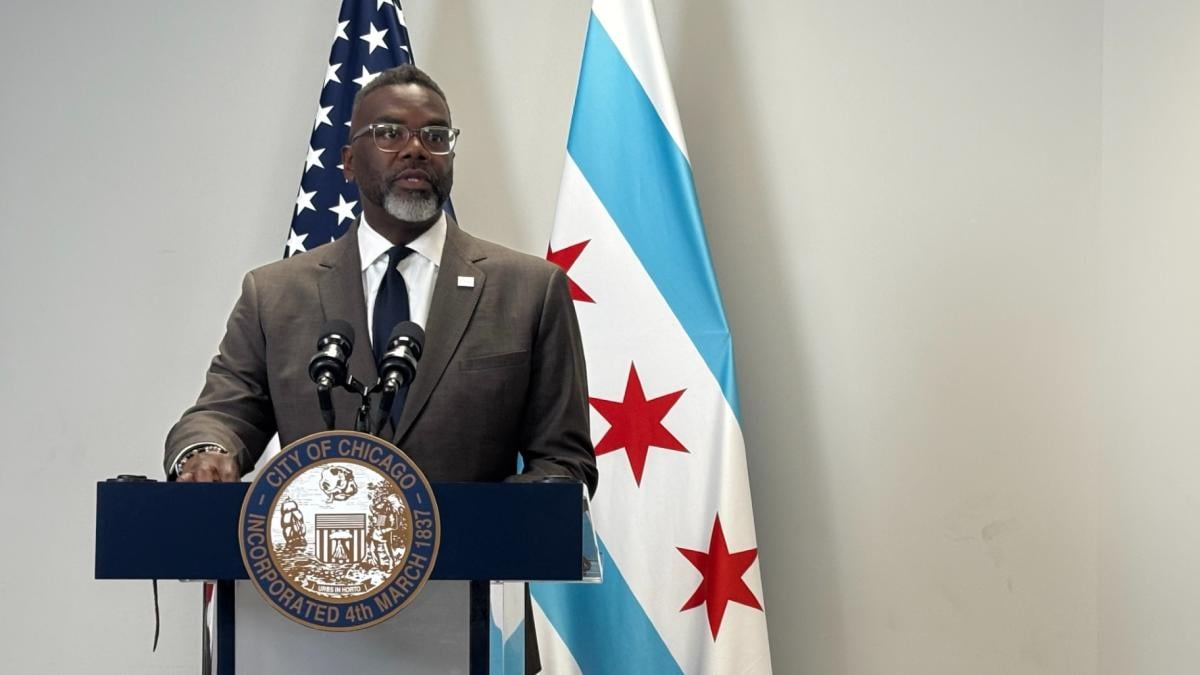 Mayor Brandon Johnson addresses the news media on Tuesday, July 7, 2026. (Heather Cherone / WTTW News)
Mayor Brandon Johnson said Tuesday that Chicago is heading into the second half of 2026 with a budget gap of at least $130 million after revenue baked into the city’s 2026 spending plan over his objection failed to materialize.
Johnson, who neither signed nor vetoed the $16.6 billion spending plan approved by the Chicago City Council, allowing it to take effect, stopped short of telling reporters layoffs or service cuts would be necessary to bridge the gap, as he warned in January.
But Johnson minced no words in blaming those members of the City Council who refused to approve a spending plan for 2026 that included new taxes on large firms, saying they had chosen to align themselves with corporations over the people of Chicago.
“I want to say this clearly,” Johnson said at a City Hall news conference. “There were other options. We did not need to cede to big money interests and fall back on the tired practice of balancing budgets on the backs of working people.”
Johnson said the City Council should have adopted his proposal to levy a $33 per month per employee tax on companies with 500 or more employees in order to generate between $82 million and $100 million.
However, the group of alderpeople who crafted the spending plan accused Johnson in a statement of failing to “fully implement” the spending plan approved by the City Council.
“Mayor Johnson and his administration have spent six months slow-walking the implementation of new revenues and efficiencies designed to close our budget deficit and prevent this administration from creating excuses to raise taxes on businesses, jobs and working families and skip the remainder of our advance pension payment,” according to the statement released by the office of Ald. Samantha Nugent (39th Ward). “Chicagoans deserve transparency and the truth from the mayor instead of attempts to shift blame away from the failures of his administration.”
But Johnson said he was just telling the people of Chicago the truth.
“Since the budget was adopted, my administration has worked diligently to implement it,” Johnson said. “We have a responsibility to make the budget work and protect the services Chicagoans rely on. But halfway through the year, we also have a responsibility to be honest about where we actually are.”
No firms have expressed any interest in purchasing the rights to collect debt owed to the city by Chicagoans who failed to pay their utility bills and red-light camera tickets, Johnson said.
The city’s budget relies on $89.6 million in new revenue from those debt collection efforts. Johnson blocked medical debt owed to the city from being included in that attempted sale. Despite diligent efforts to find a firm interested in pursuing that debt, no buyers have responded to the city’s requests for proposals, Johnson said.
In addition, no firms have expressed interest in selling advertising spots on 3,000 city light poles, city vehicles and bridge houses, Johnson said. The city’s budget counted on $29.3 million from that proposal.
Nor has there been any interest in the “augmented reality” advertising licensing program created by the budget that would allow companies to impose videos and other content on city properties like Millennium Park or the Riverwalk that can be seen through a smartphone, virtual reality glasses or tablet. That proposal was expected to bring in $6 million, according to the city’s budget.
Video gambling in Chicago bars and restaurants has also failed to bring in any revenue, with state officials issuing just six licenses for video poker and slot machines. City officials have yet to green light the video gaming terminals, which was to have brought in $6.8 million this year.
Budget Director Annette Guzman and former Chief Financial Officer Jill Jaworski repeatedly warned the City Council that revenue was unlikely to materialize, but several alderpeople said they were confident their projections were accurate.
By comparison, Johnson said several new taxes he championed have brought in more revenue than expected, making the city’s dire financial situation slightly better. In January, Johnson warned the city was facing a $163 million gap.
That includes an increase in the tax levied on software licenses, cloud services and other digital goods, Johnson said. Touted as a tax hike on “big tech,” Johnson said it has generated $40 million more than expected.
The city has also generated $6 million more than expected from a new tax on online sports gambling, Johnson said.
In addition, a new tax on social media companies has also generated $3.2 million more than projected, even as it faces a legal challenge, Johnson said, with new fees on ride-hailing services generating an unanticipated $2.9 million.
“What we are seeing in the middle of the year is pretty straightforward,” Johnson said. “When we collect revenue that is stable, fair, and doesn’t place the burden on working families, that budget works. When we shy away from asking the wealthiest to pay their fair share, and instead seek to collect more from working Chicagoans, that approach does not work. And that has real consequences for this year and how we plan for the future.”
The back-and-forth between Johnson and his foes on the City Council signals the beginning of another tough debate over the city’s finances. Efforts to craft a spending plan for 2027 will be complicated by the fact that all 50 alderpeople — and the mayor — face reelection in less than a year.
Chicago faces a likely deficit of $1.16 billion in 2027, according to the city’s most recent budget forecast. A new forecast is due to be released by the end of August.
Contact Heather Cherone: @HeatherCherone | (773) 569-1863 | [email protected]