Crime & Law
Illinois Asks Supreme Court to Reject Trump’s Appeal of Order Blocking National Guard Deployment
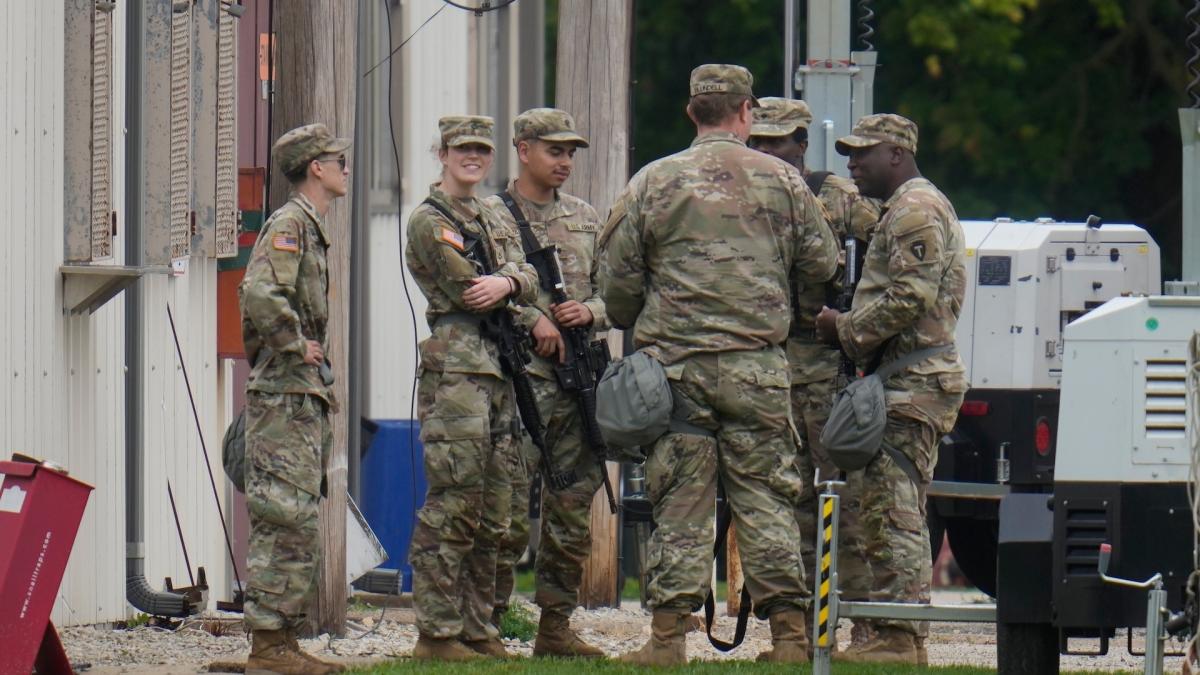 Military personnel in uniform, with the Texas National Guard patch on, are seen at the U.S. Army Reserve Center, Wednesday, Oct. 8, 2025, in Elwood, Ill., a suburb of Chicago. (AP Photo / Laura Bargfeld)
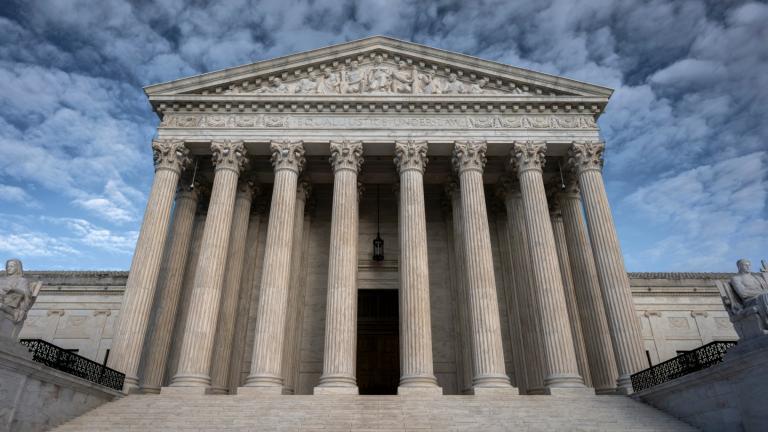
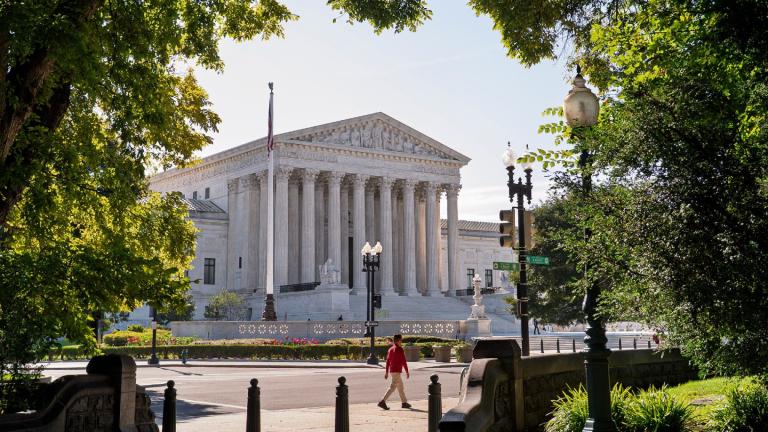
Attorneys for the state of Illinois on Monday asked the U.S. Supreme Court to reject a request by the Trump administration to allow the immediate deployment of 700 National Guard troops into Chicago.
The filing comes after the Trump Administration last week filed an emergency appeal days after a federal judge temporarily blocked “the federalization and deployment” of 300 members of the Illinois National Guard, 200 members of the Texas National Guard and 14 members of the California National Guard into Illinois.
“Applicants’ contrary arguments rest on mischaracterizations of the factual record or the lower courts’ views of the legal principles,” the state said in its response. “As the district court found, state and local law enforcement officers have handled isolated protest activities in Illinois, and there is no credible evidence to the contrary.”
The state claimed that while the Trump administration is seeking further relief, it “cannot show that such extraordinary relief is warranted” and called on the Supreme Court to deny the administration’s “dramatic step of permitting deployment of National Guard troops over Illinois’s objection.”
While hundreds of National Guard troops have already arrived in Illinois, their deployment was halted earlier this month by an order from U.S. District Judge April Perry, who said she found federal officials’ assertions that federal agents had been subjected to serious and coordinated violence by protestors “unreliable.”
The Trump administration appealed that order to the 7th U.S. Circuit Court of Appeals, which allowed Perry’s ruling blocking the deployment of National Guard troops in Illinois to stand, while halting her order stopping Trump from federalizing those troops.
But a three-judge appeals court panel last week rejected the Trump administration’s request to overturn Perry’s order, prompting them to move on to the U.S. Supreme Court.
The conservative-dominated Supreme Court has handed Trump repeated victories in emergency appeals since he took office in January, after lower courts have ruled against him and often over the objection of the three liberal justices. The court has allowed Trump to ban transgender people from the military, claw back billions of dollars of congressionally approved federal spending, move aggressively against immigrants and fire the presidentially appointed leaders of independent federal agencies.
Attorneys for the Trump administration argued the Department of Homeland Security and other federal law enforcement agencies have been forced to operate “under the constant threat of mob violence” in and around Chicago.
Perry has a hearing on the case scheduled for Wednesday morning.
Trump’s efforts to deploy National Guard troops in Democratic-led cities have been mired in legal challenges. A judge in California ruled that his deployment of thousands of National Guard troops in Los Angeles violated the Posse Comitatus Act, a longstanding law that generally prohibits the use of the military for civilian policing.
In a separate case in Oregon, an appeals court on Monday put on hold a lower court ruling that kept President Donald Trump from taking command of 200 Oregon National Guard troops. However, Trump is still barred from actually deploying those troops, at least for now.
U.S. District Judge Karin Immergut issued two temporary restraining orders early this month — one that prohibited Trump from calling up the troops so he could send them to Portland, and another that prohibited him from sending any National Guard members to Oregon at all, after the president tried to evade the first order by deploying California troops instead.
The Justice Department appealed the first order, and in a 2-1 ruling Monday, a panel from the 9th U.S. Circuit Court of Appeals sided with the administration. The majority said the president was likely to succeed on his claim that he had the authority to federalize the troops based on a determination he was unable to enforce the laws without them.
Heather Cherone and the Associated Press contributed to this report.